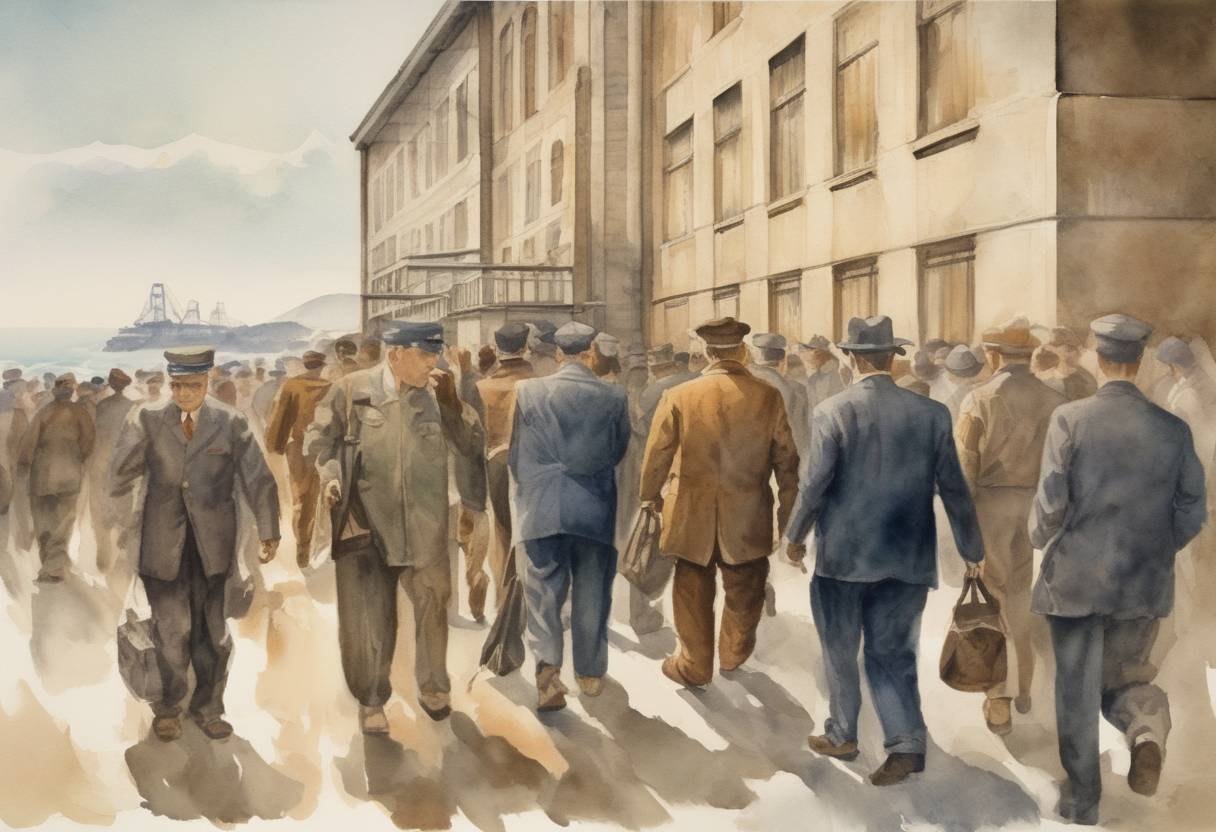
The Arrival of the First Civilian Prisoners at Alcatraz Island - August 11, 1934
On August 11, 1934, the first group of civilian prisoners arrived at the newly established federal penitentiary on Alcatraz Island, marking a significant transformation in the island’s history. Alcatraz, located in San Francisco Bay, had previously served as a military prison, but its conversion into a federal prison was part of a broader effort to address the challenges of the American penal system during the early 20th century.
Context and Background
Military History: Alcatraz Island had been used as a military fortification since the mid-19th century and later as a military prison. By the early 1930s, the island’s facilities were deemed suitable for conversion into a high-security federal prison.
The Great Depression and Crime: The United States was grappling with the Great Depression, which saw a rise in crime rates. The federal government sought to establish a prison that could house the most dangerous and incorrigible criminals, those who were considered escape risks or who had caused trouble in other prisons.
Selection of Alcatraz: The island’s isolation and the strong currents of the surrounding waters made it an ideal location for a maximum-security prison. The decision to convert Alcatraz into a federal penitentiary was part of a strategy to centralize the incarceration of high-profile criminals.
The Arrival of Prisoners
First Inmates: On August 11, 1934, the first group of civilian prisoners was transferred to Alcatraz. This group consisted of 137 inmates, who were carefully selected from other federal prisons across the country. These prisoners were considered the most difficult to manage and included notorious bank robbers, murderers, and other high-risk offenders.
Security Measures: The transfer was conducted with high security, reflecting the prison’s status as a facility for the most dangerous criminals. The prisoners were transported under heavy guard to ensure that the transition was smooth and secure.
Significance and Aftermath
Symbol of Federal Authority: Alcatraz quickly became a symbol of the federal government’s commitment to maintaining law and order during a turbulent period in American history. Its reputation as an “escape-proof” prison was bolstered by its remote location and rigorous security measures.
Notable Inmates: Over the years, Alcatraz housed several infamous criminals, including Al Capone, George “Machine Gun” Kelly, and Robert Stroud, the “Birdman of Alcatraz.”
Closure and Legacy: The prison operated until 1963, when it was closed due to high operational costs and deteriorating facilities. Today, Alcatraz is a popular tourist destination and a part of the Golden Gate National Recreation Area, offering visitors a glimpse into its storied past.
The arrival of the first civilian prisoners on August 11, 1934, marked the beginning of Alcatraz’s era as a federal penitentiary, a chapter that would leave a lasting imprint on American penal history.