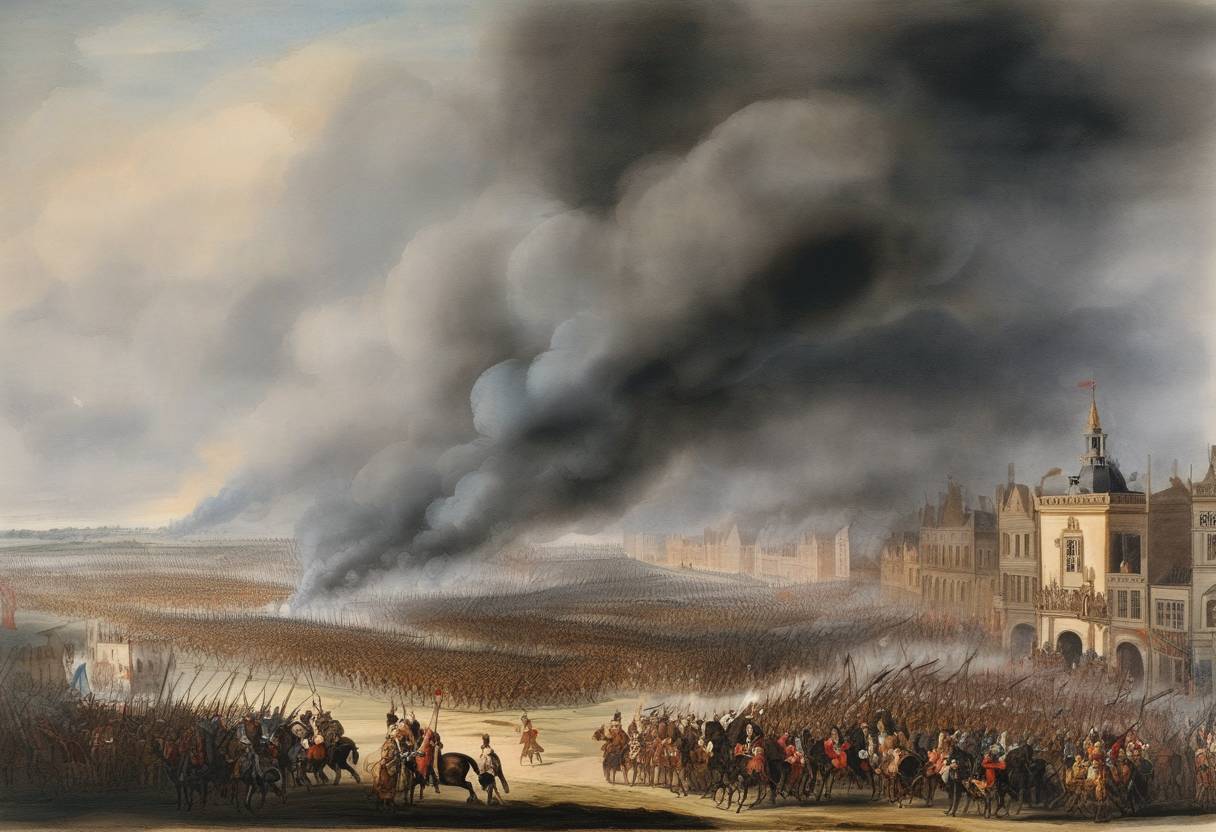
Battle of Oudenarde (July 11, 1708)
The Battle of Oudenarde was a significant engagement during the War of the Spanish Succession, taking place on July 11, 1708, near the town of Oudenarde, in present-day Belgium. This clash saw the forces of the Grand Alliance, led by the Duke of Marlborough and Prince Eugene of Savoy, achieve a decisive victory over the French army commanded by the Duke of Burgundy and Marshal Vendôme.
Context and Lead-up
- Background: The War of the Spanish Succession (1701-1714) was primarily fought over who should inherit the Spanish throne, following the death of the childless Charles II of Spain. France, under Louis XIV, sought to place his grandson, Philip of Anjou, on the throne, which alarmed other European powers who feared the potential for a unified Franco-Spanish empire.
- Strategic Importance: The control of the Spanish Netherlands was a key objective during the war. Holding this region would give the French a favorable position to launch further incursions into Europe. The Grand Alliance, comprising England, the Holy Roman Empire, the Dutch Republic, and several other states, aimed to prevent French dominance in Europe.
The Battle
- Commanders: The Allied forces were expertly commanded by the Duke of Marlborough, known for his strategic brilliance, and Prince Eugene of Savoy. The French army was led by the Duke of Burgundy, a relatively inexperienced commander, and Marshal Vendôme, a seasoned general.
- Troop Movements: The battle commenced as the French aimed to capture the town of Oudenarde, with their forces deployed along the Scheldt River. Marlborough rapidly mobilized his forces to intercept the French, marching them over 50 kilometers in two days.
- Engagement: The Allies adopted aggressive tactics, initiating a surprise attack to disrupt the French army’s planned encirclement. Despite initially being caught off guard, the French regrouped but were continually pressured by Marlborough’s and Eugene’s coordinated assaults.
- Outcome: After intense fighting, marked by significant maneuvers and combat, the French lines were broken. The rapid and decisive action of the Allied forces forced the French to retreat, resulting in a major victory for the Grand Alliance.
Aftermath and Significance
- Strategic Gain: The victory at Oudenarde impeded French plans and significantly tilted the balance in favor of the Allies. It allowed the Allies to proceed into French territories and set the stage for the subsequent siege and capture of Lille, another strategic stronghold.
- Impact on Morale: This battle reinforced the reputation of Marlborough and Eugene as formidable military leaders and boosted the morale of the Allied forces. It also highlighted the effectiveness of combined arms tactics and rapid maneuver warfare.
- Political Ramifications: The defeat further strained France’s resources and weakened its political standing in the conflict, contributing to the eventual peace negotiations that led to the Treaty of Utrecht in 1713.
Legacy
The Battle of Oudenarde is often celebrated as a tactical masterpiece and remains a key example of effective coalition warfare during the early 18th century. It illustrates the dynamics of military leadership and strategy that characterized the War of the Spanish Succession, marking a turning point in the fight against Louis XIV’s expansionist ambitions.