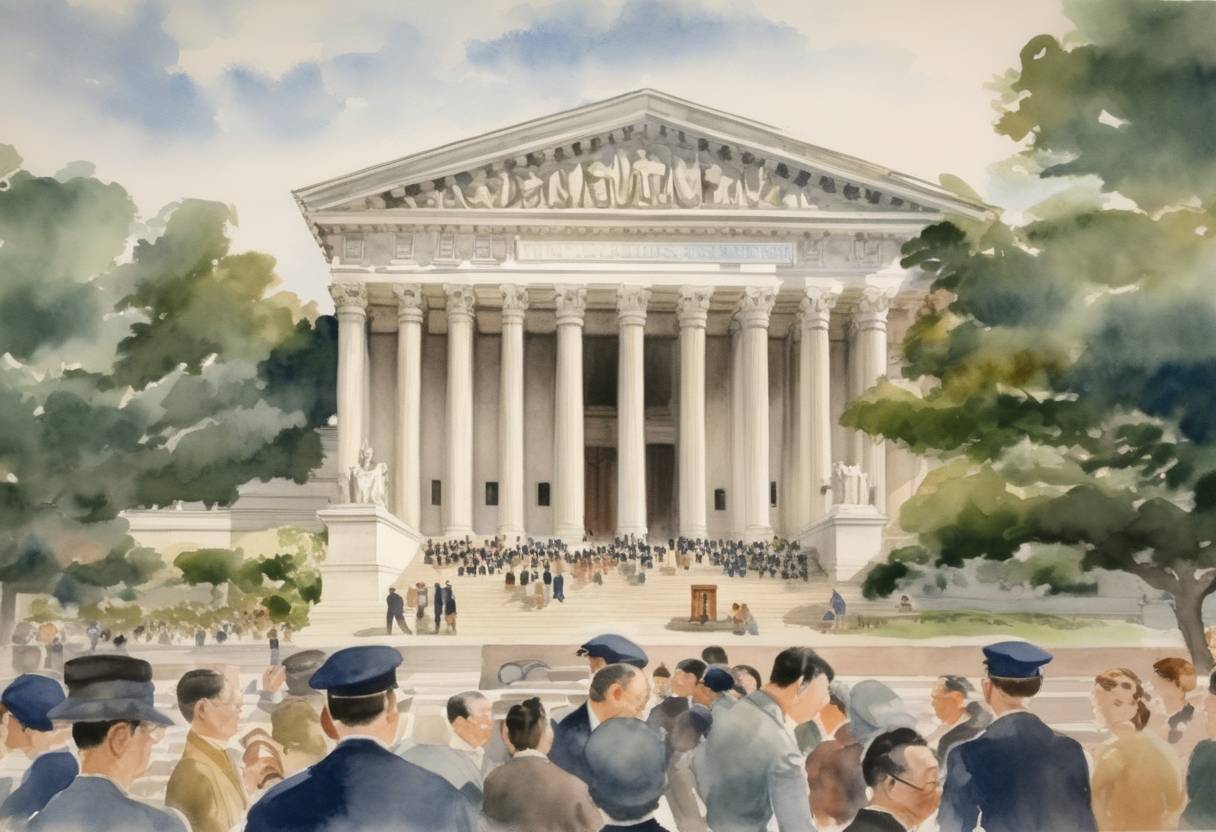
Korematsu v. United States: Supreme Court Ruling on December 18, 1944
On December 18, 1944, the United States Supreme Court delivered its decision in the landmark case Korematsu v. United States. This ruling upheld the conviction of Fred Korematsu for defying a government order to relocate to an internment camp, thus affirming the constitutionality of Executive Order 9066 during World War II. The decision has since been highly scrutinized and remains a significant subject of discussion regarding civil liberties in times of national crisis.
Background
In the context of World War II, following the attack on Pearl Harbor in December 1941, heightened fears and suspicions about Japanese Americans’ loyalty led President Franklin D. Roosevelt to issue Executive Order 9066 on February 19, 1942. This order authorized the Secretary of War to prescribe certain areas as military zones, leading to the internment of over 110,000 Japanese Americans.
Fred Korematsu, an American citizen of Japanese descent, chose to remain in San Leandro, California, violating the order. His arrest and subsequent conviction for evading internment highlighed a crucial legal battle over constitutional rights and wartime powers.
Supreme Court Decision
The Supreme Court’s decision in Korematsu v. United States was a closely divided 6-3 ruling. Justice Hugo Black delivered the majority opinion, stating that the need to protect against espionage outweighed Korematsu’s individual rights. The Court argued that the internment order was not based on racial discrimination, but rather on military necessity given the strain of wartime.
The majority opinion emphasized that the decision was under the extraordinary circumstances provided by the state of war, pointing to the potential threats to national security as justification.
Dissenting Opinions
The dissenting justices, including Justices Robert H. Jackson, Frank Murphy, and Owen J. Roberts, strongly criticized the decision. Justice Jackson notably argued that punishing a citizen solely because of their heritage established a dangerous precedent, warning against the judicial validation of racial discrimination.
Justice Murphy described the internment as “legalization of racism,” underscoring that no sufficient evidence of disloyalty among Japanese Americans was presented.
Aftermath and Legacy
The Korematsu decision remains a controversial point in American legal history. It has prompted continued debate on the balance between civil liberties and national security. In later years, the case’s authorities have been largely discredited, especially as evidence revealed that the government had suppressed critical information during the trial that contradicted claims of espionage threats.
In 1983, Korematsu’s conviction was formally vacated after it was uncovered that the government had withheld crucial evidence. Furthermore, in 1988, the U.S. Congress passed the Civil Liberties Act, which formally apologized for the internment and provided reparations to surviving Japanese Americans.
Though the Korematsu decision was not formally overruled, it was effectively disavowed by the Supreme Court in Trump v. Hawaii (2018), in which Chief Justice John Roberts acknowledged its wrongful basis, stating, “Korematsu was gravely wrong the day it was decided.”
The Korematsu ruling serves as a stark reminder of the potential impact of government actions under wartime conditions on civil liberties and the importance of judicial vigilance in preserving constitutional rights.