Discovery of Uranus by William Herschel on March 13, 1781
1781 · Bath, United Kingdom
William Herschel discovered the planet Uranus, expanding the known boundaries of the solar system for the first time in modern history.
August 28, 1789
William Herschel discovered Saturn's moon Enceladus.
Bath, England
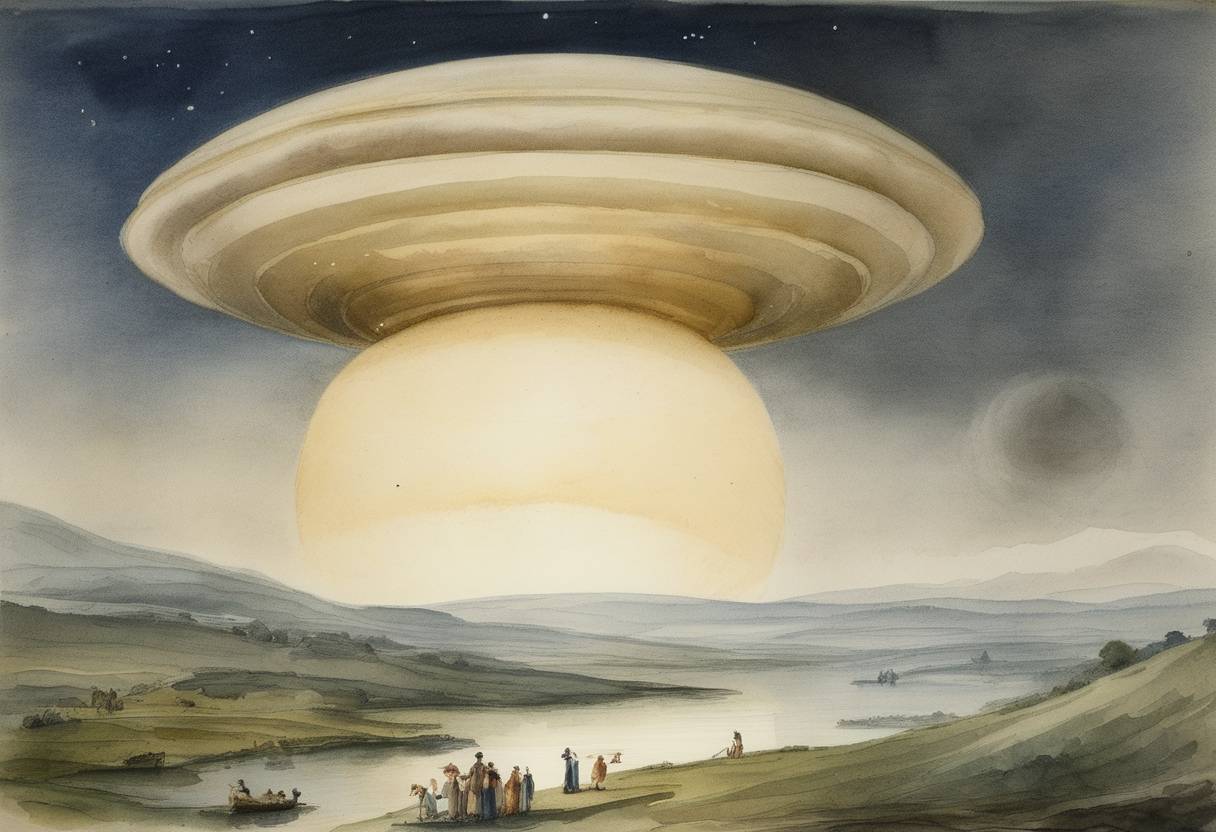
On August 28, 1789, the renowned astronomer Sir William Herschel made a groundbreaking discovery by identifying Enceladus, one of Saturn’s moons. This celestial discovery contributed significantly to the understanding of the Saturnian system and demonstrated the advancements in observational astronomy at the time.
William Herschel, originally a German-born musician, had shifted his focus to astronomy after moving to England. His dedication to the study of the heavens was marked by his construction of increasingly powerful telescopes, with which he made several notable discoveries, including Uranus in 1781, the first planet found with a telescope.
Using his 1.2-meter (48-inch) diameter telescope, one of the largest telescopes of the era, Herschel observed Saturn and its complex system of rings and moons. On the night of August 28, 1789, Herschel identified a new object orbiting Saturn, which he later named Enceladus, after one of the Gigantes in Greek mythology.
Enceladus is the sixth-largest moon of Saturn, known for its bright, reflective surface, primarily composed of ice. Post-discovery analysis revealed that Enceladus has significant geological activity, including geysers that spew water vapor and ice particles into space. These geysers contribute to Saturn’s E-ring, a faint ring situated within Enceladus’ orbit.
Herschel’s discovery of Enceladus highlighted the complex nature of Saturn’s satellite system. Over the centuries, subsequent observation and exploration, particularly by space missions such as the Cassini spacecraft, have provided deeper insights into Enceladus’ geology, potential habitability, and the dynamic processes at work within the Saturnian system.
Herschel’s legacy continues to influence modern astronomy, as his pioneering methods and instruments expanded the boundaries of celestial observation, setting the stage for future astronomers to explore and understand our solar system and beyond.
Source: www.nasa.gov