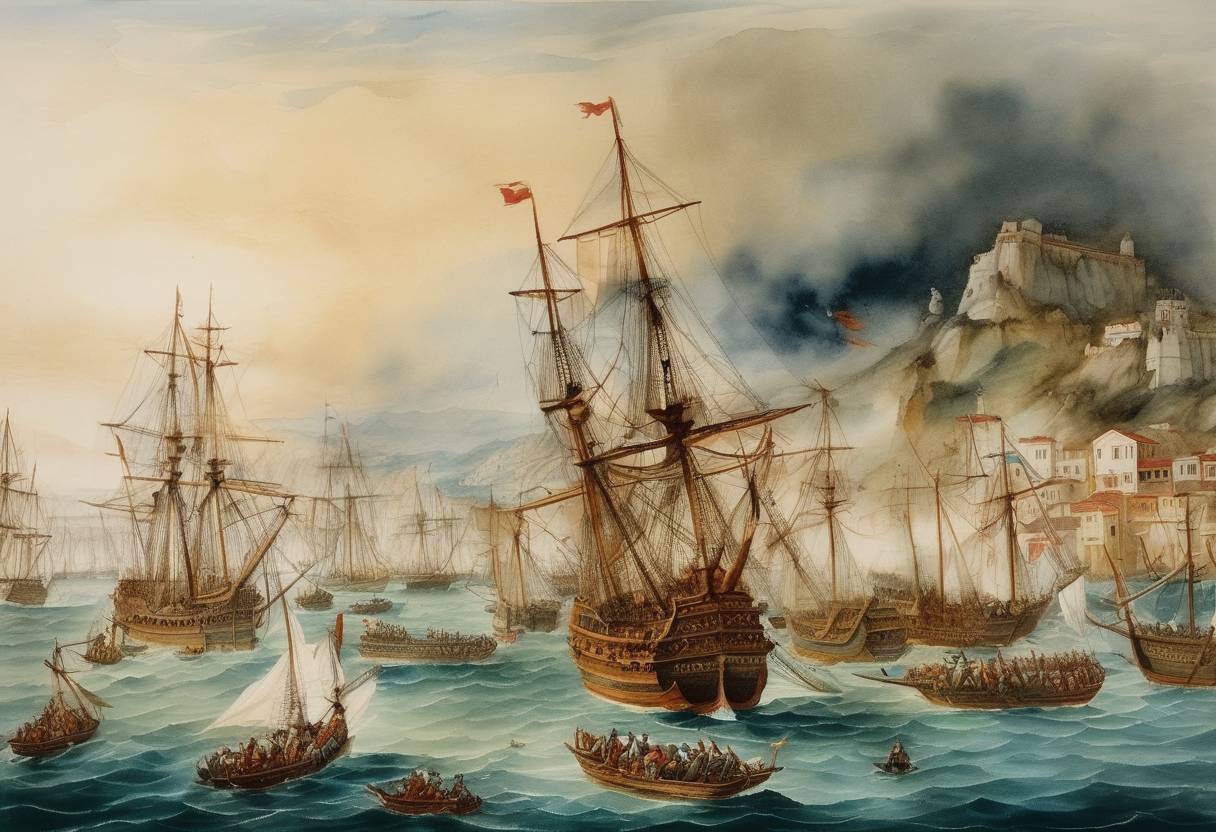
Battle of Preveza - September 28, 1538
The Battle of Preveza was a significant naval conflict fought on September 28, 1538, in the waters off Preveza, in western Greece. This confrontation was between the fleet of the Holy League, a coalition of Christian states, and the naval forces of the Ottoman Empire. The battle resulted in a decisive victory for the Ottomans, cementing their dominance over the eastern Mediterranean.
Context and Prelude
- Holy League Formation: The Holy League was formed under the auspices of Pope Paul III to counter the expansion of the Ottoman Empire in the Mediterranean. This coalition included key European powers: Spain, the Papal States, the Republic of Venice, and the Knights of Malta.
- Ottoman Expansion: The Ottomans, under the rule of Sultan Suleiman the Magnificent, sought to expand their influence westward, having already secured critical footholds in the Mediterranean.
Key Players
- Ottoman Empire: Led by Hayreddin Barbarossa, the famed corsair and admiral who commanded the Ottoman fleet, renowned for his naval expertise and strategic acumen.
- Holy League: Commanded by Andrea Doria, a distinguished Genoese admiral leading the combined forces of the league, noted for his cautious approach but also his astute naval strategies.
The Battle
- Naval Strategies: The Ottomans, with superior knowledge of the local waters and favorable wind conditions, adopted a tactically aggressive maneuver, engaging the Holy League in a series of skillful moves that leveraged their faster and more maneuverable galleys.
- Engagement: Despite numerical superiority, the Holy League was hindered by lack of coordination and the cumbersome nature of some of its vessels, particularly those of larger size which struggled in the confined waters.
Outcome and Consequence
- Decisive Victory: The Ottomans’ tactical brilliance and effective use of their fleet led to a decisive victory. The Holy League suffered significant losses in ships and manpower, forcing a retreat and abandonment of their campaign.
- Long-term Impact: The victory at Preveza ensured Ottoman control over the eastern Mediterranean for decades, marking a high point in their naval supremacy and contributing to their dominance until the later Battle of Lepanto in 1571.
- Strategic Significance: This battle showcased the rise of Ottoman naval technology and strategy, signaling a shift in the balance of naval power in the Mediterranean. It also highlighted the challenges faced by disparate European powers in forming cohesive and effective military coalitions against a unified Ottoman force.
The Battle of Preveza remains a pivotal event in Mediterranean history, influencing naval warfare strategies and the geopolitical landscape of the 16th century.