The Battle of Hastings - October 14, 1066
1066 · Hastings, England
The Battle of Hastings took place, where William the Conqueror defeated King Harold II of England, leading to the Norman conquest of England.
September 29, 1066
Duke William of Normandy's fleet lands at Pevensey, England, marking the beginning of the Norman Conquest. This expedition was part of William's claim to the English throne, challenging Harold II, the Anglo-Saxon king.
Pevensey, England | Norman forces
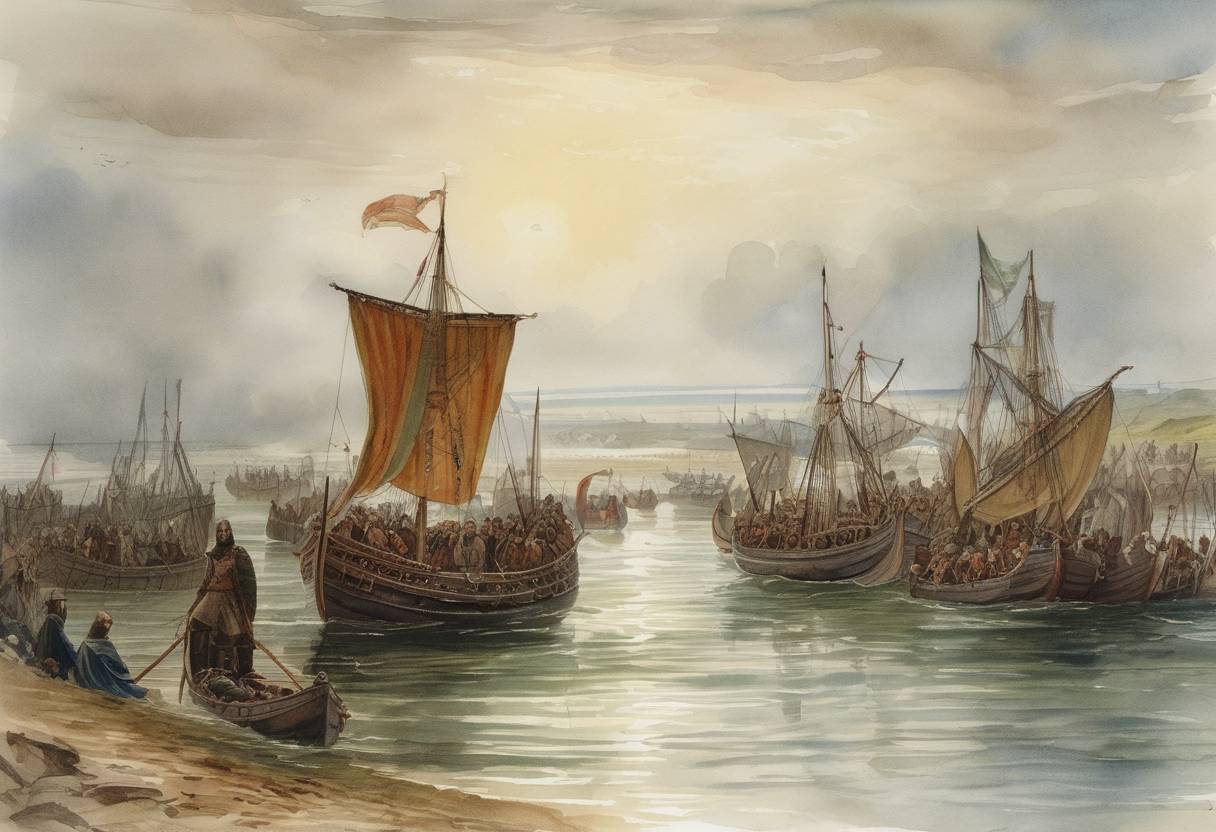
On September 29, 1066, Duke William of Normandy, later known as William the Conqueror, landed his fleet at Pevensey on the southern coast of England. This event marked the beginning of the Norman Conquest, a pivotal chapter in English history.
The backdrop to this invasion was a dynastic struggle over the English throne. Upon the death of the childless King Edward the Confessor in January 1066, a succession crisis ensued. Harold Godwinson, a powerful English nobleman, claimed the throne and was crowned as Harold II. William, Duke of Normandy, contested this claim, asserting that Edward had promised him the crown years earlier, and that Harold had sworn an oath to support William’s succession.
William meticulously prepared for the invasion throughout 1066, assembling an impressive fleet and a well-equipped army. Gathering his forces from Normandy and other parts of France, he secured the blessing of Pope Alexander II for his claim, thus framing the invasion as a holy endeavor.
On September 27, 1066, William’s fleet set sail from the River Dives in France, navigating across the English Channel. Originally delayed by adverse winds, the fleet finally landed two days later at Pevensey, located in modern-day East Sussex.
The choice of Pevensey as a landing site was tactical. The sheltered bay offered a suitable spot for disembarkation, and Pevensey itself was in close proximity to Hastings, providing a defensible position to consolidate forces. William’s forces quickly seized Pevensey Castle, reinforcing and using it as a base from which to conduct further operations in England.
The landing compelled King Harold II, who was then located in the north of England after defeating a Norwegian invasion at Stamford Bridge, to march his exhausted troops southwards to confront this new threat. The stage was set for the Battle of Hastings, an engagement that would decisively determine the fate of the English crown.
The successful landing at Pevensey was more than just a military maneuver; it was the prelude to a series of events that would lead to the profound transformation of English society. The Norman Conquest not only altered the monarchy but also led to significant changes in land ownership, governance, language, and culture across England.
William’s arrival at Pevensey marked the start of what would become an enduring legacy, as the Normans integrated into and reshaped the social fabric of their new realm, leaving an indelible mark on future generations.
Source: www.britannica.com