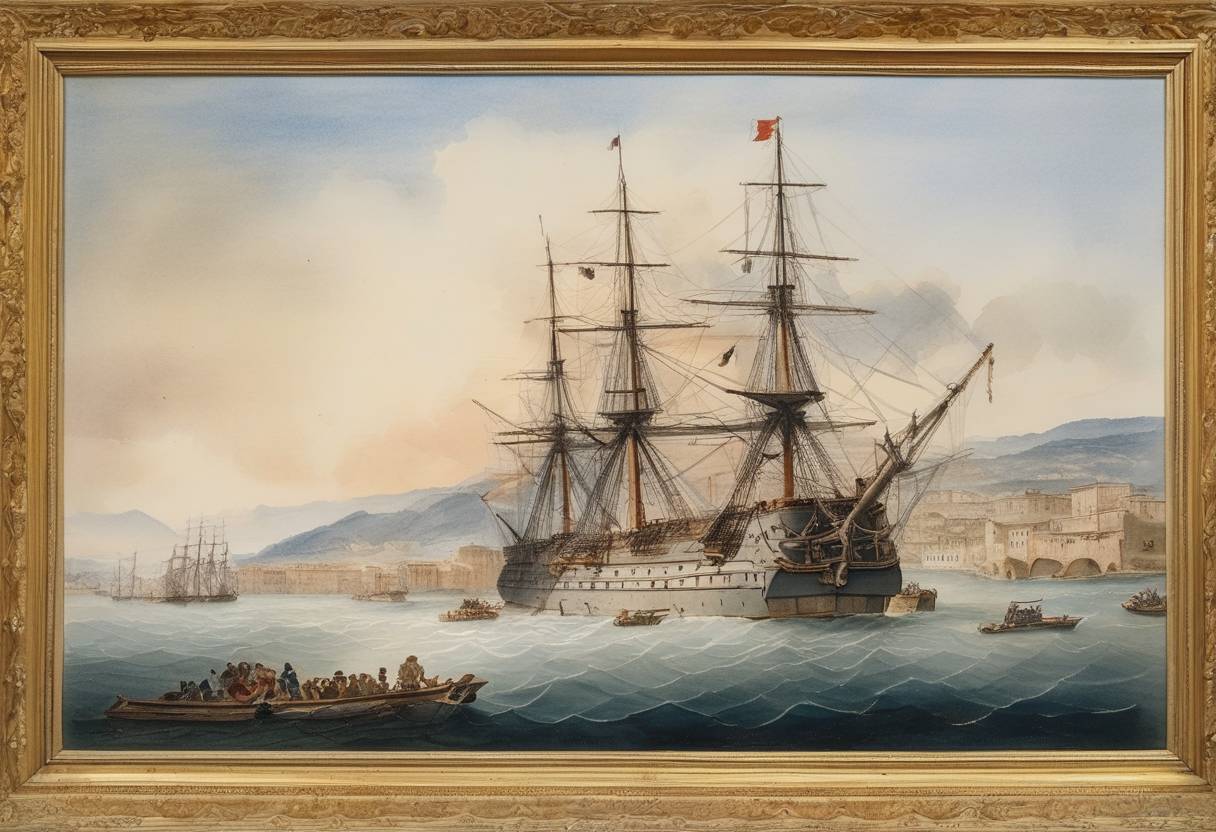
Scuttling of HMS Le Juste: September 2, 1806
On September 2, 1806, during the Napoleonic Wars, the Royal Navy’s HMS Le Juste played a pivotal role in the strategic operations surrounding the French siege of Gaeta, particularly during the War of the Third Coalition.
Background
The War of the Third Coalition (1805–1806) saw European powers, including Great Britain, Russia, and Austria, aligned against Napoleon’s France. The strategic control of Italian territories and, in particular, coastal strongholds like Gaeta on the Tyrrhenian Sea, was crucial due to their geopolitical and logistical significance.
Siege of Gaeta
Gaeta was a fortified coastal town under French siege intended to firm up Napoleonic control in Italy. The defenses of Gaeta, however, proved resilient, and the prolonged standoff became a focal point of naval and military engagements in the region.
The Scuttling of HMS Le Juste
HMS Le Juste, under British command, had become an essential asset in the blockade and attempted relief of Gaeta. The ship’s presence was intended to disrupt French supply lines and provide support to allied forces resisting the French siege.
Faced with overwhelming French forces and the imminent capture of the ship, the decision was made to scuttle HMS Le Juste on September 2, 1806. Scuttling—a practice involving deliberately sinking a ship to prevent it from being captured by the enemy—was executed to deny Napoleon’s forces the strategic and technological advantage posed by the ship’s capture.
Aftermath and Significance
While the scuttling of HMS Le Juste marked a tactical loss, the broader strategic objectives remained focused on resisting French dominance in the Mediterranean. The siege of Gaeta persisted until the fortress eventually surrendered to French forces in July 1806, months before the scuttling, underscoring the prolonged challenges faced by the coalition.
This event illustrated the contentious naval dynamics of the Napoleonic Wars and the sacrifices made by naval forces in maintaining balance against Napoleonic expansions. The scuttling served as a testament to the Royal Navy’s commitment to undermine French capabilities, which continued throughout the Napoleonic Wars.