President Harry S. Truman Announces Hydrogen Bomb Development Program
1950 · Washington D.C., United States
President Harry S. Truman announces a program to develop the hydrogen bomb.
March 5, 1946
Winston Churchill delivered his famous 'Iron Curtain' speech in Fulton, Missouri, highlighting the division between Western powers and the Soviet Union, marking the beginning of the Cold War era.
Fulton, United States | Westminster College
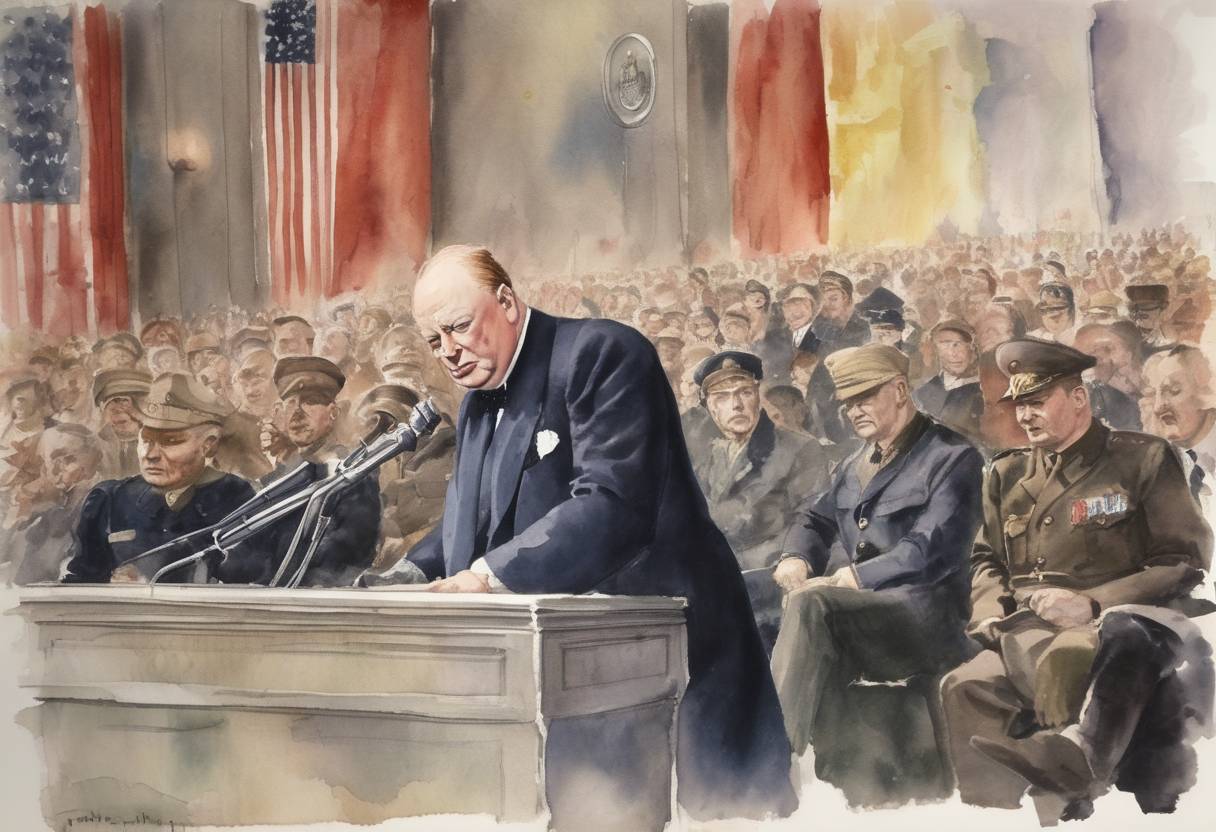
On March 5, 1946, former British Prime Minister Winston Churchill delivered one of the most significant speeches of the 20th century at Westminster College in Fulton, Missouri. This address, officially titled “The Sinews of Peace,” is famously known for introducing the metaphor of the “Iron Curtain,” which vividly described the division between the Western powers and the Soviet Union, marking a pivotal moment in the early Cold War era.
Post-World War II Tensions: The end of World War II in 1945 left Europe in a state of devastation and political instability. The wartime alliance between the United States, the United Kingdom, and the Soviet Union began to fray as ideological differences emerged.
Soviet Expansion: The Soviet Union, under Joseph Stalin, had extended its influence over Eastern Europe, establishing communist governments in countries like Poland, Hungary, and Romania. This expansion was perceived as a threat by Western democracies.
U.S. and U.K. Concerns: Both the United States and the United Kingdom were increasingly concerned about Soviet intentions and the spread of communism. Churchill’s speech was delivered in this climate of growing unease.
The Iron Curtain: Churchill famously stated, “From Stettin in the Baltic to Trieste in the Adriatic, an iron curtain has descended across the Continent.” This metaphor highlighted the division of Europe into two distinct spheres: the democratic West and the communist East.
Call for Unity: Churchill emphasized the need for unity among Western nations to counter the Soviet threat. He advocated for a strong partnership between the United States and the United Kingdom, which he referred to as the “special relationship.”
Warning Against Complacency: Churchill warned against the dangers of appeasement and urged Western nations to remain vigilant in the face of Soviet expansionism.
Cold War Era: Churchill’s speech is often regarded as a defining moment in the onset of the Cold War, a period of geopolitical tension between the Soviet bloc and Western powers that lasted until the early 1990s.
U.S. Foreign Policy: The speech influenced U.S. foreign policy, contributing to the development of the Truman Doctrine and the policy of containment aimed at preventing the spread of communism.
Public Perception: While the speech was initially met with mixed reactions, it gradually became recognized as a prescient analysis of the emerging global order.
Churchill’s “Iron Curtain” speech remains a critical moment in history, encapsulating the ideological divide that characterized much of the 20th century and setting the stage for the geopolitical dynamics of the Cold War.
Source: www.history.com