Joseph Stalin Becomes Premier of the Soviet Union - May 6, 1941
1941 · Moscow, Soviet Union
Joseph Stalin became the Premier of the Soviet Union, consolidating his power and marking a significant moment in Soviet history.
November 12, 1927
Leon Trotsky is expelled from the Soviet Communist Party, marking a significant power shift in the Soviet Union and consolidating Joseph Stalin's control.
Moscow, Soviet Union | Soviet Communist Party
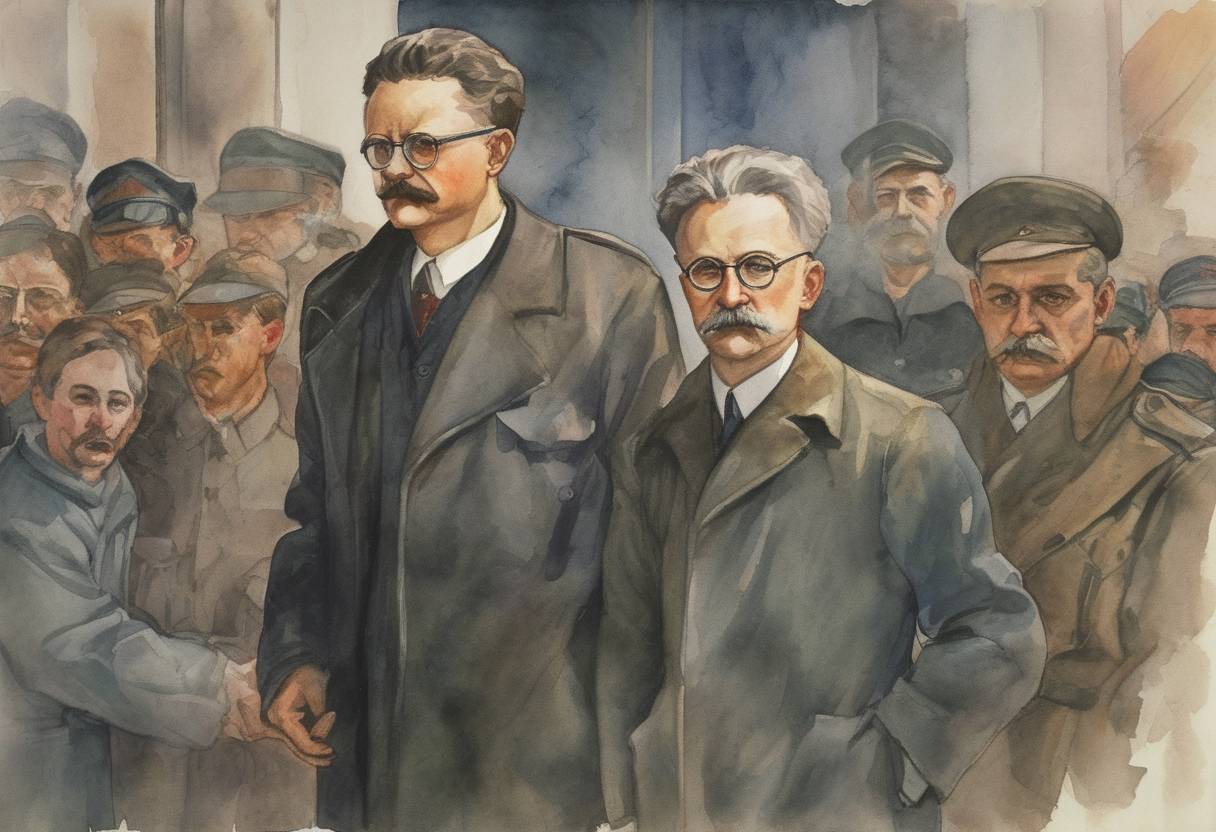
The expulsion of Leon Trotsky from the Soviet Communist Party on November 12, 1927, marked a pivotal moment in the power dynamics of the Soviet Union. This event was a culmination of a series of political struggles following the death of Vladimir Lenin in 1924. The power vacuum left by Lenin’s death led to a fierce competition among the Soviet leadership, primarily between Joseph Stalin and Leon Trotsky.
Lenin’s Death and the Power Struggle: After Lenin’s death, a power struggle ensued within the Communist Party. Trotsky, a prominent revolutionary leader and founder of the Red Army, was seen as a natural successor due to his close association with Lenin and his role in the October Revolution.
Stalin’s Rise: Joseph Stalin, who held the position of General Secretary of the Communist Party, used his role to build a strong base of support within the party. He strategically aligned with other party leaders, such as Grigory Zinoviev and Lev Kamenev, to marginalize Trotsky.
The United Opposition: Trotsky, along with Zinoviev and Kamenev, formed the United Opposition in 1926 to challenge Stalin’s growing influence. They criticized Stalin’s policies and called for a return to the principles of the October Revolution.
Party Congresses and Defeats: Stalin’s control over the party apparatus allowed him to outmaneuver the United Opposition. At the 15th Party Congress in 1927, Stalin’s faction successfully condemned the opposition, leading to the expulsion of Trotsky and Zinoviev from the Central Committee.
On November 12, 1927, Leon Trotsky was formally expelled from the Communist Party. This expulsion was a decisive move by Stalin to eliminate his most formidable rival and consolidate his power. Trotsky’s expulsion was justified by accusations of factionalism and anti-party activities, which were seen as threats to party unity and the socialist state.
Exile and Assassination: Following his expulsion, Trotsky was exiled to Alma-Ata in Kazakhstan and later deported from the Soviet Union in 1929. He continued to oppose Stalin from abroad, eventually settling in Mexico, where he was assassinated in 1940 by a Soviet agent.
Stalin’s Consolidation of Power: Trotsky’s expulsion marked the beginning of Stalin’s unchallenged rule over the Soviet Union. Stalin continued to eliminate political rivals through purges and show trials, solidifying his authoritarian regime.
Impact on Soviet Policy: With Trotsky out of the picture, Stalin implemented policies that diverged significantly from Trotsky’s vision, including the collectivization of agriculture and rapid industrialization, which had profound effects on Soviet society and economy.
The expulsion of Leon Trotsky was a critical step in the establishment of Stalin’s totalitarian regime. It underscored the shift from the collective leadership envisioned by Lenin to a centralized, autocratic rule under Stalin. This event not only shaped the future of the Soviet Union but also had lasting implications for global communism and the ideological battles of the 20th century.
Source: en.wikipedia.org