Bangladesh Declares Independence from Pakistan
1971 · Dhaka, Bangladesh
Bangladesh declares its independence from Pakistan, marking the start of the Bangladesh Liberation War.
December 16, 1971
Bangladesh Liberation War ends with the surrender of the Pakistan Eastern Command in Dhaka, leading to the creation of Bangladesh.
Dhaka, Bangladesh | Pakistan Eastern Command
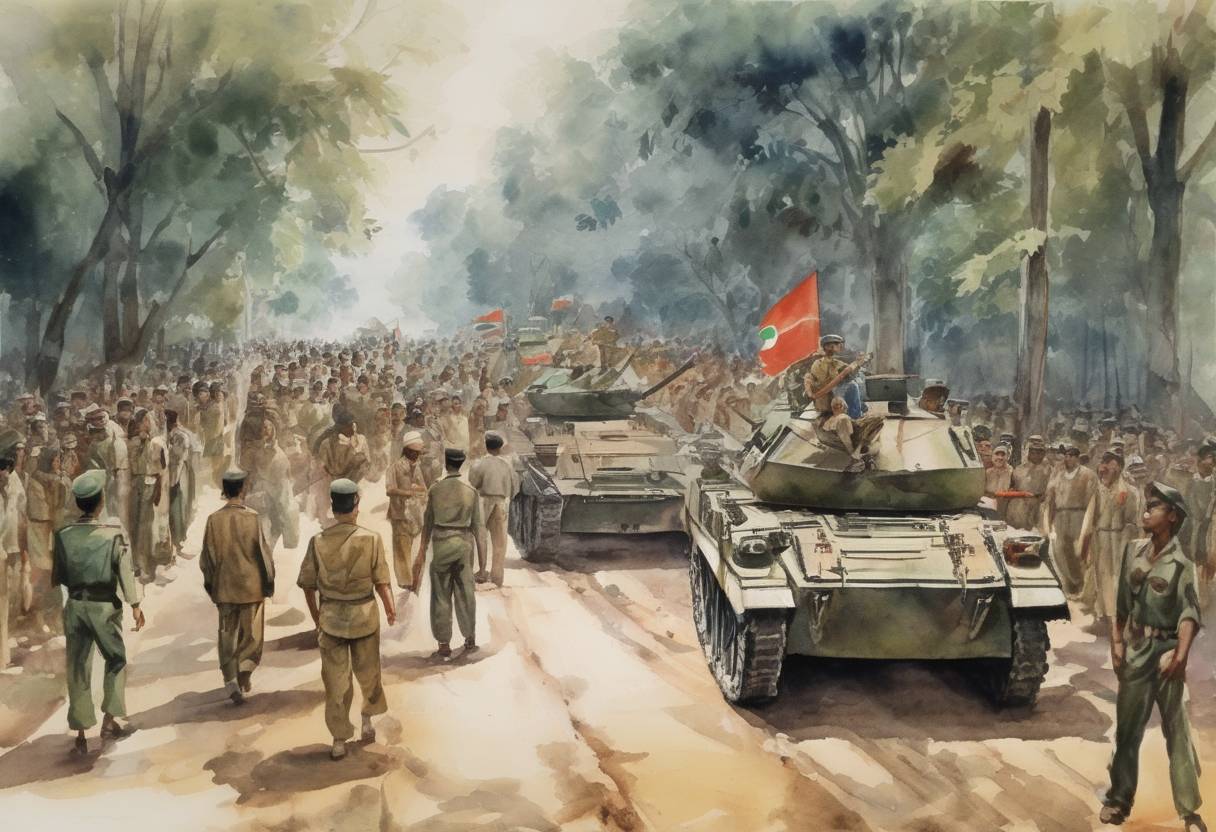
On December 16, 1971, a pivotal moment in South Asian history unfolded with the conclusion of the Bangladesh Liberation War. This day marked the surrender of the Pakistan Eastern Command in Dhaka, leading to the creation of the independent nation of Bangladesh.
The Bangladesh Liberation War was rooted in long-standing political, economic, and cultural tensions between East Pakistan (now Bangladesh) and West Pakistan (now Pakistan). The conflict was ignited by the refusal of the Pakistani government to recognize the electoral victory of the Awami League, led by Sheikh Mujibur Rahman, in the 1970 general elections. The Awami League’s victory underscored the demand for greater autonomy for East Pakistan.
Operation Searchlight: On March 25, 1971, the Pakistani military launched Operation Searchlight, a brutal crackdown on the Bengali population in East Pakistan. This operation aimed to suppress the independence movement and resulted in widespread atrocities, including mass killings and human rights abuses.
Formation of the Mukti Bahini: In response to the crackdown, the Mukti Bahini (Liberation Army) was formed, comprising Bengali military personnel and civilians. They waged a guerrilla war against the Pakistani forces, receiving support from India.
India’s Involvement: The humanitarian crisis, marked by millions of refugees fleeing to India, prompted Indian intervention. On December 3, 1971, Pakistan launched preemptive airstrikes on Indian airfields, leading to a full-scale war between India and Pakistan.
On December 16, 1971, Lieutenant General A. A. K. Niazi, the commander of the Pakistan Eastern Command, formally surrendered to the joint Indian and Mukti Bahini forces in Dhaka. The Instrument of Surrender was signed at the Ramna Race Course (now Suhrawardy Udyan) in Dhaka, marking the end of the war.
Creation of Bangladesh: The surrender led to the establishment of Bangladesh as an independent nation, ending the nine-month-long war and the oppressive rule of West Pakistan over East Pakistan.
Humanitarian Impact: The war resulted in significant loss of life, with estimates of civilian casualties ranging from hundreds of thousands to several million. The conflict also caused a massive refugee crisis, with millions displaced.
Geopolitical Consequences: The war altered the geopolitical landscape of South Asia, leading to strained relations between India and Pakistan. It also highlighted issues of self-determination and human rights on the global stage.
Recognition of Bangladesh: Bangladesh was soon recognized by most countries around the world, and it became a member of the United Nations in 1974.
December 16 is celebrated annually as Victory Day in Bangladesh, commemorating the country’s hard-fought independence and honoring the sacrifices made during the liberation struggle.
Source: en.wikipedia.org