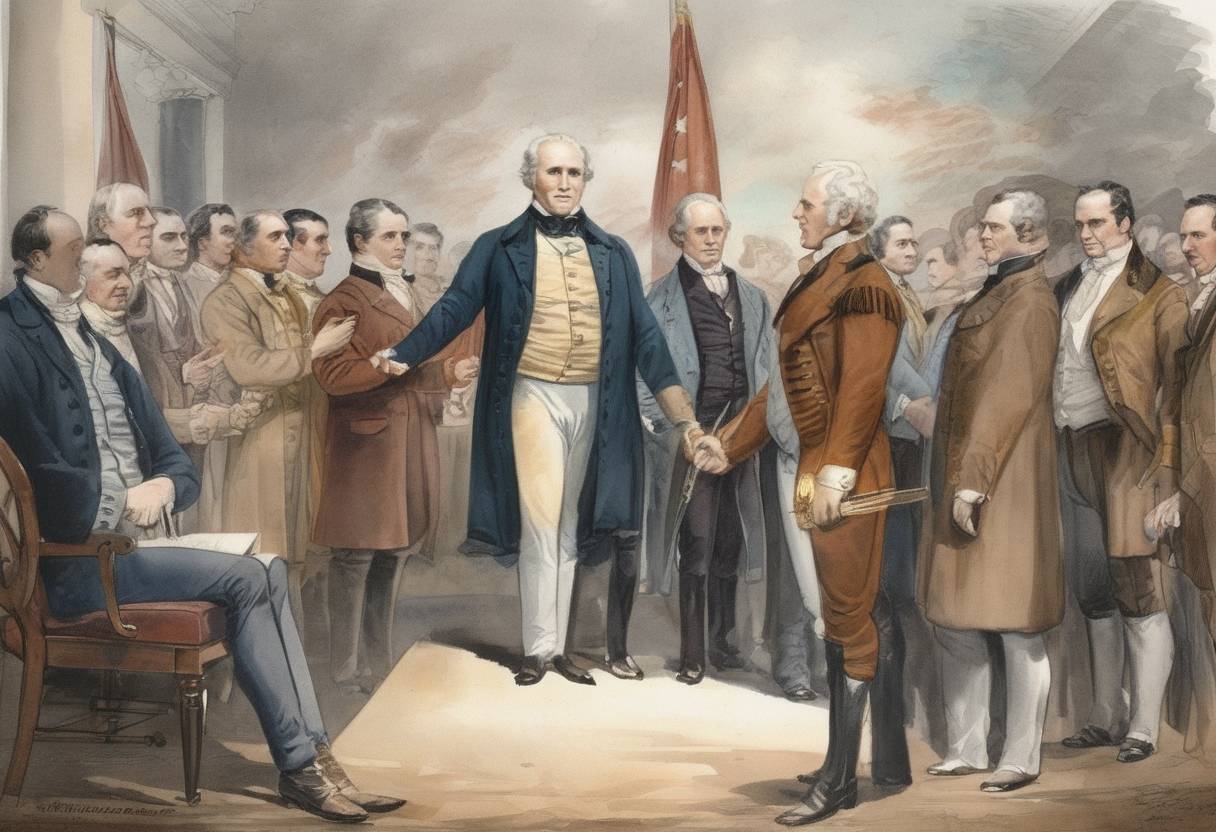
Sam Houston’s Inauguration as the First President of the Republic of Texas
On October 22, 1836, Sam Houston was inaugurated as the first President of the Republic of Texas, marking a pivotal moment in the history of Texas and its journey towards becoming an independent nation.
Context Leading Up to the Inauguration
Texas Revolution: The inauguration followed the Texas Revolution, a conflict that began in 1835 between the Mexican government and Texan colonists. The revolution was driven by tensions over issues such as immigration policies, cultural differences, and the centralization efforts of the Mexican government under President Antonio López de Santa Anna.
Battle of San Jacinto: A decisive victory for the Texan forces occurred on April 21, 1836, at the Battle of San Jacinto, where Sam Houston led his troops to defeat Santa Anna’s army. This victory effectively secured Texan independence from Mexico.
Treaties of Velasco: Following the battle, the Treaties of Velasco were signed in May 1836, which stipulated the withdrawal of Mexican troops and recognized Texan independence, although the Mexican government later repudiated these treaties.
The Inauguration
Election of Sam Houston: Sam Houston was elected as the first president of the Republic of Texas in September 1836. His leadership during the revolution and his status as a war hero made him a popular choice among the Texan populace.
Inauguration Ceremony: The inauguration took place in Columbia, Texas, which was the capital of the Republic at the time. Houston’s presidency marked the beginning of the Republic’s efforts to establish a stable government and gain international recognition.
Significance and Aftermath
Challenges Faced: As president, Houston faced numerous challenges, including securing recognition from foreign powers, managing the Republic’s finances, and dealing with ongoing threats from Mexico.
Legacy: Houston’s leadership was instrumental in laying the groundwork for the Republic’s future. His diplomatic efforts eventually led to the annexation of Texas by the United States in 1845.
Historical Impact: The inauguration of Sam Houston as president is a significant event in Texan history, symbolizing the transition from a revolutionary movement to an independent republic. It set the stage for Texas’s eventual statehood and its role in the broader narrative of American expansion.
Sam Houston’s presidency was a critical period in the early history of Texas, characterized by efforts to stabilize and legitimize the fledgling republic on the international stage. His leadership during this formative time remains a key part of Texas’s rich historical legacy.