The Sylacauga Meteorite Incident: November 30, 1954
1954 · Sylacauga, United States
The first modern instance of a meteorite striking a human occurred in Sylacauga, Alabama, when a meteorite crashed through a roof and hit Ann Hodges.
April 5, 1804
The High Possil meteorite fell in Glasgow, Scotland. This was the first recorded meteorite fall in Scotland.
Glasgow, Scotland | N/A
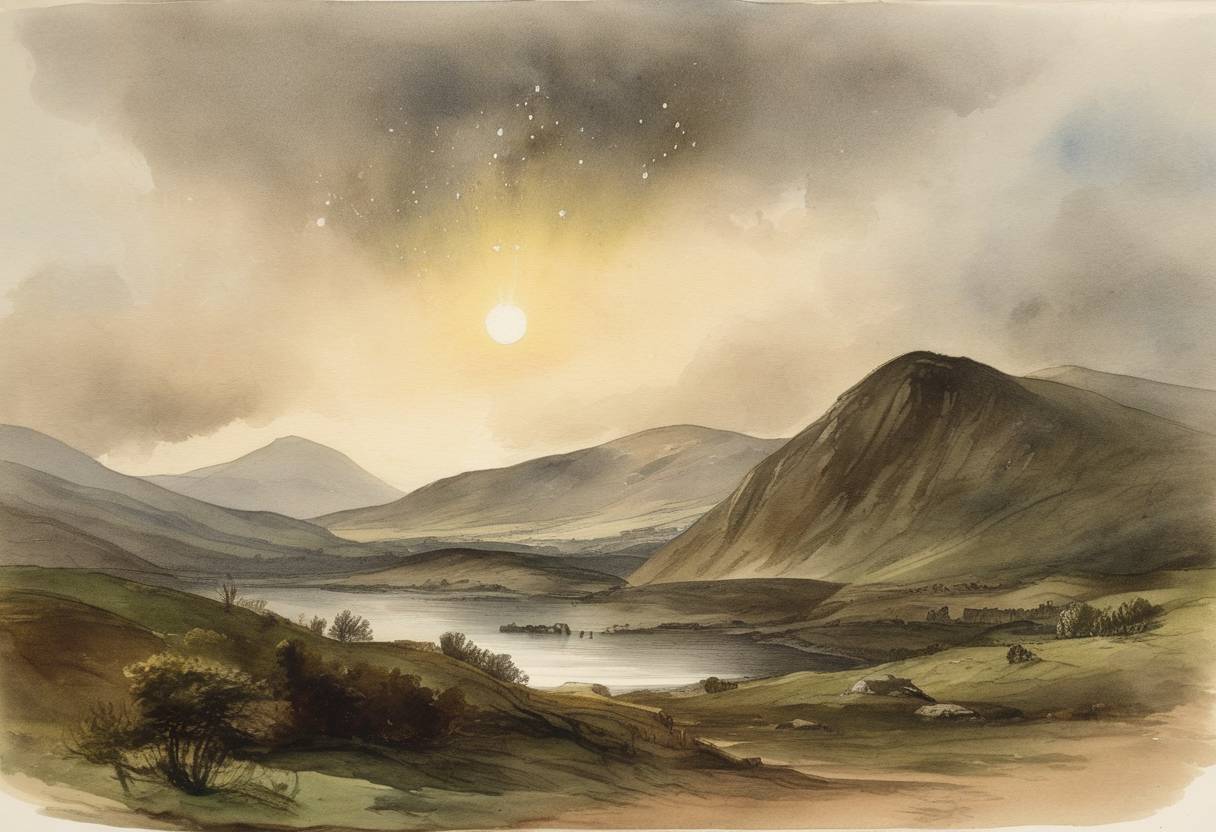
On April 5, 1804, a significant astronomical event occurred near Glasgow, Scotland, when the High Possil meteorite fell to Earth. This event marks the first recorded meteorite fall in Scotland, attracting considerable attention from the scientific community of the time.
The early 19th century was a period when the study of meteorites was burgeoning. Scientists were beginning to understand these celestial objects not as mystical phenomena but as natural occurrences worthy of scientific scrutiny. During this era, the study of meteorites added to the growing body of knowledge that would eventually contribute to the disciplines of geology and astronomy.
On the morning of April 5, near the village of Possil, situated just north of Glasgow, villagers witnessed a sudden explosion in the sky. This was followed by the sight of an object falling to the ground. The phenomenon was accompanied by loud noises described as similar to the sound of artillery fire, which startled the local population.
A search was quickly organized, and the meteorite was recovered shortly after its impact. The recovered fragment was modest in size, approximately 10 kilograms (about 22 pounds), but its importance was underscored by the rarity of such events at the time.
The High Possil meteorite’s fall offered a valuable opportunity for scientific study. Researchers from Glasgow and the surrounding areas took a keen interest in analyzing its composition, marking a critical moment in the advancement of meteoritics. The meteorite was identified as a chondrite, a type still prevalent in meteorite studies today.
The fall of the High Possil meteorite had broader implications beyond its immediate scientific impact. It cemented the acceptance of meteorites as objects of scientific inquiry, contributing to the shift in understanding celestial phenomena as natural rather than supernatural.
By documenting and analyzing such occurrences, scientists laid the groundwork for more systematic approaches in geology and astronomy, leading to a better understanding of the solar system’s formation and the nature of extraterrestrial materials.
The High Possil meteorite remains an important artifact in the historical study of meteorites, symbolizing a pivotal point in the scientific evolution and public perception of these celestial events.
Source: en.wikipedia.org