The Battle of Neville's Cross: October 17, 1346
1346 · Durham, England
The Battle of Neville's Cross took place, where English forces defeated the Scots, capturing King David II of Scotland.
July 19, 1333
The Battle of Halidon Hill: A decisive battle of the Second War of Scottish Independence, where English forces under Edward III defeated a Scottish army near Berwick-upon-Tweed.
Berwick-upon-Tweed, England | Kingdom of England
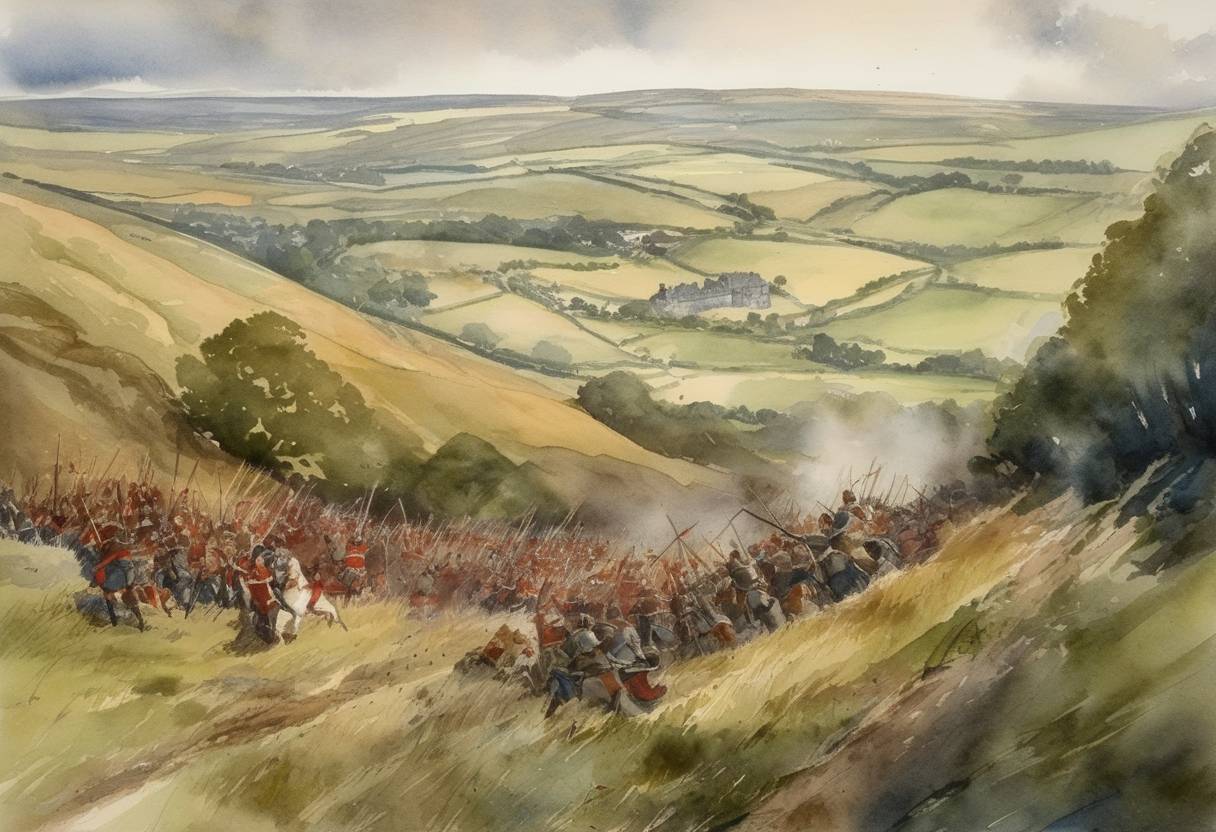
The Battle of Halidon Hill, fought on July 19, 1333, was a crucial conflict during the Second War of Scottish Independence. This engagement near Berwick-upon-Tweed in northern England saw the forces of Edward III of England decisively defeat the Scottish army led by Sir Archibald Douglas.
The battle occurred against the backdrop of continued tensions between Scotland and England, following the death of Robert the Bruce and the accession of his young son, David II. Amidst internal strife in Scotland, Edward Balliol, a claimant to the Scottish throne with English support, sought to overthrow David II. In 1332, Balliol briefly gained control of parts of Scotland but was soon ousted.
To regain power, Balliol called on Edward III for assistance. The English king laid siege to Berwick-upon-Tweed, a strategic fortress town on the Anglo-Scottish border, prompting the Scots to intervene.
The Scots attempted to relieve the siege by positioning themselves on Halidon Hill, strategically located northwest of Berwick. Despite the high ground advantage, the Scots faced the formidable longbowmen of Edward III. The English army, well-organized and disciplined, included significant contingents of archers positioned on the flanks.
When the battle commenced, the Scottish forces advanced downhill to engage the English. This move proved disadvantageous as the well-prepared English forces unleashed a devastating barrage of arrows, decimating the Scottish ranks. The terrain and skilled archery disrupted and disorganized the Scottish advance, leading to a decisive victory for the English.
The defeat at Halidon Hill resulted in severe Scottish casualties, weakening their military capabilities significantly. Sir Archibald Douglas was killed, and the surviving Scottish forces retreated. Soon after, Berwick-upon-Tweed surrendered to Edward III, consolidating his control over the region.
The battle’s outcome strengthened Edward III’s position and reestablished English influence in southern Scotland. Additionally, it bolstered Edward Balliol’s claim, allowing him to temporarily regain the Scottish crown. However, ongoing resistance and the eventual return of David II from exile continued the struggle for Scottish independence in subsequent years.
The Battle of Halidon Hill emphasized the effectiveness of the English longbow in medieval warfare and showcased the strategic acumen of Edward III. It remains a significant episode in the prolonged struggle between England and Scotland for dominance in the British Isles.
Source: en.wikipedia.org