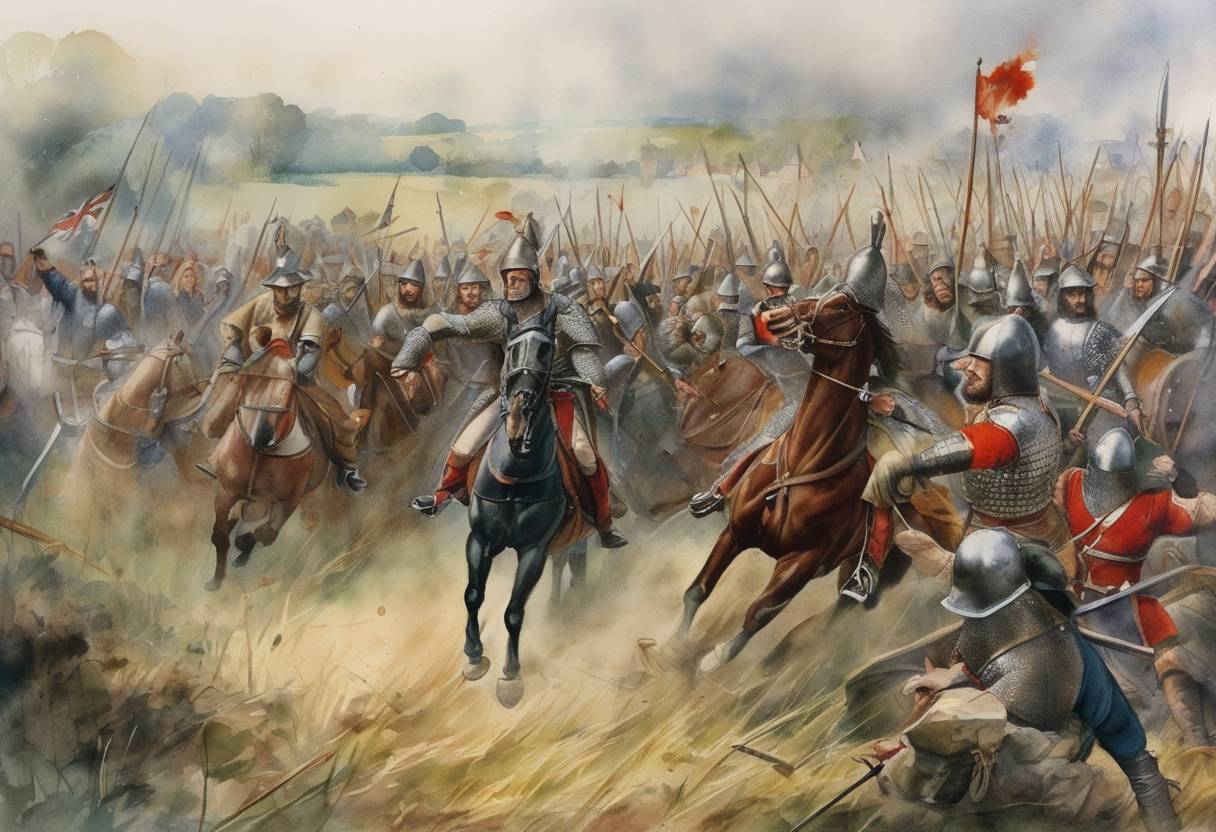
The Battle of Lincoln - February 13, 1141
The Battle of Lincoln was a pivotal engagement in the period of civil war in England known as The Anarchy, occurring on February 13, 1141. This decisive battle saw the forces of King Stephen of England clashing with the army of Empress Matilda, Stephen’s cousin and rival claimant to the English throne.
Context and Background
The Anarchy was characterized by a period of dispute over the English throne following the death of King Henry I in 1135. Upon the king’s death, his daughter, Empress Matilda, was named his successor. However, Matilda faced significant opposition from her cousin Stephen of Blois, who quickly seized the throne with the backing of a majority of England’s nobility. This led to a protracted civil war from 1135 to 1153, with key battles and sieges erupting across the kingdom.
The Prelude to Battle
The conflict leading to the Battle of Lincoln was fueled by ongoing struggles between supporters of Empress Matilda, primarily her half-brother Robert of Gloucester, and the forces loyal to King Stephen. In early 1141, tensions increased as Stephen attempted to consolidate his power by taking punitive action against rebellious barons sympathetic to Matilda’s cause.
Lincoln, located in the East Midlands, became a focal point when Ranulf of Chester, allied with Empress Matilda, captured the city along with the castle. In response, King Stephen laid siege to Lincoln, seeking to force submission and reassert control over this strategically important locale.
The Battle
Robert of Gloucester, commanding Matilda’s forces, organized a relief expedition to break the siege. On February 13, 1141, Gloucester’s army arrived, leading to a decisive confrontation in the fields surrounding Lincoln. The battle commenced with fierce fighting, as Stephen’s forces were assailed by Gloucester’s troops, who were well-coordinated and determined to lift the siege.
Despite efforts, Stephen’s army suffered from a lack of cohesive strategy and eventual exhaustion, largely due to the surprise and intensity of Gloucester’s assault. During the melee, Stephen fought valiantly, wielding a massive battle axe and personally engaging in the fray, but his efforts were insufficient to turn the tide.
The Outcome and Consequences
The battle concluded with the capture of King Stephen, who was taken prisoner and brought before Empress Matilda. This victory was a significant boost to Matilda’s cause, as capturing a reigning king upended the balance of power in her favor. Politically, this opened a path for Matilda to be declared “Lady of the English,” though her rule was marred by opposition and unrest.
Despite the capture of Stephen, the broader struggle for the throne persisted, illustrating the deeply fragmented state of English politics during this era. The eventual negotiated end of the civil war in 1153 saw Stephen retain the throne, but his son renounced claims, paving the way for Matilda’s son, Henry II, to ascend the throne, thereby ending The Anarchy.
The Battle of Lincoln stands as a crucial moment in this turbulent period, symbolizing both the ferocity of the conflict and the volatile nature of medieval English politics.