Emperor Henry IV at Canossa, January 25, 1077
1077 · Canossa, Italy
Emperor Henry IV stood as a penitent before Pope Gregory VII at Canossa, seeking the lifting of his excommunication.
January 27, 1077
Emperor Henry IV met Pope Gregory VII at Canossa and begged for forgiveness in the midst of the Investiture Controversy. This marked a pivotal point in the conflict between church and state in medieval Europe.
Canossa, Italy | Catholic Church
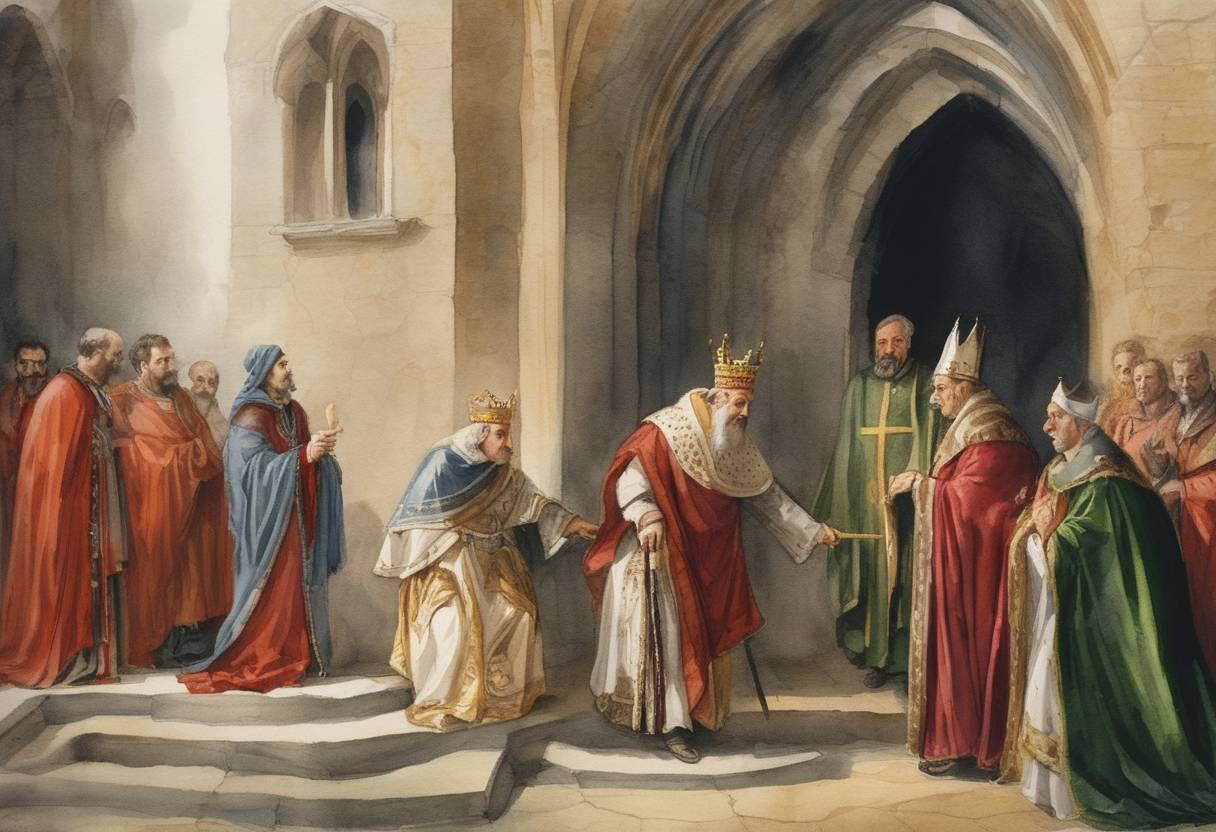
On January 27, 1077, one of the most dramatic turn of events in the medieval conflict between church and state unfolded as Holy Roman Emperor Henry IV met Pope Gregory VII at Canossa Castle. This event became emblematic of the struggle over the right of investiture—a critical issue that questioned whether secular rulers or the pope had the authority to appoint bishops and abbots.
The Investiture Controversy centered on the power to install church officials into office. Traditionally, European monarchs, including the Holy Roman Emperor, had played a significant role in appointing church leaders. The papacy, led by Pope Gregory VII, sought to eliminate secular influence, aiming for reform and asserting church independence from temporal powers.
In 1075, Pope Gregory VII issued the Dictatus Papae, a decree asserting papal authority over secular rulers in spiritual matters. This provoked Emperor Henry IV, leading to a series of confrontations. In response to Henry’s disregard for papal decree and his appointment of bishops, Gregory excommunicated him in 1076, which threatened Henry’s authority as emperor.
Facing rebellion from his own nobility and the potential disintegration of his empire, Henry IV decided to seek reconciliation with the pope. In a dramatic gesture of penance, Henry traveled across the Alps in the depths of winter to meet with Pope Gregory VII. For three days, Henry reportedly stood barefoot in the snow outside the gates of Canossa Castle, dressed in a hair shirt as an act of penance.
On January 27, 1077, Gregory VII consented to meet Henry. The emperor’s penance and plea for pardon resulted in the pope lifting the excommunication. This meeting at Canossa did not immediately resolve the wider investiture conflict but highlighted the papacy’s growing influence and the precedence of spiritual authority over temporal power.
The reconciliation at Canossa did not mark the end of conflicts between the church and state. Although Henry IV regained his title, underlying tensions persisted, leading to further disputes and another excommunication. The investiture struggle continued long beyond the lifetimes of Gregory VII and Henry IV, culminating eventually in the Concordat of Worms in 1122, which defined the limits of ecclesiastical and imperial authority.
The penitential act at Canossa became symbolic of the complex dynamics between the church and secular rulers, shaping medieval political and religious landscapes. It underscored the pope’s increasing authority, influencing future interactions between religious and political entities in Europe.
Source: en.wikipedia.org