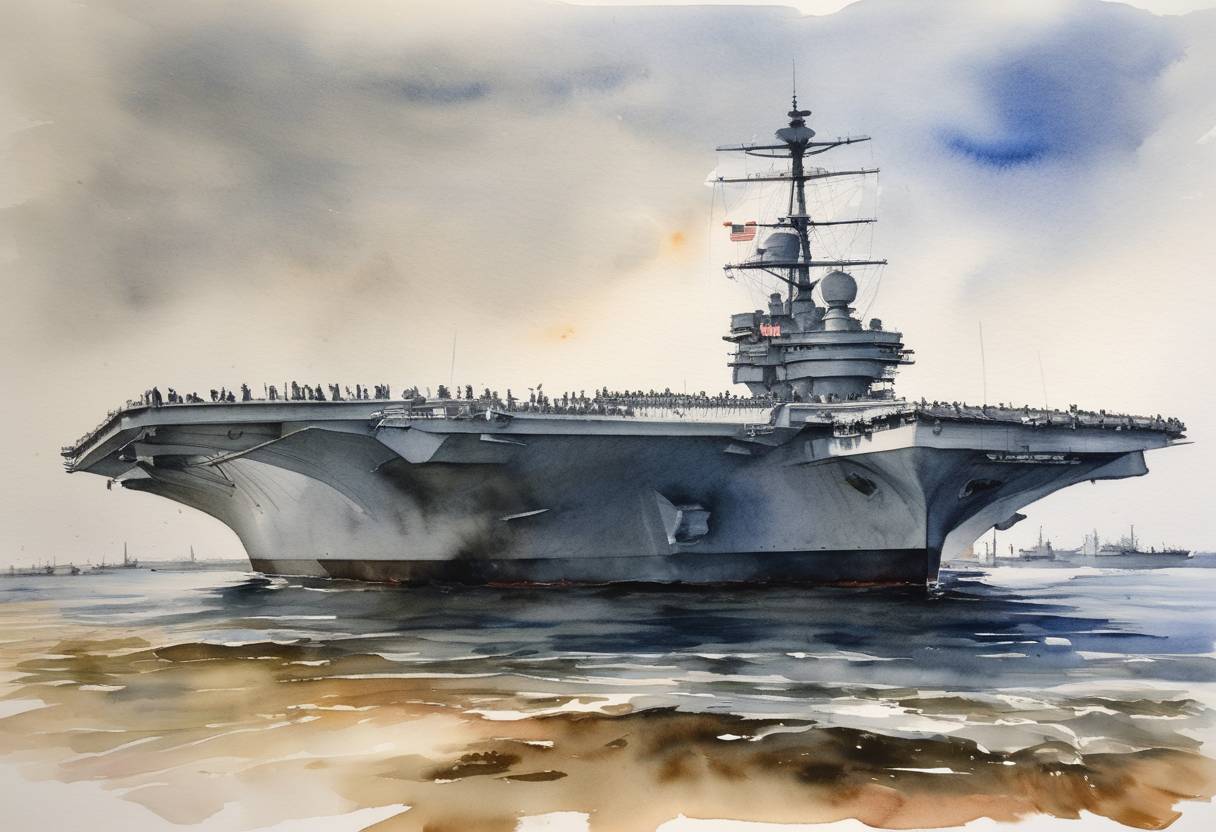
Commissioning of the USS Lexington (CV-16)
On November 3, 1943, the USS Lexington (CV-16) was commissioned as the fifth aircraft carrier of the United States Navy. Named in honor of the Revolutionary War’s Battle of Lexington, this vessel was part of the Essex-class carriers, which were instrumental during World War II.
Background and Construction
The USS Lexington (CV-16) was originally to be named USS Cabot, but after the earlier USS Lexington (CV-2) was lost during the Battle of the Coral Sea in May 1942, the name was reassigned to CV-16. Built by the Bethlehem Steel Company at its Fore River Shipyard in Quincy, Massachusetts, the carrier was laid down on July 15, 1941, launched on September 26, 1942, and commissioned the following year, in 1943.
Role in World War II
The USS Lexington played a critical role in the Pacific Theater during World War II. After her commissioning, she joined the Pacific Fleet and became a significant asset in numerous battles, including:
The Battle of the Philippine Sea (June 1944): Known as the “Great Marianas Turkey Shoot,” where Lexington’s aircraft contributed to the destruction of Japanese aircraft carriers.
The Battle of Leyte Gulf (October 1944): One of the largest naval battles in history, where Lexington’s involvement was pivotal in crippling the Japanese fleet.
Post-War Service
After World War II, the USS Lexington was decommissioned on April 23, 1947, but was later modernized and recommissioned. She served through various roles during subsequent decades, including acting as a training carrier. The Lexington was finally decommissioned on November 8, 1991, after almost 50 years of service.
Legacy
Today, USS Lexington is preserved as a museum ship in Corpus Christi, Texas, where it serves as a historic site, educating the public about naval and military history. Her commissioning signaled the strengthening of America’s naval capabilities, significantly contributing to the Allied victory in World War II.