The Battle of Liegnitz: April 9, 1241
1241 · Legnica, Poland
The Battle of Liegnitz took place, where Mongol forces defeated a combined force of European knights, including Polish, Moravian, and German troops.
May 3, 1241
The Battle of Legnica, also known as the Battle of Liegnitz, took place in modern Poland. This battle was fought between the troops of the Mongol Empire and a coalition of European forces led by Henry II the Pious, Duke of Silesia.
Legnica, Poland | Mongol Empire
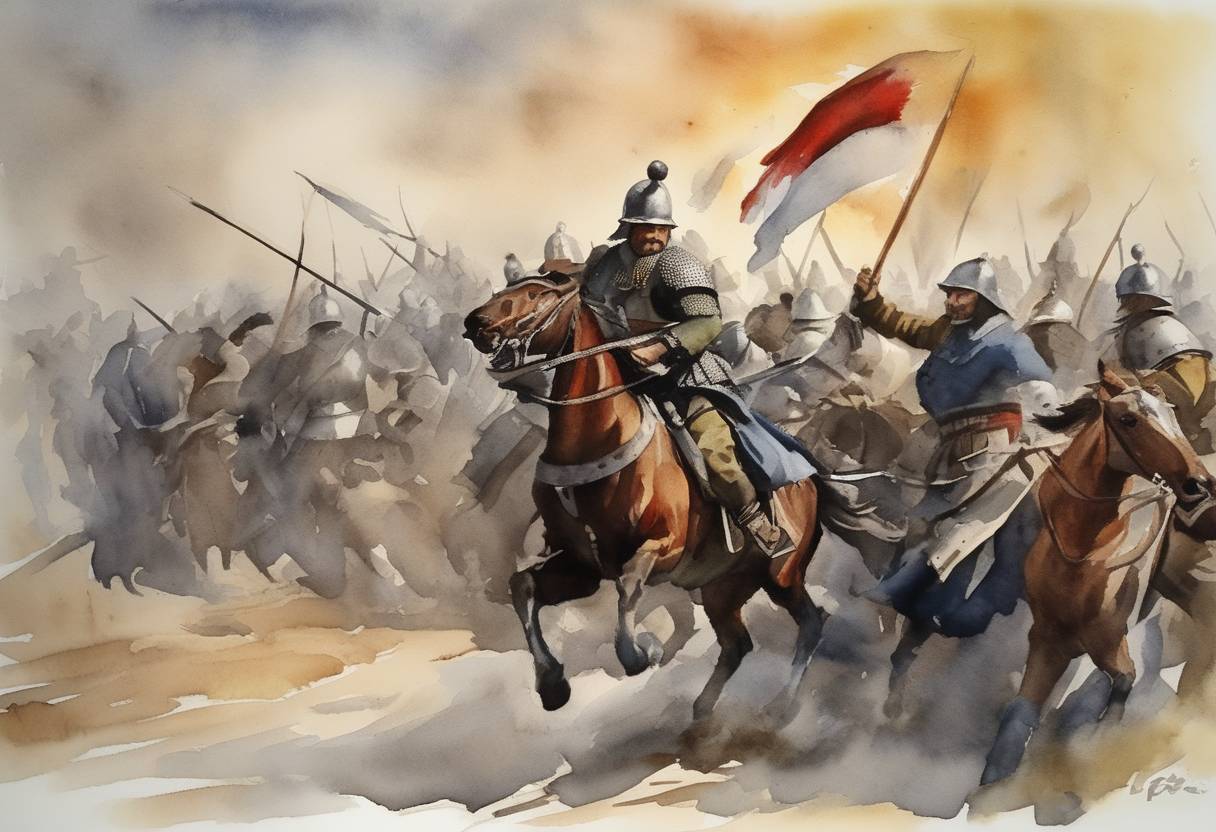
The Battle of Legnica, also known as the Battle of Liegnitz, was a significant confrontation that took place on April 9, 1241, near the town of Legnica in present-day Poland. This battle was part of the Mongol invasion of Europe and pitted the forces of the Mongol Empire against a European coalition led by Duke Henry II the Pious of Silesia.
The Mongols, under the command of Subutai and Batu Khan, initiated their campaign into Europe as part of their vast expansion. By the early 13th century, the Mongol Empire had already made significant conquests in Asia, and their westward movement was a continuation of this expansion strategy. The Mongols aimed to secure their western frontiers, increase their influence, and gather information about European political and military structures.
The European forces were a patchwork alliance, hastily assembled to counter the Mongol threat. This coalition mainly consisted of Polish knights led by Duke Henry II, supported by troops from various regions including Moravia, Bohemia, and fragmented forces from the German principalities and Teutonic Knights. However, the size and unity of the Christian forces were inadequate compared to the highly disciplined Mongol army.
The clash occurred on April 9, 1241. The Mongol forces employed their usual tactics of mobility, feigned retreats, and superior archery, which proved effective against the European knights who relied heavily on traditional heavy cavalry charges. The Mongol strategy involved luring Henry’s forces into a trap where they encircled and decimated the coalition. Despite fierce resistance, the European forces were overwhelmed by the Mongol tactical prowess.
The battle resulted in a decisive Mongol victory. Duke Henry II was killed in the battle, and the defeat left much of central Europe vulnerable to further Mongol raids. Nevertheless, the Mongols did not continue their westward expansion immediately as they were soon recalled to Asia due to the death of Ögedei Khan, the Great Khan of the Mongol Empire, which required the presence of their leaders back in the Mongol heartland.
The Battle of Legnica is often remembered as a pivotal moment demonstrating the effectiveness of Mongol military tactics against European forces and highlighting the fragmentation and lack of unified defense mechanisms among European states during that era. Though a defeat for the Europeans, it underscored the need for more cohesive defense strategies against external threats, which would play a role in future military and political developments in Europe.
Source: en.wikipedia.org