Edward VI's Coronation as King of England
1547 · London, England
Edward VI is crowned King of England at the age of nine following the death of his father, Henry VIII.
May 24, 1487
The ten-year-old Lambert Simnel is crowned in Dublin as "King Edward VI" of England, in a Yorkist attempt to threaten Henry VII's reign.
Dublin, Ireland | Yorkists
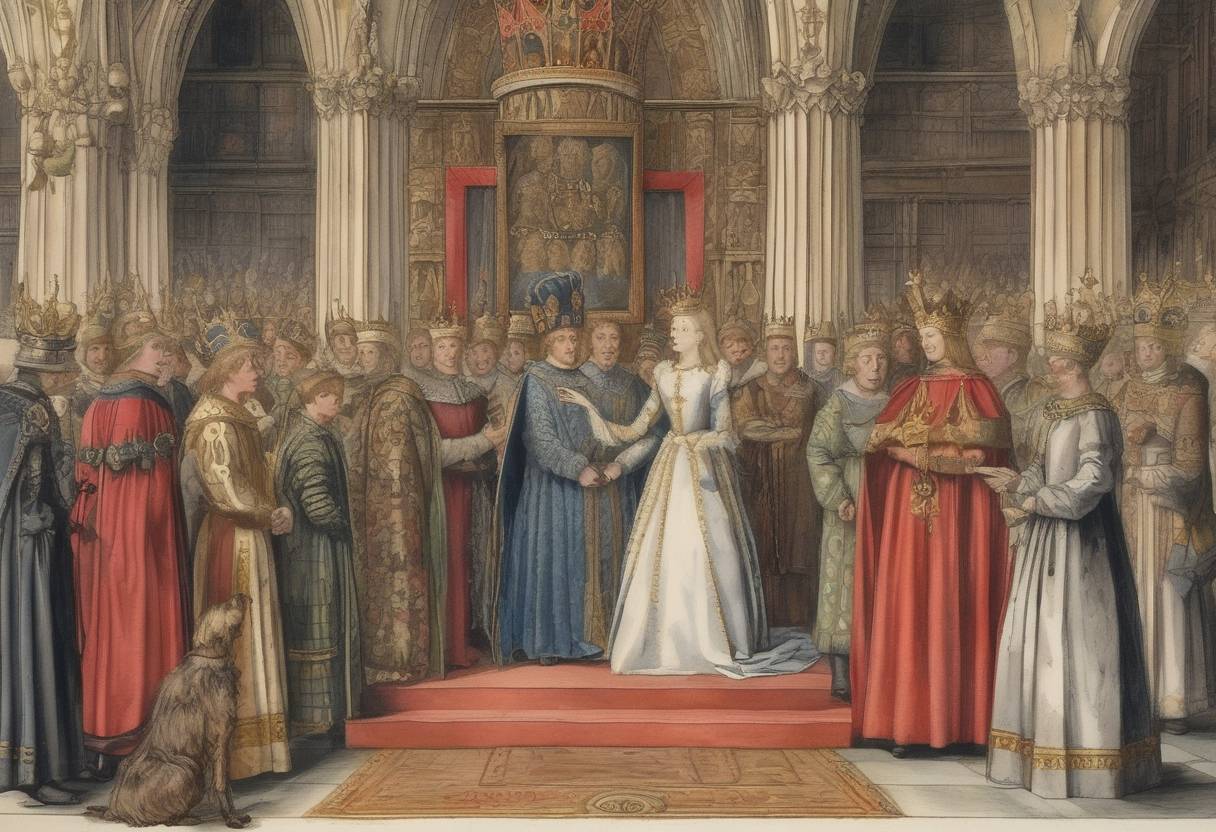
On May 24, 1487, a significant event unfolded in Dublin, Ireland, as Lambert Simnel, a ten-year-old boy, was crowned as “King Edward VI” of England. This event was a pivotal moment in the Yorkist challenge to the reign of Henry VII, the first monarch of the Tudor dynasty.
The Wars of the Roses, a series of dynastic conflicts between the houses of Lancaster and York, had left England in a state of political instability. Henry VII, a Lancastrian, had seized the throne in 1485 after defeating Richard III at the Battle of Bosworth Field. However, his claim was tenuous, and Yorkist supporters sought to restore their influence.
Lambert Simnel, a boy of humble origins, was chosen by Yorkist conspirators as a figurehead to challenge Henry VII. He was tutored by Richard Symonds, a priest who claimed that Simnel was actually Edward Plantagenet, the Earl of Warwick, a legitimate Yorkist heir imprisoned in the Tower of London.
The Yorkist plotters, including John de la Pole, Earl of Lincoln, and Francis Lovell, sought support from Margaret of Burgundy, a staunch Yorkist and sister of Edward IV and Richard III. With her backing, they gathered an army of mercenaries and supporters.
On May 24, 1487, Simnel was crowned in Dublin’s Christ Church Cathedral as “King Edward VI.” This coronation was a symbolic act intended to legitimize the Yorkist claim and rally support against Henry VII. The ceremony was attended by Irish nobles and clergy, who were sympathetic to the Yorkist cause.
Following the coronation, the Yorkist forces, led by the Earl of Lincoln, invaded England. They landed in Lancashire and marched south, hoping to gather more support. However, their campaign culminated in the Battle of Stoke Field on June 16, 1487. Henry VII’s forces decisively defeated the Yorkists, effectively ending the rebellion.
Lambert Simnel was captured but spared by Henry VII, who recognized the boy as a mere pawn in the conspiracy. Simnel was given a position in the royal kitchens, where he lived out his life in relative obscurity.
The Lambert Simnel affair was one of the last significant attempts by the Yorkists to reclaim the English throne. It underscored the fragile nature of Henry VII’s early reign and the lingering Yorkist sentiment. The defeat at Stoke Field solidified Henry’s position and marked the decline of Yorkist plots, paving the way for the Tudor dynasty’s consolidation of power.
This event also highlighted the use of imposture and deception in medieval politics, a tactic that would reappear in subsequent pretender claims, such as that of Perkin Warbeck.
Source: en.wikipedia.org