The Coronation of Charles V as Holy Roman Emperor
1520 · Aachen, Holy Roman Empire
Charles V is crowned Holy Roman Emperor by Pope Clement VII in Aachen.
January 6, 1205
Philip of Swabia was crowned King of the Romans.
Aachen, Holy Roman Empire | Holy Roman Empire
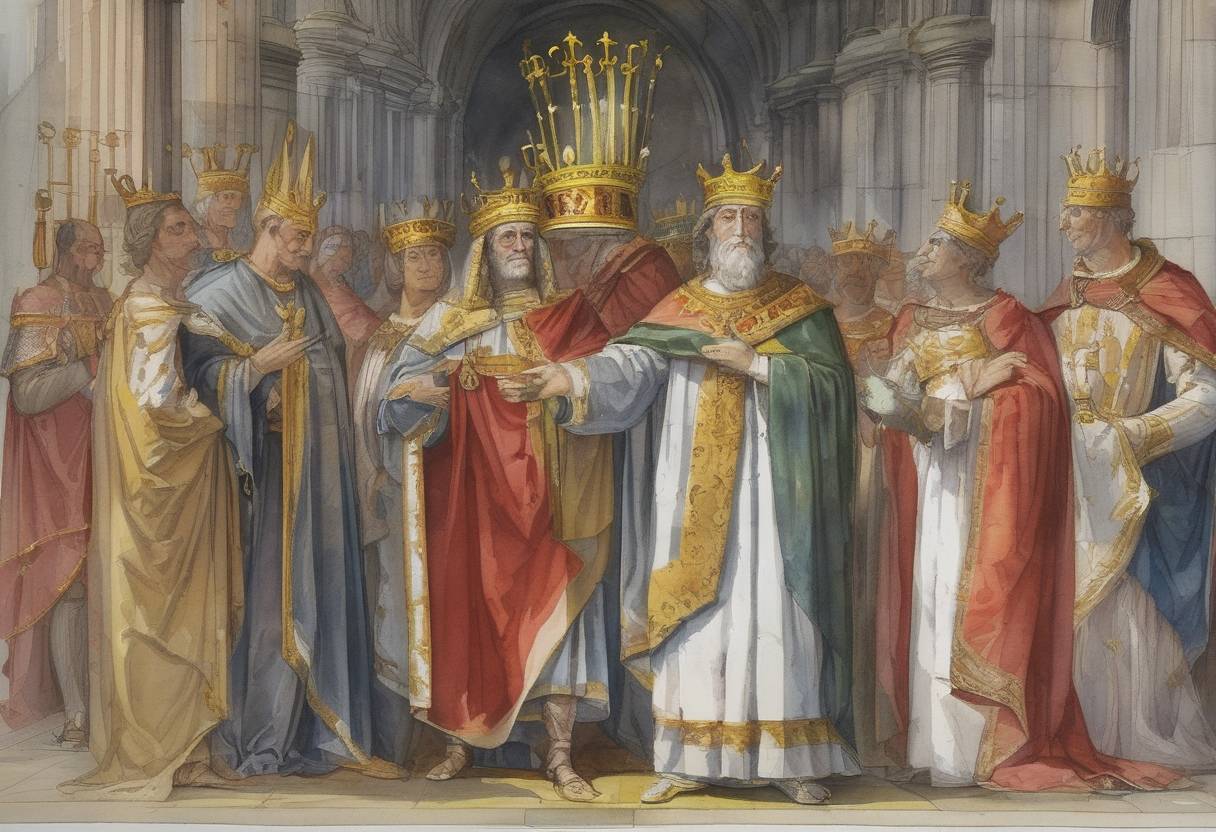
On January 6, 1205, Philip of Swabia was crowned King of the Romans, a significant event in the complex political landscape of the Holy Roman Empire during the early 13th century. This coronation was a pivotal moment in the struggle for power within the empire, marked by a period of internal conflict and rivalry.
Philip of Swabia was a member of the Hohenstaufen dynasty, a powerful family that had previously produced several Holy Roman Emperors. The death of his brother, Emperor Henry VI, in 1197 left a power vacuum and a contested succession. Henry VI’s young son, Frederick II, was initially the designated heir, but his minority and the political ambitions of other nobles led to a fractious environment.
The election of the King of the Romans, who would traditionally be crowned Holy Roman Emperor by the Pope, became a contentious issue. The Welf dynasty, rivals of the Hohenstaufens, supported Otto of Brunswick, leading to a split among the German princes.
Philip was elected King of the Romans by a faction of princes in 1198, but his position was contested by Otto IV, who was elected by another faction. This dual election led to a protracted civil war within the empire, known as the German throne dispute.
Philip’s coronation on January 6, 1205, in Aachen, was a significant assertion of his claim to the throne. Aachen was the traditional site for the coronation of German kings, lending legitimacy to his rule. The ceremony was conducted by Archbishop Adolf of Cologne, a key supporter of Philip.
Philip’s reign was marked by ongoing conflict with Otto IV, with both sides seeking support from various European powers and the papacy. The struggle for the throne continued until Philip’s assassination in 1208, which temporarily resolved the conflict in favor of Otto IV.
However, the long-term consequences of this period of instability were significant. The internal divisions weakened the authority of the central monarchy and set a precedent for future disputes over the imperial succession. Additionally, the rivalry between the Hohenstaufen and Welf dynasties continued to shape the political landscape of the Holy Roman Empire for decades.
Philip’s assassination and the subsequent reconciliation between the factions eventually led to the election of Frederick II, his nephew, as King of the Romans, who would later become one of the most influential emperors of the medieval period.
Philip of Swabia’s coronation and the ensuing conflict highlight the complexities of medieval German politics and the challenges of maintaining a unified empire. The events surrounding his reign illustrate the intricate balance of power between noble families, the influence of the papacy, and the broader European political context of the time.
Source: en.wikipedia.org