Establishment of the Sturmabteilung (SA)
1921 · Munich, Germany
The Sturmabteilung (SA), the original paramilitary wing of the Nazi Party, was formally established in Germany.
February 24, 1920
The Nazi Party (NSDAP) was founded in Germany, marking the beginning of a political movement that would have profound effects on world history.
Munich, Germany | Nazi Party
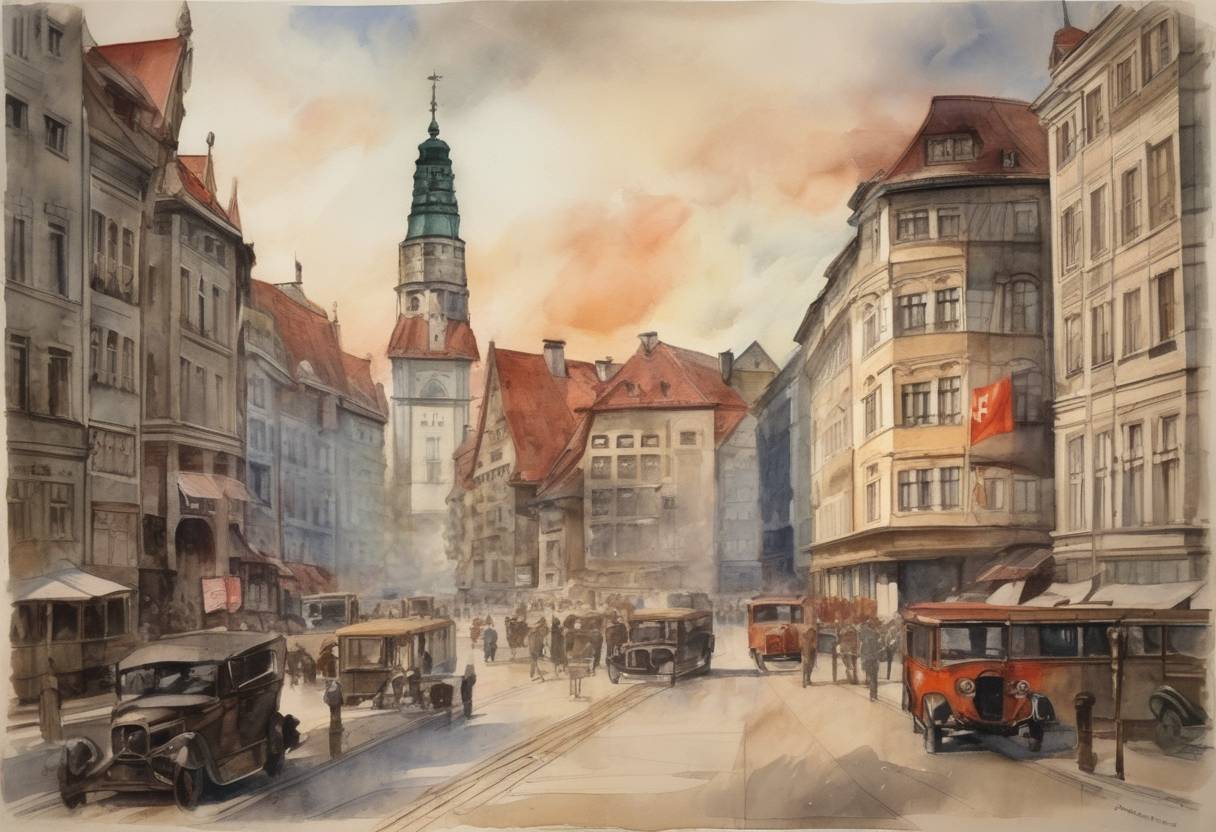
On February 24, 1920, a pivotal event in world history occurred with the formal establishment of the National Socialist German Workers’ Party (NSDAP), commonly known as the Nazi Party. This date marks the beginning of a political movement that would eventually lead to significant and devastating consequences for Germany and the world.
In the aftermath of World War I, Germany was in a state of political and economic turmoil. The Treaty of Versailles, signed in 1919, imposed harsh reparations and territorial losses on Germany, leading to widespread dissatisfaction and economic hardship. This environment of instability and resentment provided fertile ground for radical political movements.
The Nazi Party evolved from the German Workers’ Party (DAP), which was founded by Anton Drexler in Munich in 1919. Adolf Hitler, a former soldier who had been employed by the German army to spy on political groups, joined the DAP in September 1919. His oratory skills and charismatic leadership quickly propelled him to prominence within the party.
On February 24, 1920, at a mass meeting in Munich’s Hofbräuhaus, the party was officially renamed the National Socialist German Workers’ Party (NSDAP). During this meeting, Hitler presented the party’s 25-point program, which outlined its nationalist, anti-Semitic, and anti-Marxist ideology. Key points included the unification of all Germans, the abrogation of the Treaty of Versailles, and the exclusion of Jews from German citizenship.
The founding of the NSDAP marked the beginning of a movement that would grow in power and influence throughout the 1920s and 1930s. The party’s rise was facilitated by economic instability, social unrest, and the perceived failures of the Weimar Republic. By 1933, the Nazis had gained enough support to enable Hitler’s appointment as Chancellor of Germany, leading to the establishment of a totalitarian regime.
The consequences of the Nazi Party’s rise to power were catastrophic. Their aggressive expansionist policies led to World War II, and their genocidal ideology resulted in the Holocaust, during which six million Jews and millions of others were systematically murdered.
The events of February 24, 1920, set in motion a series of developments that reshaped global history. The Nazi regime’s actions had profound effects on international relations, leading to the reconfiguration of global power structures and the establishment of the United Nations. The atrocities committed during the Holocaust prompted a reevaluation of human rights and the creation of international laws to prevent future genocides.
In summary, the founding of the Nazi Party was a critical moment in history, marking the emergence of a movement that would have lasting and far-reaching impacts on the world.
Source: en.wikipedia.org