The Battle of Dorestad - April 17, 690
690 · Dorestad, Frisia
The Battle of Dorestad takes place, where the Frisians, led by King Radbod, defeat the Frankish forces, temporarily halting Frankish expansion.
March 20, 0687
The Battle of Tertry takes place, where Pepin of Herstal defeats Theuderic III, consolidating his power over the Frankish territories.
Tertry, Frankish Kingdom | Frankish Army
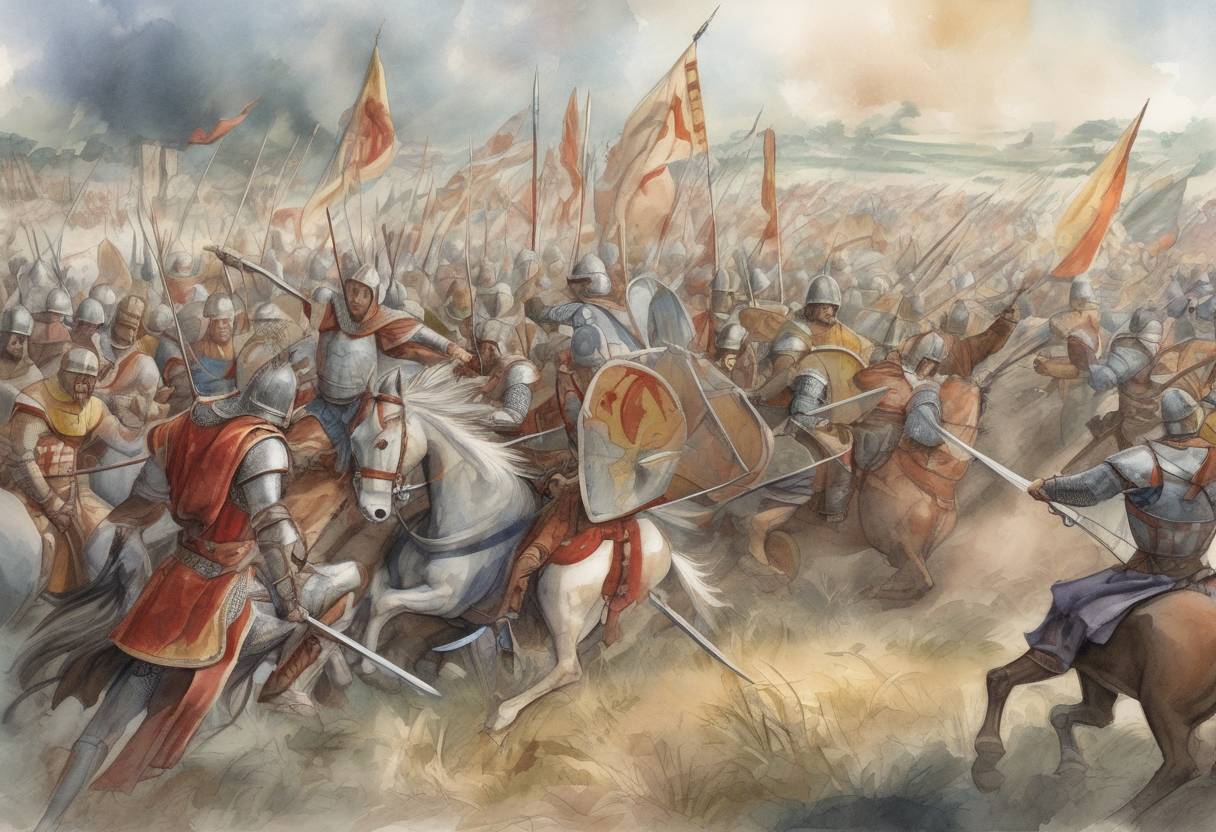
The Battle of Tertry, fought on March 20, 687, was a pivotal conflict in the history of the Frankish territories. This battle marked a significant turning point in the power dynamics of the Frankish kingdoms, leading to the consolidation of power by Pepin of Herstal.
During the late 7th century, the Frankish realm was divided into several regions, primarily Austrasia and Neustria, each ruled by its own king. The Merovingian kings, who were the nominal rulers, had become largely figureheads, with real power often held by the mayors of the palace. These officials wielded significant influence, controlling the administration and military affairs of their respective regions.
Pepin of Herstal: The Mayor of the Palace of Austrasia, Pepin was a member of the powerful Arnulfing family, later known as the Carolingians. He sought to expand his influence over the entire Frankish realm.
Theuderic III: The Merovingian king of Neustria, Theuderic was a puppet ruler under the control of his own mayor of the palace, Berchar.
The conflict at Tertry was the culmination of ongoing tensions between Austrasia and Neustria. Pepin of Herstal, seeking to assert his dominance, led the Austrasian forces against Theuderic III and the Neustrian army. The battle took place near the village of Tertry, in present-day northern France.
Pepin’s forces decisively defeated the Neustrians, capturing Theuderic III. This victory effectively ended the Neustrian resistance and allowed Pepin to consolidate his power over the Frankish territories.
Following the battle, Pepin of Herstal became the de facto ruler of the Frankish kingdom, although he maintained the Merovingian kings as figureheads to legitimize his rule. This victory laid the groundwork for the rise of the Carolingian dynasty, which would eventually replace the Merovingians as the ruling family of the Franks.
Pepin’s consolidation of power also set the stage for the future unification of the Frankish territories under his descendants, most notably his grandson, Charlemagne, who would go on to establish the Carolingian Empire.
The Battle of Tertry is thus seen as a crucial step in the transition from Merovingian to Carolingian rule, marking the beginning of a new era in European history.
Source: en.wikipedia.org