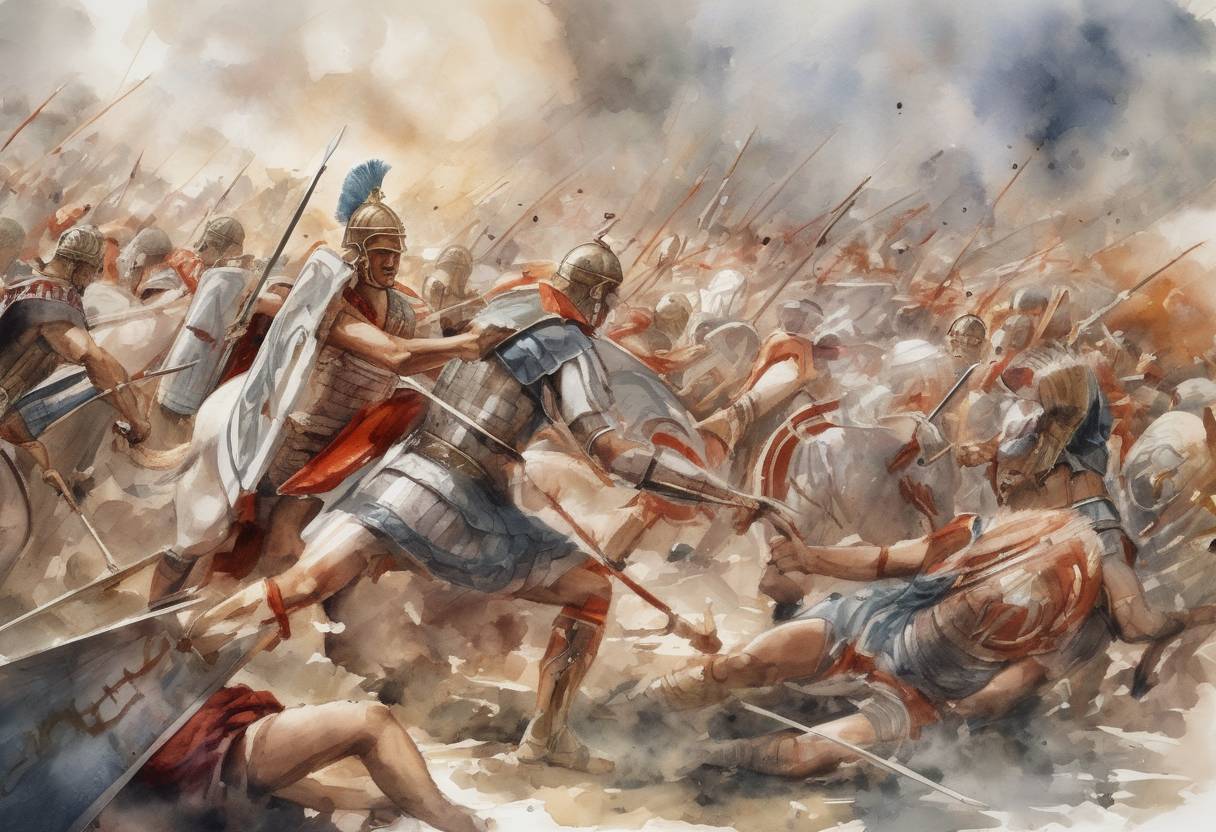
The Second Battle of Bedriacum: October 24, 69 AD
The Second Battle of Bedriacum, fought on October 24, 69 AD, was a pivotal conflict in the Year of the Four Emperors, a chaotic period of civil war in the Roman Empire. This battle marked a decisive moment in the struggle for imperial power, ultimately leading to the rise of Vespasian as Roman Emperor.
Context and Prelude
The Year of the Four Emperors was characterized by rapid changes in leadership following the death of Emperor Nero in 68 AD. Galba, Otho, Vitellius, and Vespasian each claimed the imperial throne in quick succession. Vitellius had ascended to power earlier in 69 AD after defeating Otho at the First Battle of Bedriacum. However, his rule was soon challenged by Vespasian, a seasoned military commander with significant support from the eastern provinces and the legions stationed there.
Vespasian’s claim to the throne was bolstered by his reputation as a competent leader, particularly noted for his role in the Roman campaign in Judea. His supporters, including key military leaders like Marcus Antonius Primus, rallied to his cause, setting the stage for a confrontation with Vitellius.
The Battle
The Second Battle of Bedriacum took place near the town of Bedriacum in northern Italy, close to modern-day Cremona. Vespasian’s forces, commanded by Antonius Primus, advanced from the east, while Vitellius’s army, led by his generals, sought to defend his claim to the throne.
The battle was fiercely contested, with both sides demonstrating considerable military prowess. However, Vespasian’s forces, benefiting from superior strategy and morale, gained the upper hand. The decisive moment came when Antonius Primus’s troops successfully breached Vitellius’s defenses, leading to a rout of his forces.
Aftermath and Significance
The defeat at Bedriacum was catastrophic for Vitellius. His remaining supporters quickly abandoned him, and he was captured and executed in December 69 AD. This victory paved the way for Vespasian’s unchallenged rise to power. He was officially declared emperor by the Roman Senate, marking the beginning of the Flavian dynasty.
Vespasian’s reign brought stability to the Roman Empire after a year of turmoil. He implemented significant reforms, restored financial stability, and embarked on ambitious construction projects, including the initiation of the Colosseum. His leadership set the foundation for the prosperity of the Flavian dynasty, which continued under his sons, Titus and Domitian.
The Second Battle of Bedriacum thus stands as a crucial turning point in Roman history, illustrating the volatility of imperial succession and the eventual establishment of a more stable regime under Vespasian.