The Surrender of Muslim Valencia to King James I of Aragon on September 28, 1238
1238 · Valencia, Spain
Muslim Valencia surrendered to the besieging forces of King James I of Aragon.
April 3, 0801
King Louis the Pious captures Barcelona from the Moors, marking a significant expansion of the Carolingian Empire into the Iberian Peninsula.
Barcelona, Spain | Carolingian Empire
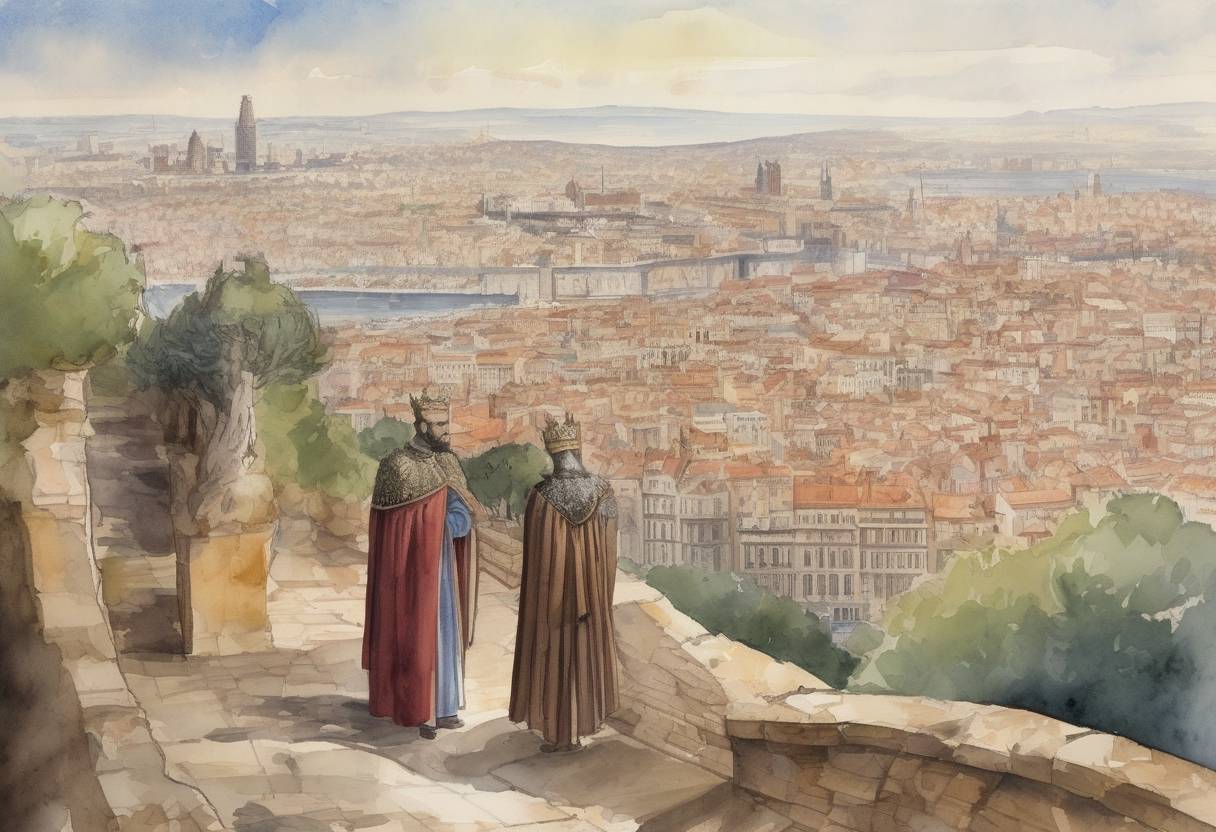
On April 3, 801, King Louis the Pious, son of Charlemagne, successfully captured the city of Barcelona from the Moors, marking a significant expansion of the Carolingian Empire into the Iberian Peninsula. This event was a pivotal moment in the Carolingian reconquest efforts and had lasting implications for the region’s political and cultural landscape.
Carolingian Expansion: The Carolingian Empire, under Charlemagne, sought to expand its territories and influence across Europe. The Iberian Peninsula, largely under Muslim control since the early 8th century, was a strategic target for expansion.
The Reconquista: The capture of Barcelona was part of the broader Christian Reconquista, a series of campaigns by Christian states to reclaim territories from Muslim rule in the Iberian Peninsula.
Strategic Importance: Barcelona, a key city in the region, was of significant strategic importance due to its location and economic potential. Its capture would provide the Carolingians with a foothold in the region and a base for further military operations.
Military Campaign: The campaign to capture Barcelona began in 800, led by Louis the Pious, who was then King of Aquitaine and acting on behalf of his father, Charlemagne. The siege involved a coordinated effort by Frankish forces and local Christian allies.
Siege Tactics: The Carolingian forces employed siege tactics to cut off supplies and weaken the city’s defenses. The siege lasted several months, demonstrating the determination and military prowess of Louis’s forces.
Surrender and Capture: On April 3, 801, the city surrendered to Louis the Pious. The capture was achieved with relatively minimal destruction, allowing the Carolingians to quickly establish control and begin integrating the city into their empire.
Establishment of the Spanish March: Following the capture, the Carolingians established the Spanish March, a buffer zone aimed at protecting the empire from further Muslim incursions. This region became a critical frontier for the Carolingian Empire.
Cultural and Political Impact: The capture of Barcelona facilitated the spread of Carolingian influence and culture into the Iberian Peninsula. It also strengthened the position of the Carolingian dynasty and Louis the Pious’s reputation as a capable leader.
Legacy: The event marked a turning point in the Christian reconquest of the Iberian Peninsula, setting the stage for future campaigns and the eventual establishment of Christian kingdoms in the region.
The capture of Barcelona by Louis the Pious was a testament to the strategic vision and military capabilities of the Carolingian Empire. It not only expanded their territorial reach but also laid the groundwork for the complex political and cultural transformations that would shape medieval Spain.
Source: en.wikipedia.org