Publication of "Dialogue Concerning the Two Chief World Systems"
1632 · Florence, Italy
Galileo's book "Dialogue Concerning the Two Chief World Systems" was published, which compared the Copernican system with the traditional Ptolemaic system.
December 28, 1612
Galileo Galilei became the first astronomer to observe the planet Neptune, although he mistakenly cataloged it as a fixed star.
Florence, Italy | None
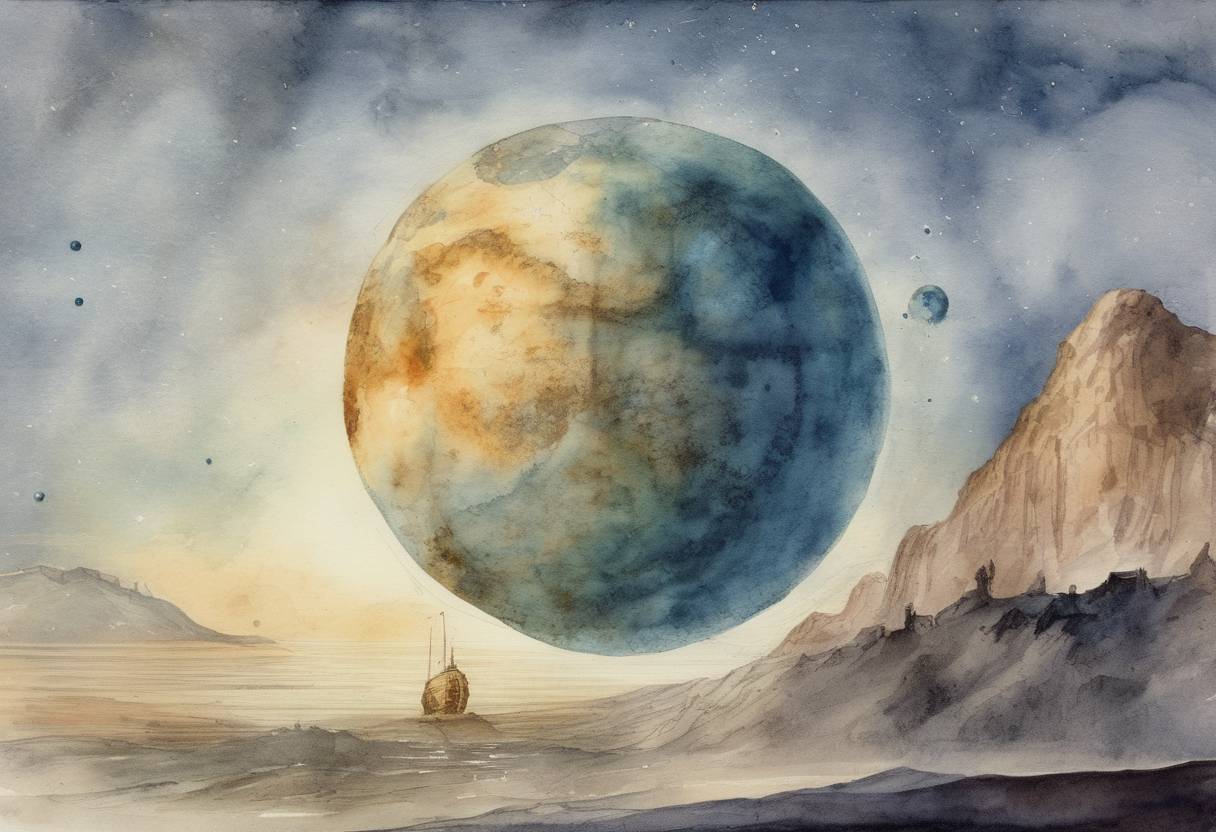
On December 28, 1612, the renowned Italian astronomer Galileo Galilei made a significant yet unrecognized astronomical observation. While observing the night sky through his telescope, Galileo became the first person to record the position of what we now know as the planet Neptune. However, he mistakenly cataloged it as a fixed star, not realizing its planetary nature.
Galileo Galilei, a pivotal figure in the Scientific Revolution, was known for his advancements in telescopic technology and his groundbreaking observations that challenged the geocentric model of the universe. By 1612, Galileo had already made several important discoveries, including the four largest moons of Jupiter and the phases of Venus, which supported the heliocentric model proposed by Copernicus.
During his observations on December 28, 1612, Galileo noted a “star” near Jupiter in his drawings. This “star” was, in fact, Neptune, which was positioned close to Jupiter in the sky at that time. Due to the limitations of his telescope and the slow apparent motion of Neptune, Galileo did not detect its movement relative to the background stars, leading him to classify it as a fixed star.
Although Galileo did not recognize Neptune as a planet, his observation is significant as it predates the official discovery of Neptune by over two centuries. Neptune was officially discovered on September 23, 1846, by Johann Galle and Heinrich d’Arrest, based on predictions by Urbain Le Verrier and John Couch Adams.
Galileo’s misclassification of Neptune highlights the challenges faced by early astronomers in identifying celestial bodies with the limited technology available at the time. It also underscores the importance of his contributions to observational astronomy, as his meticulous records provided valuable data for future astronomers.
Galileo’s work laid the foundation for modern astronomy and influenced subsequent generations of scientists. His observations and methods paved the way for the eventual discovery of Neptune and other celestial phenomena. The incident also serves as a reminder of the iterative nature of scientific discovery, where initial observations can lead to significant breakthroughs as technology and understanding advance.
In summary, while Galileo did not recognize Neptune as a planet, his observation on December 28, 1612, remains a noteworthy moment in the history of astronomy, illustrating both the limitations and the potential of early scientific inquiry.
Source: www.nasa.gov