The First Fatal Airplane Crash: The Death of Lieutenant Thomas Selfridge
1908 · Fort Myer, United States
Lieutenant Thomas Selfridge became the first person to die in an airplane crash, during a demonstration flight piloted by Orville Wright.
August 8, 1908
Wilbur Wright makes his first flight at a racecourse at Le Mans, France. It is the Wright brothers' first public flight.
Le Mans, France | Wright Brothers
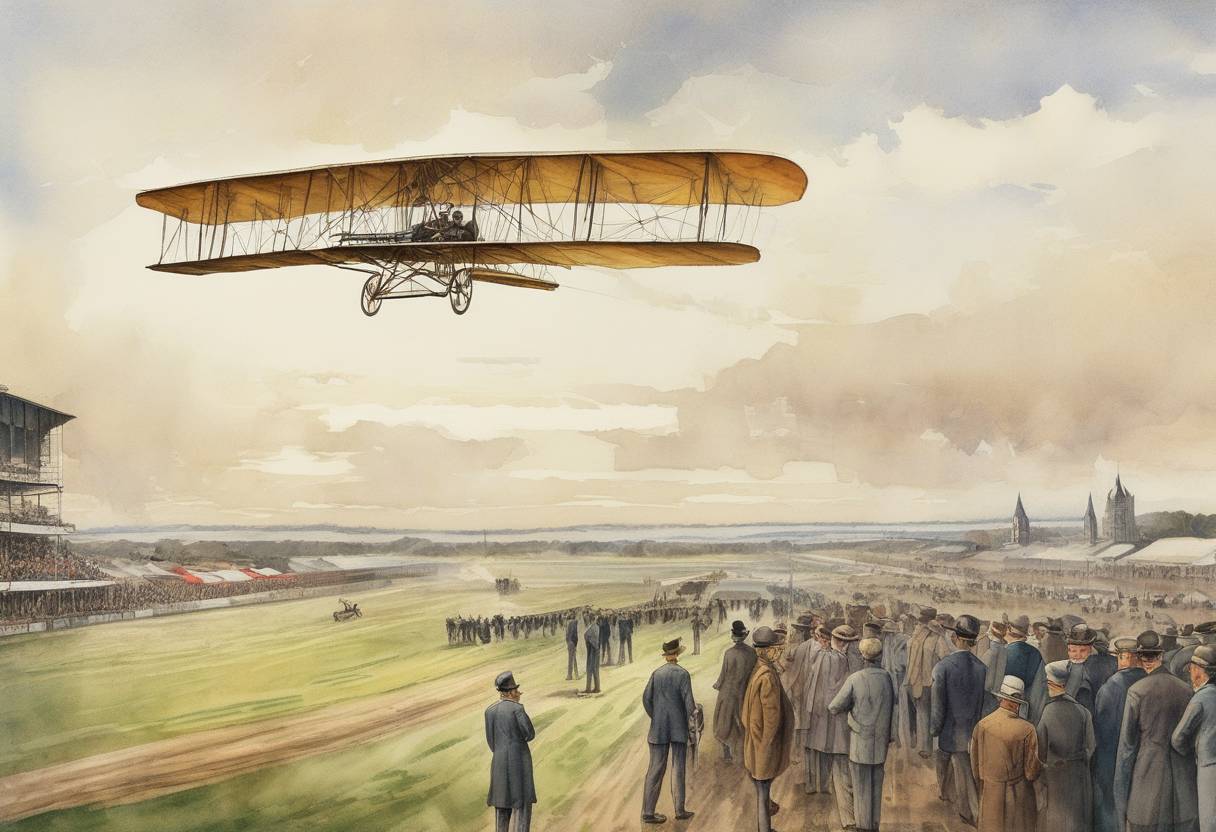
On August 8, 1908, Wilbur Wright made a significant mark in aviation history by conducting the Wright brothers’ first public flight at the Hunaudières racecourse near Le Mans, France. This event was pivotal in demonstrating the capabilities of powered flight to a skeptical European audience and solidifying the Wright brothers’ place in aviation history.
The Wright Brothers: Orville and Wilbur Wright, American inventors and aviation pioneers, are credited with inventing and building the world’s first successful motor-operated airplane. Their first powered flight occurred on December 17, 1903, in Kitty Hawk, North Carolina.
European Skepticism: Despite their success in the United States, the Wright brothers faced skepticism in Europe. Many European aviators and engineers doubted the authenticity of their achievements, as the brothers had conducted their flights in relative secrecy.
The Move to Europe: To counter skepticism and secure contracts, the Wright brothers decided to demonstrate their aircraft in Europe. Wilbur traveled to France, while Orville prepared for demonstrations in the United States.
Location: The demonstration took place at the Hunaudières racecourse near Le Mans, a site chosen for its open space and accessibility to the public.
The Aircraft: Wilbur flew the Wright Model A, an improved version of their earlier designs, featuring a more powerful engine and better control mechanisms.
The Flight: On August 8, 1908, Wilbur Wright took off in front of a crowd that included journalists, aviation enthusiasts, and notable figures in the field of aeronautics. He flew for approximately 1 minute and 45 seconds, covering a distance of about 1.6 kilometers (1 mile) and reaching an altitude of 10 meters (33 feet).
Public Acclaim: The successful flight was a turning point for the Wright brothers, as it garnered widespread acclaim and silenced many of their critics. The demonstration proved the viability of controlled, powered flight and showcased the Wrights’ technological advancements.
Impact on Aviation: The flight at Le Mans marked the beginning of a series of public demonstrations in Europe, leading to increased interest and investment in aviation. It also paved the way for the Wright brothers to secure contracts with governments and private entities.
Legacy: The event is remembered as a crucial moment in the history of aviation, highlighting the Wright brothers’ role in advancing human flight and inspiring future generations of aviators and engineers.
Wilbur Wright’s flight at Le Mans remains a testament to the power of innovation and perseverance in overcoming skepticism and achieving groundbreaking success.
Source: www.history.com