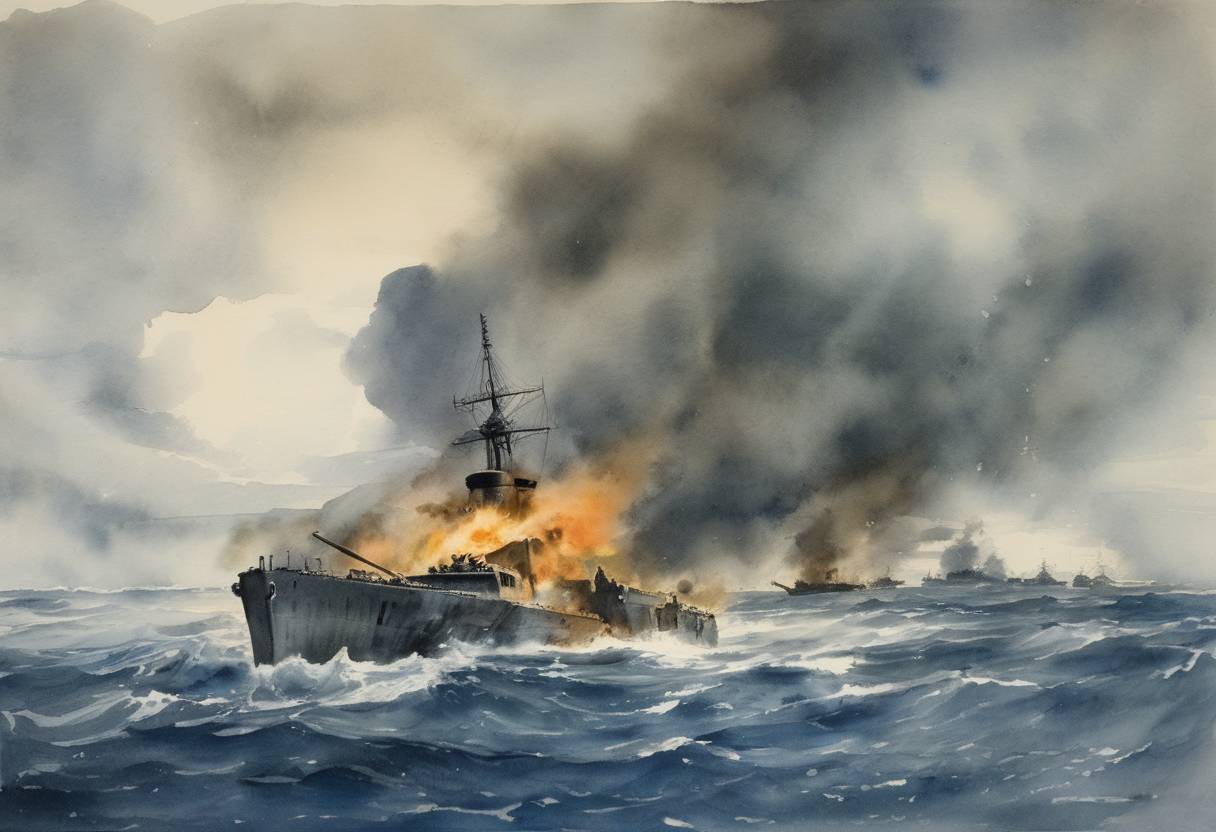
Battle of Tassafaronga
The Battle of Tassafaronga occurred on the night of November 30, 1942, off the coast of Guadalcanal in the Solomon Islands. This engagement was part of the larger Guadalcanal Campaign, a critical series of confrontations in the Pacific Theater during World War II, as both the Allied and Japanese forces vied for control over this strategic region.
Background
The Guadalcanal Campaign began in August 1942 when Allied forces, primarily from the United States, launched an assault to capture the island from Japanese control. By November, the campaign had devolved into a protracted struggle for dominance, with both sides recognizing Guadalcanal’s strategic importance due to its airfield, Henderson Field, which helped control supply routes in the Pacific.
In late November, the Japanese, facing dwindling supplies for their forces on Guadalcanal, organized nightly supply runs along what the Allies termed the “Tokyo Express.” A particular mission on November 30, 1942, was led by Rear Admiral Raizō Tanaka, tasked with delivering provisions to beleaguered troops on the island.
The Engagement
The United States, under Rear Admiral Carleton H. Wright, sought to intercept and thwart these supply runs. The American forces included a task force composed of five cruisers and four destroyers. They encountered the Japanese fleet, which consisted of eight destroyers, near Tassafaronga Point. Despite their numerical superiority, the U.S. forces faced several disadvantages, notably inadequate radar capabilities and tactical challenges in night engagements.
The American ships opened fire on the approaching Japanese destroyers. However, Tanaka skillfully maneuvered his forces, launching a devastating torpedo attack. The Japanese Long Lance torpedoes, known for their range and explosive power, struck with precision, sinking the USS Northampton (CA-26) and severely damaging three other cruisers, including the USS Minneapolis (CA-36), USS New Orleans (CA-32), and USS Pensacola (CA-24).
Aftermath and Significance
The Battle of Tassafaronga resulted in a tactical victory for the Japanese, showcasing their adept use of night tactics and torpedo technology. Despite suffering no ship losses themselves, they failed to deliver the intended supplies to Guadalcanal, so the strategic outcome was less clear-cut.
The battle highlighted the intense naval engagements characterizing the Pacific Theater and underscored the effectiveness of Japanese torpedoes and night fighting capabilities. It also prompted the U.S. Navy to revise tactics and prioritize the development of improved technologies and strategies for nighttime battles.
In the broader context of the Guadalcanal Campaign, though the battle was a setback for U.S. forces, it did not deter Allied efforts. Continuous pressure eventually led to Japanese withdrawal from the island in early 1943, marking a turning point in the Pacific War in favor of the Allies.