Coronation of Elizabeth I: Beginning of the Elizabethan Era
1559 · London, England
Elizabeth I was crowned Queen of England at Westminster Abbey, marking the beginning of her influential reign, often referred to as the Elizabethan Era.
December 22, 1135
Stephen of Blois is crowned King of England in Westminster Abbey, marking the beginning of the period of civil war known as The Anarchy.
London, England | Westminster Abbey
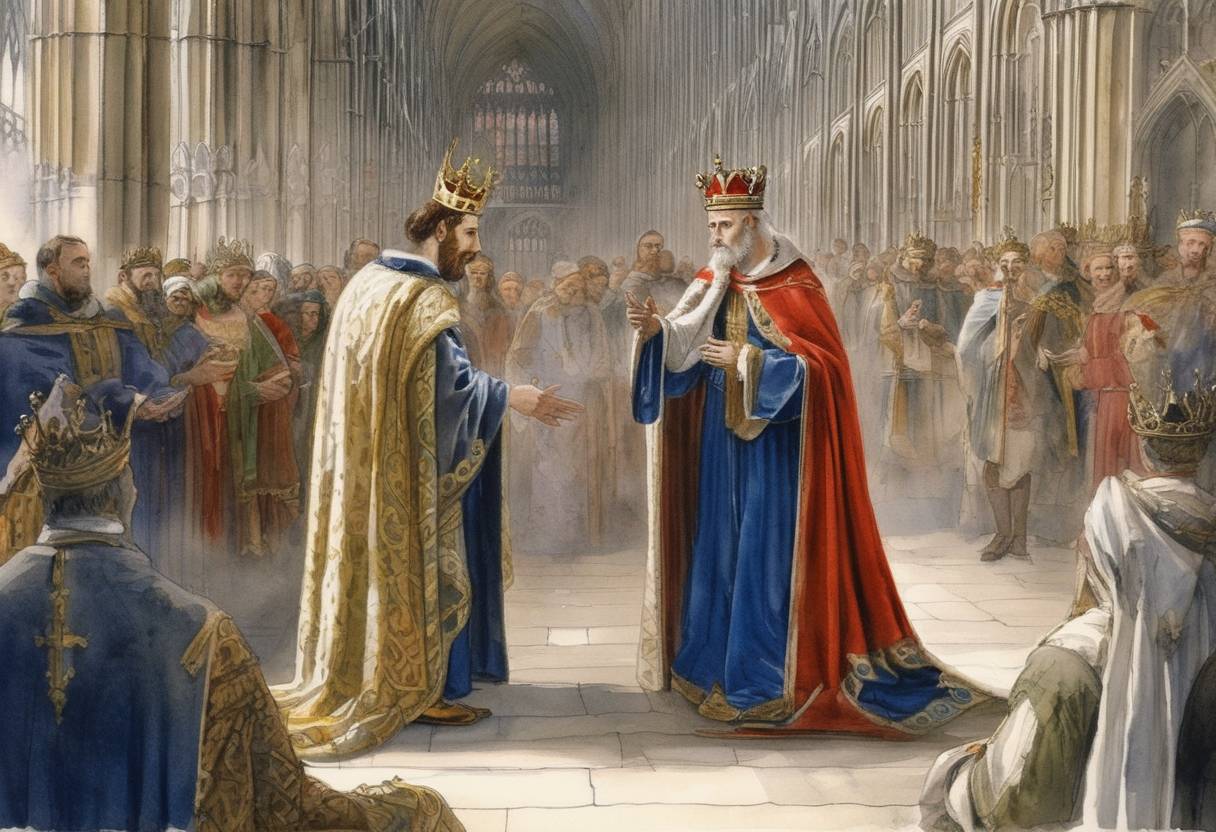
On December 22, 1135, Stephen of Blois was crowned as King of England at Westminster Abbey, a critical moment that marked the beginning of a turbulent period in English history known as The Anarchy. This event followed the death of King Henry I and set off a prolonged civil war over the English throne.
King Henry I, the fourth son of William the Conqueror, had two legitimate children, William Adelin and Matilda. After the tragic death of William Adelin in the White Ship disaster of 1120, Henry I designated his daughter Matilda as his heir. However, Matilda’s position was challenged largely due to prevailing gender norms of the time and her unpopular marriage to Geoffrey Plantagenet, Count of Anjou.
After Henry I’s death on December 1, 1135, Stephen of Blois, a grandson of William the Conqueror and nephew to Henry I, seized the opportunity to claim the throne. Stephen was a popular contender due to his charisma and promises to protect the church and realms, quickly gaining support from influential nobles and clergy.
Stephen’s coronation was conducted in Westminster Abbey, underscoring his new authority as king and formalizing his claim to the throne. The ceremony was attended by many of the kingdom’s leading figures, further solidifying his position. Despite this, the legitimacy of Stephen’s reign was contested by Matilda, his cousin and the designated heir according to Henry I’s earlier efforts.
Stephen’s accession to the throne directly provoked a prolonged period of civil war known as The Anarchy, lasting from 1135 to 1153. This period was characterized by a breakdown in royal authority, with barons and nobles asserting autonomy that often led to widespread disorder and localized conflicts. Both sides sought support from within England and abroad, leading to a shifting and unstable political landscape.
Matilda, supported by her half-brother Robert of Gloucester and her uncle David I of Scotland, made significant inroads but never fully secured the crown. Stephen’s reign was challenged repeatedly, with battles and sieges marking much of this era as neither side could secure a decisive long-term advantage.
The Anarchy finally ended with the Treaty of Wallingford in 1153, which allowed for a peaceful resolution. Stephen agreed to adopt Matilda’s son, Henry of Anjou (later Henry II), as his heir, thus restoring the order and setting the stage for the Plantagenet dynasty’s eventual rise to power.
Stephen’s reign, though tumultuous, is an essential chapter in English history that highlights the complexities of succession and the fragility of royal power structures during the medieval period. His coronation marks a pivotal moment that set the course for profound changes in England’s monarchy and governance.
Source: en.wikipedia.org