The Council of Chalcedon: October 7, 451
451 · Chalcedon, Byzantine Empire
The Council of Chalcedon, the fourth ecumenical council of the Christian Church, begins. It is significant for its definition of the two natures of Christ.
June 22, 0431
The First Council of Ephesus was convened by Emperor Theodosius II to address the Nestorian controversy, affirming the title of Theotokos for Mary and condemning Nestorius.
Ephesus, Byzantine Empire | Christian Church
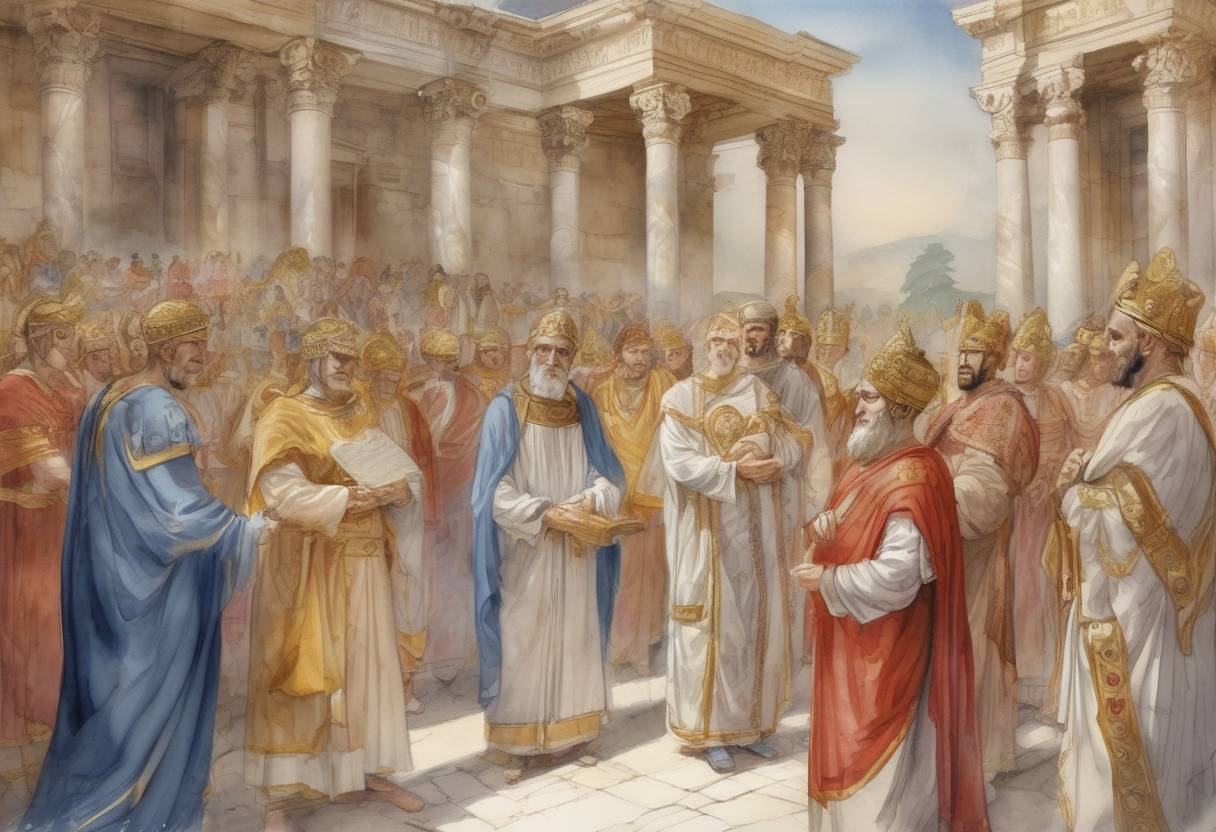
The First Council of Ephesus, convened on June 22, 431 CE, was a pivotal event in early Christian history, primarily addressing the Nestorian controversy. This ecumenical council was called by Emperor Theodosius II and held in the city of Ephesus, located in present-day Turkey. Its primary aim was to resolve theological disputes concerning the nature of Christ and the appropriate title for Mary, the mother of Jesus.
The controversy centered around the teachings of Nestorius, the Patriarch of Constantinople. Nestorius advocated for a Christological position that emphasized the distinction between Christ’s human and divine natures. He argued against the use of the term “Theotokos” (Greek for “God-bearer” or “Mother of God”) for Mary, suggesting instead “Christotokos” (Christ-bearer), to maintain a clear separation between the divine and human aspects of Jesus.
Nestorius’s views were opposed by Cyril of Alexandria, who argued that the title “Theotokos” was essential to affirm the unity of Christ’s divine and human natures. Cyril’s position was that denying Mary the title of “Theotokos” undermined the doctrine of the Incarnation, where God became fully human in the person of Jesus Christ.
Convocation and Attendance: The council was convened by Emperor Theodosius II, with bishops from across the Christian world invited to attend. Cyril of Alexandria played a leading role, while Nestorius was also present to defend his views.
Debates and Decisions: The council’s debates were intense and often contentious. Cyril’s arguments prevailed, and the council ultimately affirmed the title “Theotokos” for Mary, emphasizing the unity of Christ’s natures.
Condemnation of Nestorius: Nestorius was condemned as a heretic, and his teachings were rejected. The council declared that anyone who refused to acknowledge Mary as “Theotokos” was to be anathematized.
The decisions of the First Council of Ephesus had far-reaching implications for Christian theology and ecclesiastical politics:
Theological Impact: The affirmation of Mary as “Theotokos” became a cornerstone of orthodox Christology, reinforcing the belief in the hypostatic union—the doctrine that Jesus is both fully divine and fully human.
Church Politics: The council’s outcomes deepened the rift between the churches of Alexandria and Antioch, with lasting effects on the unity of the early Christian church.
Legacy: The council’s decisions were later ratified by subsequent councils, including the Council of Chalcedon in 451 CE, which further defined the nature of Christ and solidified the theological foundations laid at Ephesus.
In summary, the First Council of Ephesus was a critical moment in the development of Christian doctrine, addressing key theological disputes and shaping the future of Christian orthodoxy. Its affirmation of Mary as “Theotokos” remains a significant aspect of Christian belief to this day.
Source: en.wikipedia.org