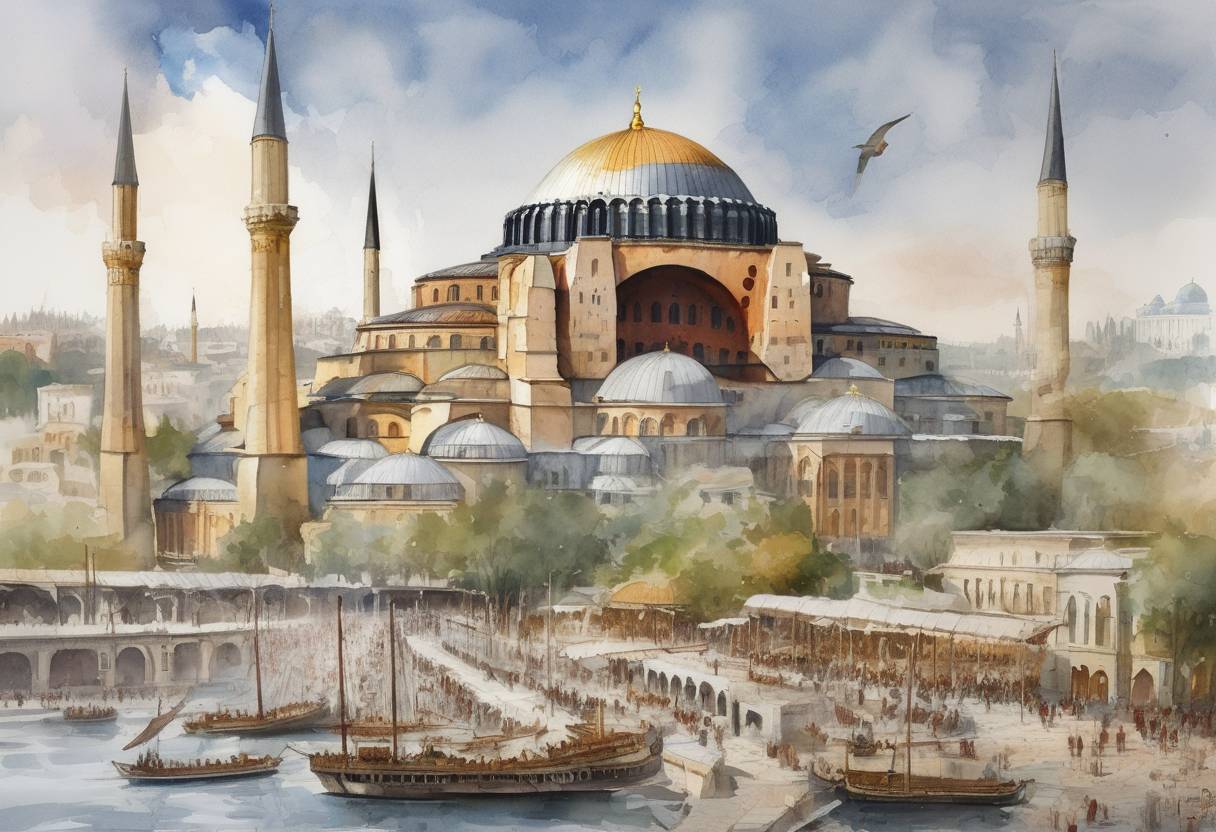
The Consecration of the Hagia Sophia: December 27, 537
On December 27, 537, the Hagia Sophia, one of the most iconic architectural marvels of the Byzantine Empire, was consecrated as a cathedral by Emperor Justinian I in Constantinople, present-day Istanbul, Turkey. This event marked a significant moment in both religious and architectural history.
Historical Context
Emperor Justinian I: Reigning from 527 to 565, Justinian I was a Byzantine emperor known for his ambitious projects, including the codification of Roman law (Corpus Juris Civilis) and extensive building programs. His reign is often seen as a period of cultural and political renaissance for the Byzantine Empire.
Previous Structures: The site of the Hagia Sophia had previously hosted two churches, both of which were destroyed. The first church, known as the Megale Ekklesia, was built by Emperor Constantius II in 360 but was burned down during riots in 404. The second church was constructed by Emperor Theodosius II in 415 and was also destroyed during the Nika Riots of 532.
Construction of the Hagia Sophia
Architectural Innovation: Commissioned by Justinian I, the Hagia Sophia was designed by the mathematician Anthemius of Tralles and the physicist Isidore of Miletus. The construction began in 532 and was completed in just five years, an impressive feat for the time.
Design and Structure: The Hagia Sophia is renowned for its massive dome, which was an engineering marvel of its time. The dome’s innovative design allowed it to appear as if it were suspended from heaven, a feature that has captivated visitors for centuries. The building combines a longitudinal basilica and a centralized building in a wholly original manner, with a vast nave covered by the central dome.
Consecration Ceremony
Religious Significance: The consecration of the Hagia Sophia as a cathedral symbolized the power and religious devotion of the Byzantine Empire. It served as the cathedral of Constantinople and the center of Eastern Orthodox Christianity for nearly a thousand years.
Cultural Impact: The Hagia Sophia was not only a religious center but also a symbol of the Byzantine Empire’s wealth and artistic achievement. Its influence extended beyond the Byzantine world, inspiring architectural styles in both the Islamic and Western Christian worlds.
Aftermath and Legacy
Transformation Over Time: After the Ottoman conquest of Constantinople in 1453, the Hagia Sophia was converted into a mosque by Sultan Mehmed II. It remained a mosque until 1935, when it was secularized and turned into a museum by the Republic of Turkey. In 2020, it was reconverted into a mosque.
Architectural Influence: The Hagia Sophia has influenced countless structures, including the Blue Mosque in Istanbul and the Basilica of San Marco in Venice. Its architectural and cultural legacy continues to be a subject of study and admiration.
The consecration of the Hagia Sophia on December 27, 537, stands as a testament to the ingenuity and vision of the Byzantine Empire, leaving an indelible mark on the history of architecture and religion.