Election of Stefan Batory as King of Poland
1576 · Warsaw, Poland
Stefan Batory is elected King of Poland, marking a significant moment in Polish history as he became a notable ruler who strengthened the Polish-Lithuanian Commonwealth.
July 1, 1569
The Union of Lublin is signed, merging the Kingdom of Poland and the Grand Duchy of Lithuania into the Polish-Lithuanian Commonwealth.
Lublin, Poland | Polish-Lithuanian Commonwealth
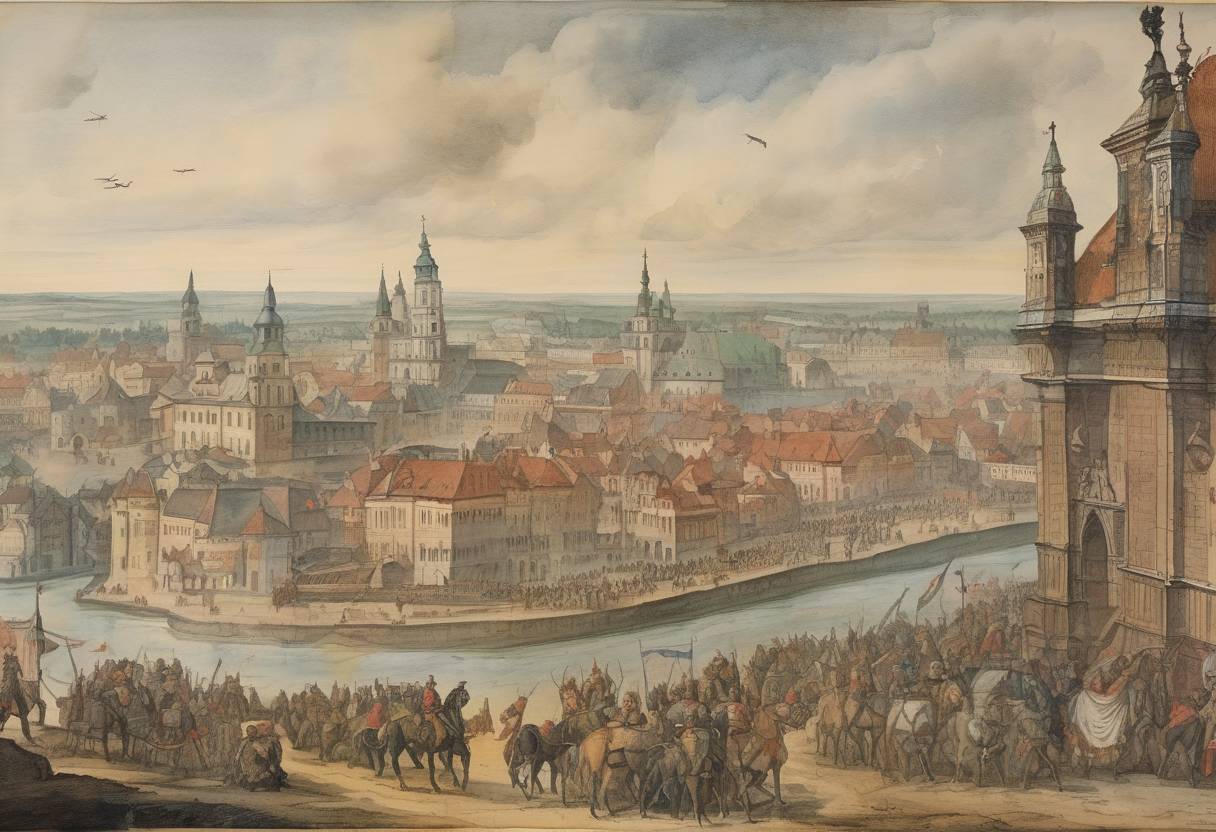
The Union of Lublin was a pivotal event in European history, marking the formal merger of the Kingdom of Poland and the Grand Duchy of Lithuania into a single political entity known as the Polish-Lithuanian Commonwealth. This union was the culmination of a series of alliances and personal unions between the two states that had been in place since the late 14th century.
Personal Union of 1386: The marriage of Queen Jadwiga of Poland and Grand Duke Jogaila of Lithuania in 1386 initiated a personal union between the two nations. Jogaila converted to Christianity, becoming King Władysław II Jagiełło of Poland.
Growing Threats: By the mid-16th century, both Poland and Lithuania faced increasing threats from neighboring powers, particularly the Muscovite state (Russia) and the Teutonic Knights. A closer political union was seen as a strategic necessity to bolster defenses.
Internal Pressures: Within the Grand Duchy of Lithuania, there was pressure from the nobility to gain the same privileges enjoyed by the Polish nobility, which included greater political influence and autonomy.
Negotiations: The Sejm (parliament) convened in Lublin in 1569 to negotiate the terms of the union. The discussions were contentious, with significant resistance from the Lithuanian nobility.
Terms of the Union: The Union of Lublin established a single elective monarchy, a common parliament (Sejm), and a shared foreign policy. However, both Poland and Lithuania retained separate armies, treasuries, and legal systems.
Significance: The union created one of the largest and most populous states in Europe at the time, stretching from the Baltic Sea to the Black Sea. It was characterized by a unique political system that combined elements of federation and confederation.
Cultural and Political Impact: The Polish-Lithuanian Commonwealth became a significant cultural and political force in Europe. It was known for its religious tolerance and a relatively democratic political system for its time, with a strong influence of the nobility.
Decline and Partition: Despite its initial success, the Commonwealth faced internal strife and external pressures over the centuries. It eventually declined and was partitioned by neighboring powers (Russia, Prussia, and Austria) in the late 18th century, leading to its dissolution.
The Union of Lublin is often cited as an early example of a constitutional monarchy and a precursor to modern federal states. It demonstrated the potential for diverse nations to coexist under a unified political framework, influencing future political unions and federations.
The Polish-Lithuanian Commonwealth’s legacy is evident in the cultural and historical ties that continue to link Poland and Lithuania today.
Source: en.wikipedia.org