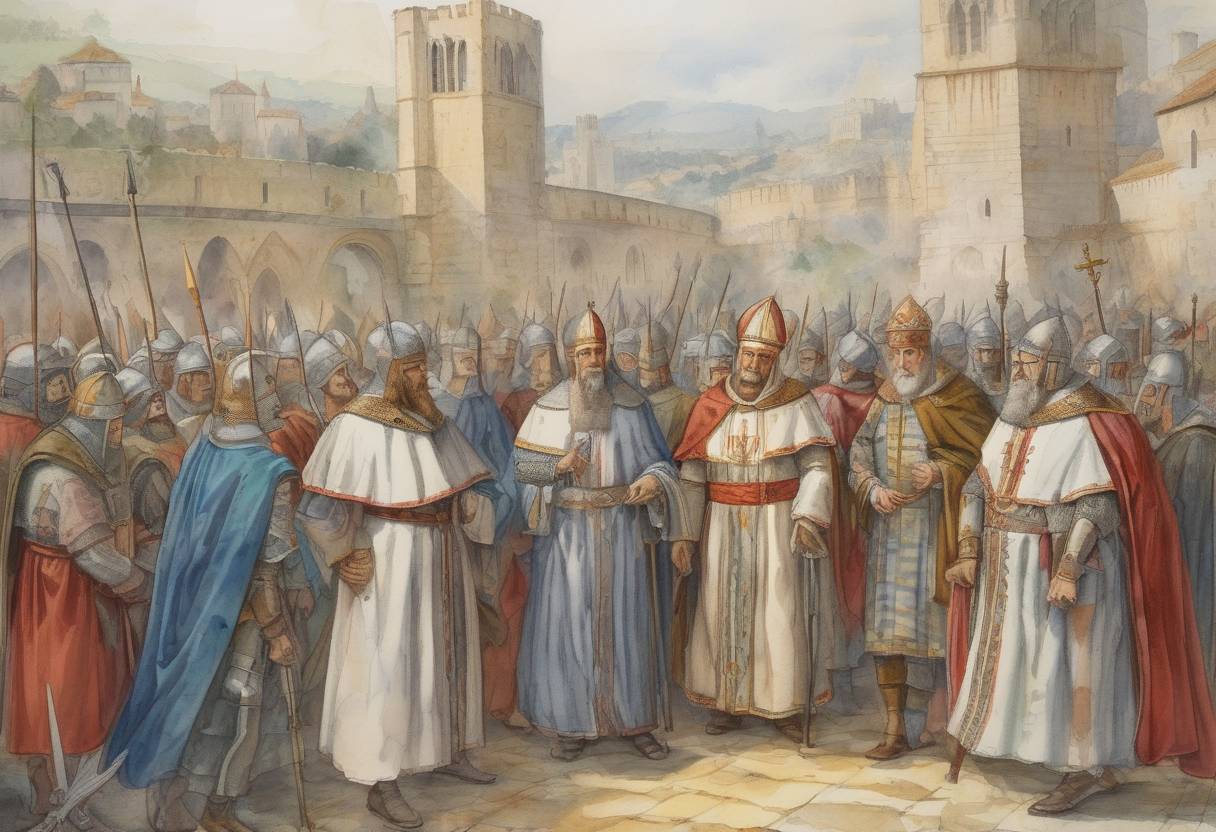
The Council of Clermont and the Call for the First Crusade
On November 27, 1095, Pope Urban II delivered a momentous speech at the Council of Clermont in France, which would have far-reaching consequences for both Europe and the Middle East. This event marked the official call for the First Crusade, urging Christians to reclaim the Holy Land from Muslim control.
Context Leading to the Council
The late 11th century was a period of significant religious and political tension. The Byzantine Empire, under Emperor Alexios I Komnenos, was facing increasing pressure from the Seljuk Turks, who had captured much of Anatolia following the Battle of Manzikert in 1071. In a bid to reclaim lost territories and stabilize his empire, Alexios appealed to the West for military assistance.
Meanwhile, Europe was experiencing a period of relative stability and growth, with a burgeoning population and increased religious fervor. The Catholic Church, under the leadership of Pope Urban II, sought to unify Christendom and extend its influence. The idea of a holy war to reclaim Jerusalem and aid fellow Christians in the East resonated deeply with the religious and martial spirit of the time.
The Council of Clermont
The Council of Clermont was convened by Pope Urban II in November 1095, initially to address church reform and other ecclesiastical matters. However, it was during this council that Urban delivered his famous sermon, calling for a crusade to the Holy Land.
Key Points of Urban’s Speech
Religious Motivation: Urban framed the crusade as a penitential act, promising spiritual rewards, including the remission of sins, for those who took up the cross.
Aid to Byzantium: He emphasized the need to assist the Byzantine Empire against Muslim forces, portraying the crusade as a defensive action to protect fellow Christians.
Liberation of Jerusalem: Urban highlighted the religious significance of Jerusalem and the Holy Land, urging Christians to liberate these sacred sites from Muslim control.
Unity of Christendom: The crusade was also presented as an opportunity to unite the warring factions of Europe under a common cause, redirecting their martial energies towards a holy mission.
Aftermath and Consequences
The response to Urban’s call was overwhelming. Thousands of knights, nobles, and commoners took up the cross, motivated by religious zeal, the promise of adventure, and potential material gain. This marked the beginning of the First Crusade, which would lead to the capture of Jerusalem in 1099 and the establishment of several Crusader states in the Levant.
The First Crusade had profound and lasting impacts:
- Cultural Exchange: It initiated a period of increased contact between the Western and Eastern worlds, leading to cultural and technological exchanges.
- Religious Tensions: The crusades intensified Christian-Muslim hostilities, with repercussions that echoed through the centuries.
- Political Dynamics: The establishment of Crusader states altered the political landscape of the Middle East and influenced European politics.
Pope Urban II’s call at Clermont was a pivotal moment in medieval history, setting the stage for centuries of crusading activity and shaping the religious and political contours of the medieval world.