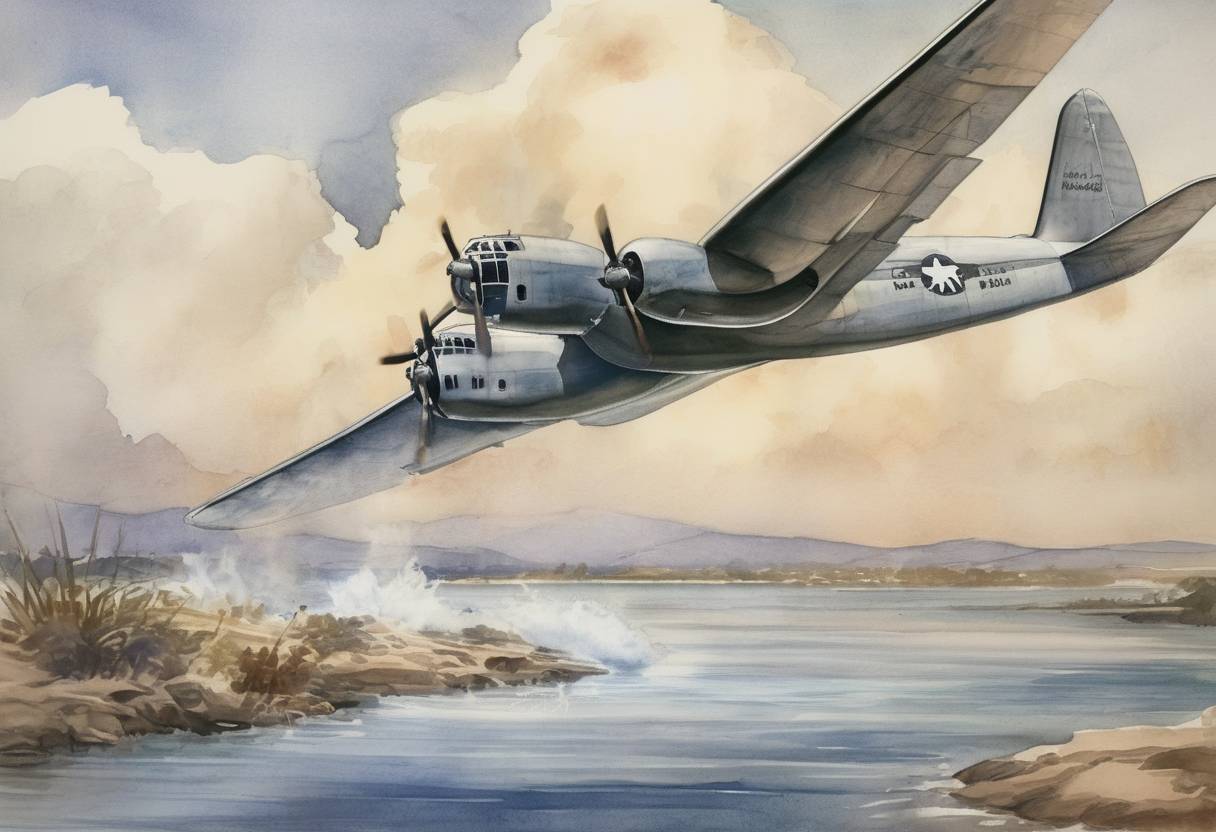
The Maiden Flight of the Hughes H-4 Hercules (“Spruce Goose”)
On November 2, 1947, Howard Hughes piloted the maiden—and only—flight of the Hughes H-4 Hercules, an event that has since become a legendary moment in aviation history. The aircraft, more commonly known as the “Spruce Goose,” was an ambitious project that symbolized both the innovative spirit and the challenges of wartime production.
Background
The Hughes H-4 Hercules was conceived during World War II as a response to the need for a large cargo-type aircraft capable of transporting troops and materials across the Atlantic Ocean. The U.S. government commissioned the project in 1942, with the goal of creating an aircraft that could bypass the threat posed by German U-boats to traditional sea routes.
Design and Construction
- Material Choice: Due to wartime restrictions on metals, the aircraft was constructed primarily from wood, specifically birch, despite its nickname “Spruce Goose.”
- Size and Specifications: The H-4 was designed to be the largest flying boat ever built, with a wingspan of 320 feet (97.5 meters) and a length of 218 feet (66.6 meters). It was powered by eight Pratt & Whitney R-4360 Wasp Major radial engines.
The Flight
The flight took place in Long Beach, California. Despite skepticism about the aircraft’s ability to fly, Howard Hughes, who was both the designer and the pilot, was determined to prove its capabilities.
- Flight Details: The flight lasted approximately 26 seconds and covered about one mile (1.6 kilometers) at an altitude of 70 feet (21 meters) above the water.
- Crew and Observers: The flight was witnessed by a crew of 32 and a group of invited guests, including journalists and aviation experts.
Aftermath and Significance
- Public Perception: The flight was met with mixed reactions. While some hailed it as a triumph of engineering, others criticized it as an extravagant folly.
- Legacy: Despite its brief flight, the H-4 Hercules remains an iconic symbol of innovation and ambition. It never flew again and was eventually placed on display at the Evergreen Aviation & Space Museum in McMinnville, Oregon.
Broader Historical Impact
The “Spruce Goose” represents the challenges of wartime innovation and the post-war shift in aviation technology. It stands as a testament to Howard Hughes’ vision and the era’s industrial capabilities, highlighting the tension between ambition and practicality in technological advancements.
In conclusion, the maiden flight of the Hughes H-4 Hercules on November 2, 1947, remains a remarkable episode in aviation history, capturing the imagination of generations and underscoring the complexities of wartime production and innovation.