Operation Banner: The End of a 38-Year Mission
2007 · Belfast, United Kingdom
Operation Banner, the British Army's longest continuous operation, officially ends in Northern Ireland after 38 years.
July 27, 2005
The Provisional Irish Republican Army (IRA) announced an end to its armed campaign, stating it would pursue its aims through peaceful means, marking a significant step in the Northern Ireland peace process.
Belfast, United Kingdom | Provisional Irish Republican Army
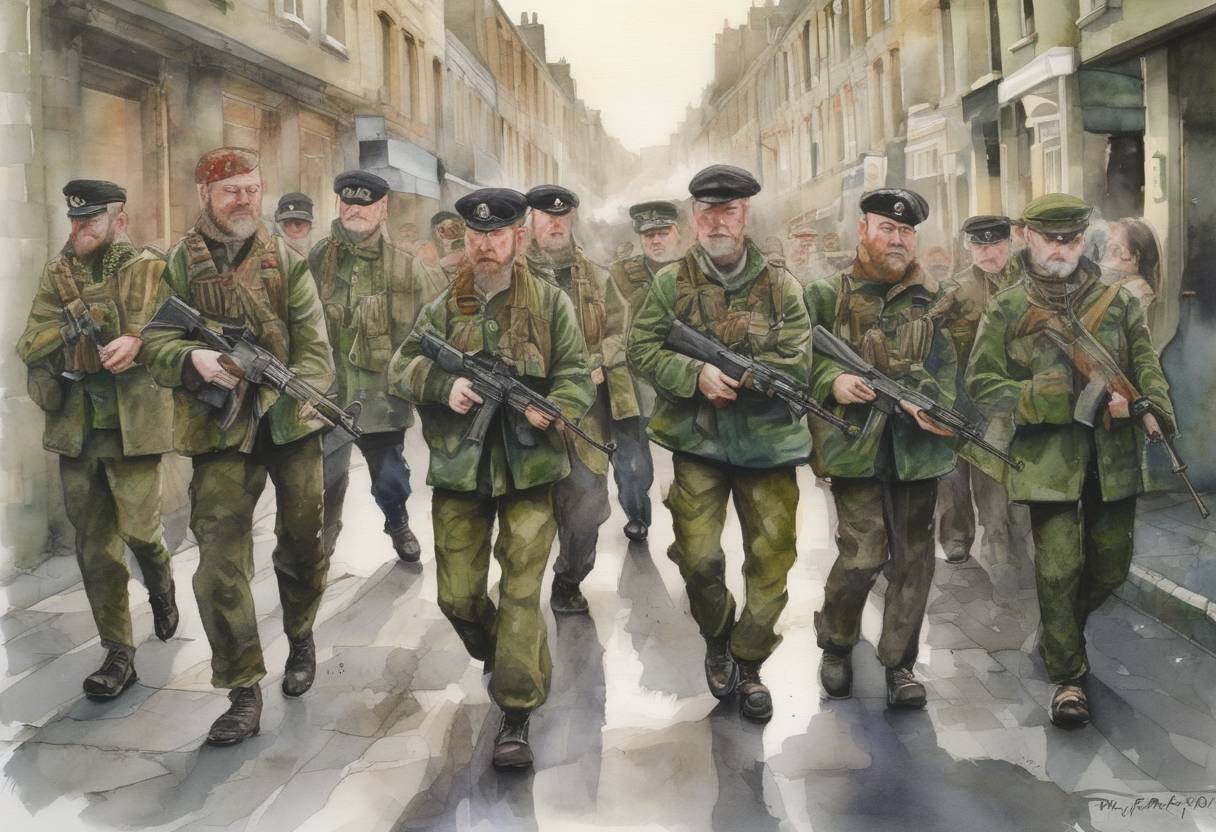
On July 27, 2005, the Provisional Irish Republican Army (IRA) made a historic announcement that marked a pivotal moment in the Northern Ireland peace process. The organization declared an end to its armed campaign, committing to pursue its objectives through exclusively peaceful and democratic means. This decision was a significant step forward in the efforts to resolve the long-standing conflict in Northern Ireland, known as “The Troubles.”
The IRA was founded in 1969 as a paramilitary organization seeking to end British rule in Northern Ireland and to reunify Ireland. Over the decades, the IRA engaged in a violent campaign against British forces and those it considered collaborators, resulting in thousands of deaths and widespread destruction.
The Troubles, which began in the late 1960s, were characterized by violent clashes between nationalist/republican communities (predominantly Catholic) who sought unification with the Republic of Ireland, and unionist/loyalist communities (predominantly Protestant) who wanted Northern Ireland to remain part of the United Kingdom.
Efforts to bring peace to Northern Ireland gained momentum in the 1990s. The Good Friday Agreement, signed in 1998, was a major milestone in the peace process, establishing a devolved government and laying the groundwork for disarmament and reconciliation. However, the full implementation of the agreement faced numerous challenges, including the issue of decommissioning weapons held by paramilitary groups.
On July 27, 2005, the IRA issued a statement declaring the end of its armed campaign. The statement was read by actor Brendan Gleeson and broadcast on television. The IRA instructed its units to dump arms and cease all military operations. The organization emphasized its commitment to achieving its goals through peaceful and democratic means, signaling a shift from its previous reliance on armed struggle.
The IRA’s decision to end its armed campaign was widely welcomed by political leaders and communities across Northern Ireland and beyond. It was seen as a crucial step in consolidating the peace process and building trust among the various factions involved.
The announcement paved the way for further political progress, including the eventual decommissioning of IRA weapons, verified by independent monitors. It also contributed to the normalization of political life in Northern Ireland, allowing for more stable governance and cooperation between former adversaries.
The end of the IRA’s armed campaign marked a turning point in the history of Northern Ireland, demonstrating the potential for conflict resolution through dialogue and negotiation. It underscored the importance of political engagement and compromise in achieving lasting peace.
The IRA’s declaration on July 27, 2005, was a landmark event in the Northern Ireland peace process. It reflected the broader shift towards peaceful resolution of conflicts and highlighted the transformative power of diplomacy and political will in overcoming deep-seated divisions. The legacy of this decision continues to influence the ongoing efforts to maintain peace and reconciliation in Northern Ireland.
Source: en.wikipedia.org