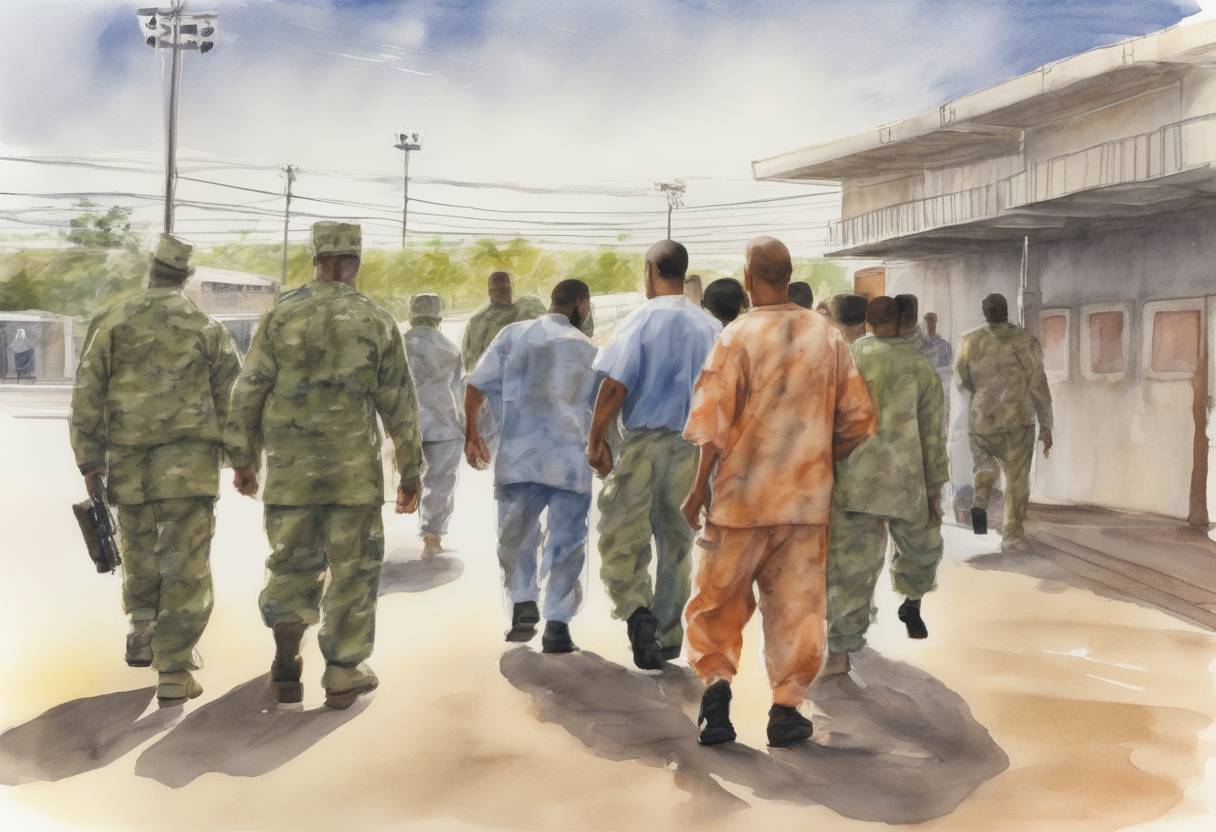
Arrival of the First Detainees at Guantanamo Bay Detention Camp
On January 11, 2002, the first group of detainees arrived at the Guantanamo Bay detention camp, a U.S. military prison located at the Guantanamo Bay Naval Base in Cuba. This event marked the beginning of a controversial chapter in the United States’ response to the global War on Terror, initiated in the aftermath of the September 11, 2001, terrorist attacks.
Context and Background
War on Terror: Following the 9⁄11 attacks, the U.S. launched the War on Terror, targeting terrorist organizations like al-Qaeda and the Taliban. The military operations began with the invasion of Afghanistan in October 2001, aiming to dismantle al-Qaeda and remove the Taliban from power.
Establishment of Guantanamo Bay: The U.S. government sought a location to detain and interrogate individuals captured during these operations. Guantanamo Bay was chosen due to its extraterritorial status, which the U.S. believed would place detainees outside the jurisdiction of U.S. courts.
Key Events on January 11, 2002
Arrival of Detainees: The first 20 detainees were flown to Guantanamo Bay from Afghanistan. They were housed in temporary facilities known as “Camp X-Ray,” which consisted of open-air cages.
Purpose: The camp was intended to hold individuals deemed “enemy combatants,” a designation used to justify indefinite detention without trial. The U.S. government argued that these detainees posed a significant threat to national security.
Controversies and Consequences
Legal and Human Rights Issues: The detention camp quickly became a focal point for legal and human rights debates. Critics argued that the indefinite detention without trial violated international law, including the Geneva Conventions.
Interrogation Techniques: Reports of harsh interrogation techniques, which some classified as torture, drew widespread condemnation from human rights organizations and international bodies.
Judicial Challenges: Over the years, several legal challenges were brought before U.S. courts, questioning the legality of the detentions and the treatment of detainees. Notably, the U.S. Supreme Court ruled in cases like Rasul v. Bush (2004) and Boumediene v. Bush (2008) that detainees had the right to challenge their detention in U.S. courts.
Broader Historical Significance
Impact on U.S. Reputation: The existence and practices of Guantanamo Bay have had lasting impacts on the U.S.’s international reputation, affecting its relationships with allies and its moral authority on human rights issues.
Ongoing Debate: As of 2023, Guantanamo Bay remains operational, though the number of detainees has significantly decreased. The debate over its closure and the future of its remaining detainees continues to be a contentious issue in U.S. politics.
The arrival of the first detainees at Guantanamo Bay on January 11, 2002, set the stage for ongoing debates about national security, human rights, and the rule of law in the context of global counterterrorism efforts.