The Voluntary Abdication of Roman Emperors Diocletian and Maximian on May 1, 305
305 · Nicomedia, Roman Empire
Roman Emperors Diocletian and Maximian retire from office, marking the first voluntary abdication of Roman emperors in history.
May 4, 0305
Roman Emperors Diocletian and Maximian retire from office, marking the first voluntary abdication of Roman emperors and leading to the establishment of the Tetrarchy system.
Nicomedia, Roman Empire | Roman Empire
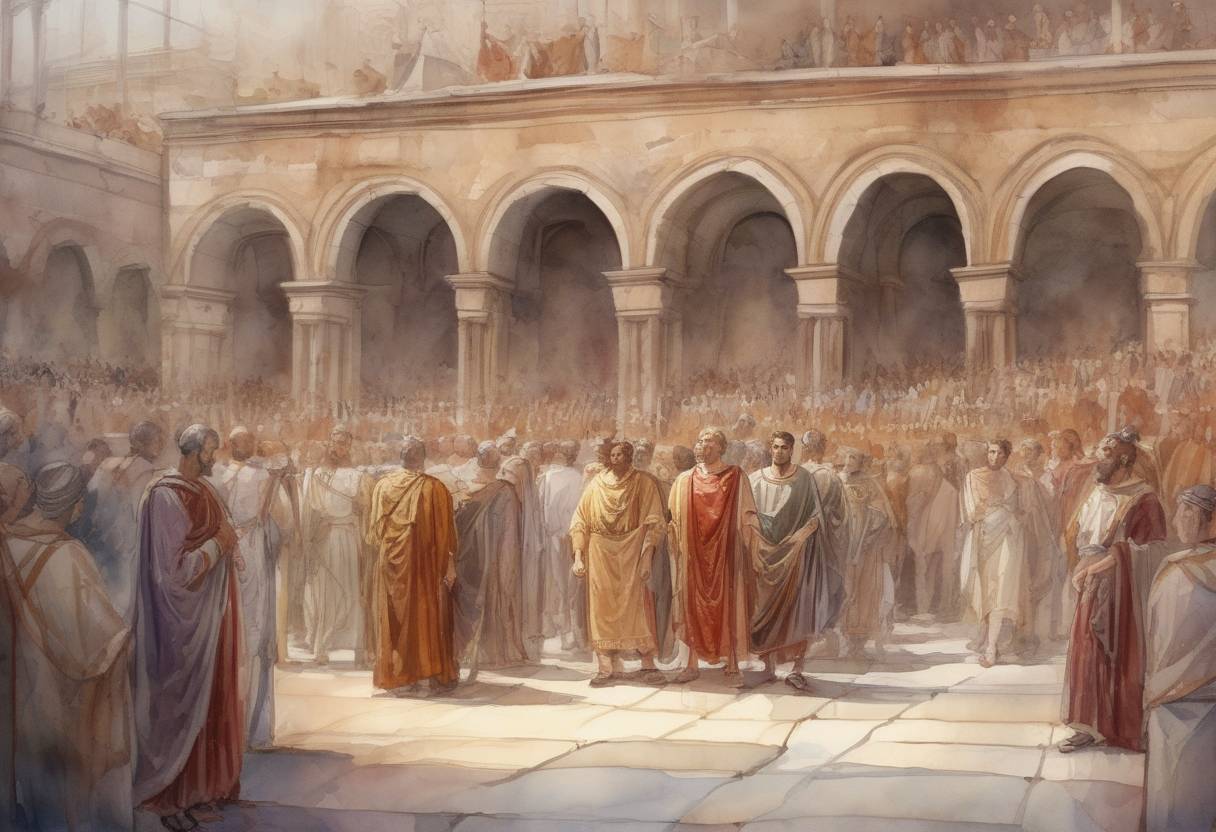
On May 1, 305, a significant event unfolded in the Roman Empire that marked a turning point in its governance: the voluntary abdication of Roman Emperors Diocletian and Maximian. This unprecedented move not only demonstrated a rare instance of voluntary power relinquishment in ancient Rome but also solidified the Tetrarchy system, a novel administrative structure designed to bring stability to the empire.
Before Diocletian’s rise to power, the Roman Empire had endured the Crisis of the Third Century, a period characterized by political instability, economic turmoil, and external threats. The empire was plagued by rapid turnover of emperors, with many ascending to power through military coups.
Diocletian became emperor in 284 AD and initiated a series of reforms to restore order and stability. Recognizing the vastness and complexity of the empire, he introduced the Tetrarchy in 293 AD, dividing the empire into two halves, each governed by an Augustus (senior emperor) and a Caesar (junior emperor). Diocletian ruled the Eastern Roman Empire, while Maximian, his trusted colleague, governed the West.
On May 1, 305, Diocletian and Maximian abdicated simultaneously. Diocletian retired to his palace in Split, modern-day Croatia, while Maximian withdrew to a villa in southern Italy. This dual abdication was a carefully orchestrated event, symbolizing the peaceful transition of power and the strength of the Tetrarchic system.
Following their abdication, the Caesars, Galerius and Constantius Chlorus, were elevated to the rank of Augustus. Two new Caesars were appointed: Maximinus Daia in the East and Severus in the West. This ensured a continuity of leadership and reinforced the Tetrarchic structure.
The Tetrarchy initially brought a measure of stability to the Roman Empire, as it allowed for more efficient governance and defense against external threats. However, the system was heavily reliant on the cooperation and mutual respect among the emperors, which proved challenging after Diocletian’s retirement.
Despite its initial success, the Tetrarchy began to unravel after Diocletian’s abdication. Power struggles and civil wars emerged as various claimants vied for control. By 324 AD, Constantine the Great had emerged victorious, reunifying the empire under a single ruler and effectively ending the Tetrarchic experiment.
Diocletian’s abdication and the establishment of the Tetrarchy were pivotal in the evolution of Roman imperial governance. They highlighted the need for administrative innovation in managing a vast empire and set a precedent for the division of power. Although the Tetrarchy ultimately failed, it paved the way for future reforms and the eventual transformation of the Roman Empire.
In conclusion, the voluntary abdication of Diocletian and Maximian on May 1, 305, was a landmark event in Roman history, reflecting both the challenges and the ingenuity of imperial administration during a time of great complexity and change.
Source: en.wikipedia.org