Thomas Edison's Demonstration of Incandescent Lighting
1879 · Menlo Park, United States
Thomas Edison demonstrated incandescent lighting to the public for the first time in Menlo Park, New Jersey, revolutionizing the use of electric light.
May 13, 1880
Thomas Edison performs the first test of his electric railway in Menlo Park, New Jersey. This innovation contributed to the development of electric transportation systems.
Menlo Park, United States | Edison Electric Light Company
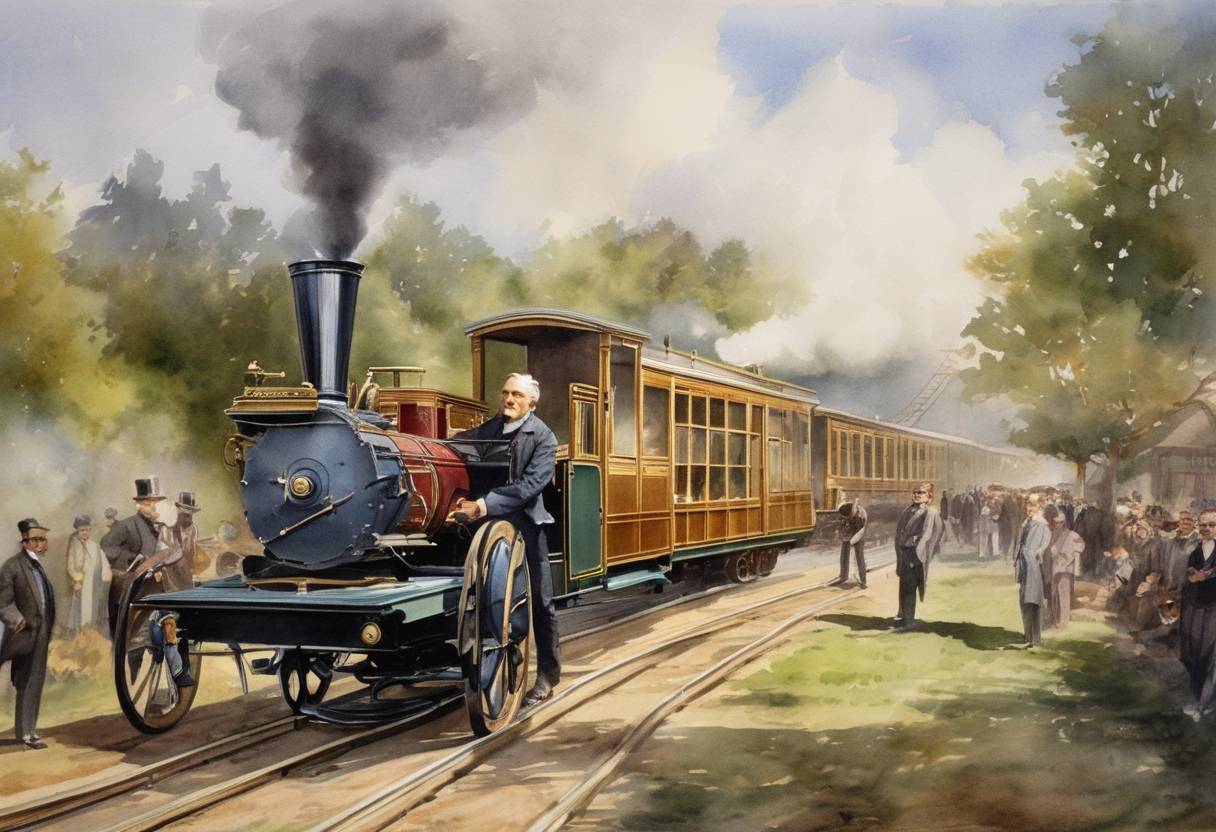
On May 13, 1880, renowned inventor Thomas Edison conducted the first test of his electric railway at Menlo Park, New Jersey. This pioneering event marked a significant step forward in the development of electric transportation systems, showcasing the potential for electricity as a viable means to power rail operations.
Edison’s work in electric railways followed his successful ventures in electric lighting and power distribution. Concurrently, the late 19th century saw rapid advancements in electrical engineering, driven by the need for efficient and cleaner transportation alternatives. Edison recognized the potential of electric propulsion to revolutionize transportation, given its advantages over steam-powered systems, such as reduced emissions and lower operational costs.
The initial railway test involved a short track laid out at Edison’s laboratory site in Menlo Park. The system was powered by a small dynamo, which served as the electricity generator, supplying current via a third rail to a specially designed locomotive. Edison’s electric locomotive itself was relatively rudimentary by modern standards but an essential prototype for future developments.
The successful demonstration underscored the feasibility of electric rail transportation and hinted at future applications in urban transit and long-distance travel. Edison’s electric railway test influenced subsequent electrification projects in cities worldwide, leading to the eventual obsolescence of steam-powered urban transport networks.
Edison’s experiments laid foundational principles for electrical engineering, directly impacting the rise of electric trolley systems and the electrification of railways. Although not as commercially successful as some of his other inventions, his work in this field undeniably contributed to the eventual adoption and expansion of electric rail transport systems, reshaping global transit infrastructures.
Through the innovation tested on that pivotal day in May 1880, Thomas Edison inspired a transformation in how people and goods could be moved, heralding an era of cleaner, more efficient transportation solutions.
Source: edison.rutgers.edu