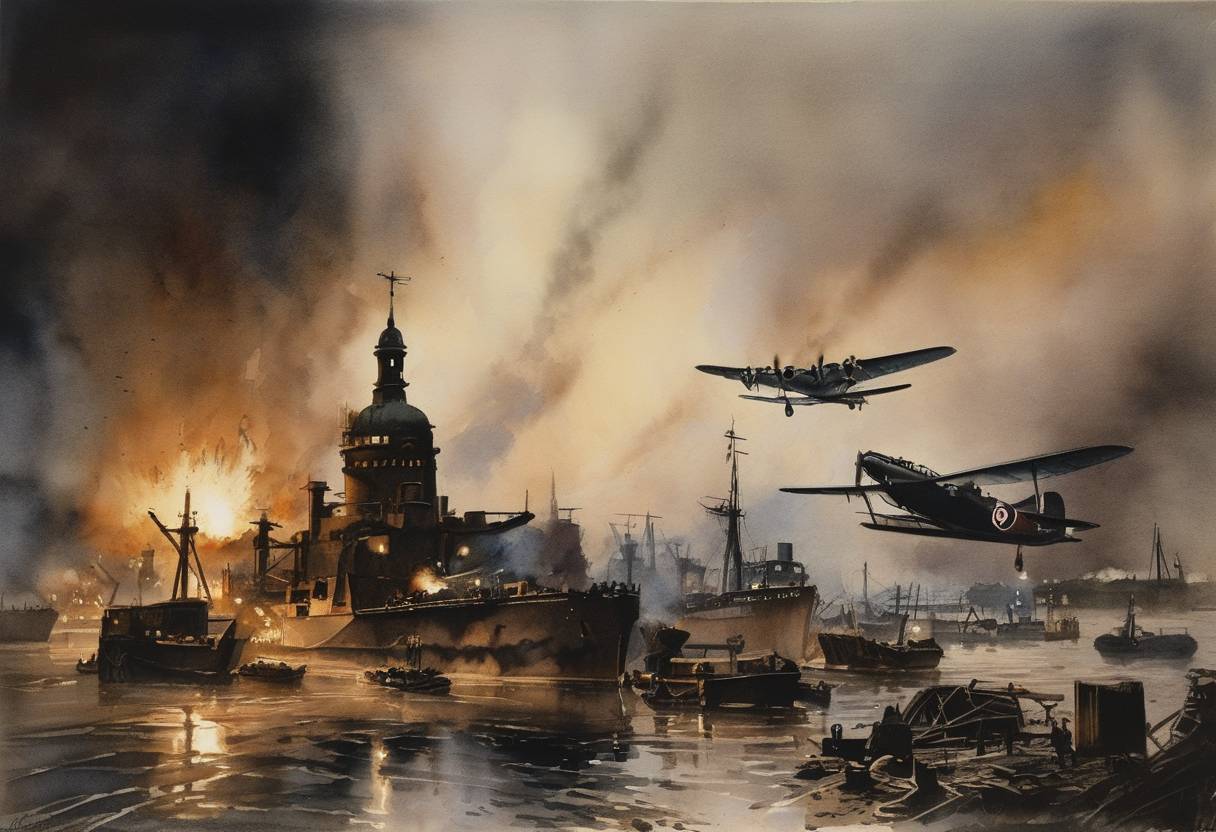
Operation Gomorrah: Bombing of Hamburg Begins
On the evening of July 24, 1943, Operation Gomorrah commenced, marking the start of one of the most devastating series of air raids of World War II. This operation involved a coordinated bombing offensive against the German city of Hamburg, executed by the Royal Air Force (RAF) by night and the United States Army Air Forces (USAAF) by day. It was the first operation of its kind designed to systematically obliterate an entire city.
Background
Operation Gomorrah was planned as part of the Allied strategic bombing campaign against Nazi Germany. By mid-1943, the war had reached a point where the Allies sought to weaken German morale and cripple their industrial capabilities. Hamburg, as Germany’s second-largest city and a major industrial center, was chosen as a strategic target due to its significant contribution to the German war effort.
The Bombing Campaign
Night of July 24, 1943
- Start of the Offensive: The operation began with a massive nighttime raid conducted by the RAF. Approximately 791 aircraft, including Lancasters, Halifaxes, and Wellingtons, were deployed to saturate the city with incendiaries and high-explosive bombs.
- Radar Jamming: The RAF utilized a new technology known as “Window,” which involved dropping strips of aluminum foil to confuse German radar systems. This innovation significantly reduced the effectiveness of German anti-aircraft defenses.
Subsequent Daylight Bombing
- Continuing Assault: Following the initial nighttime attack, American bombers carried out daylight raids. The USAAF B-17 Flying Fortresses directed their efforts towards specific industrial targets in and around Hamburg, contributing to the sustained destruction of the city.
Consequences and Aftermath
- Creation of the Firestorm: The consecutive days of bombing resulted in a firestorm, with temperatures reaching upwards of 800 degrees Celsius. This catastrophic event caused enormous destruction and chaos, leading to the deaths of tens of thousands of civilians and the displacement of hundreds of thousands more.
- Strategic Impact: Operation Gomorrah had a profound psychological and economic impact. It demonstrated the destructive potential of sustained bombing campaigns and shifted German resources towards defending their cities.
Historical Significance
Operation Gomorrah was significant for its unprecedented scale and the introduction of strategic innovations that influenced subsequent Allied bombing strategies. It marked a turning point in the air war over Europe, leading to increased focus on bombing campaigns to hasten the defeat of Nazi Germany.
The devastation of Hamburg also raised ethical questions about civilian targeting in warfare, influencing post-war discussions on military strategy and international law regarding the conduct of war.