Nuclear Testing at Enewetak Atoll - October 5, 1951
1951 · Enewetak Atoll, Marshall Islands
The first North Pole nuclear test close to Enewetak Atoll is conducted by the United States, marking an important moment in Cold War military history.
March 1, 1954
The United States carried out the Castle Bravo nuclear test at Bikini Atoll in the Marshall Islands, leading to significant radioactive fallout and international controversy.
Bikini Atoll, Marshall Islands | United States Atomic Energy Commission
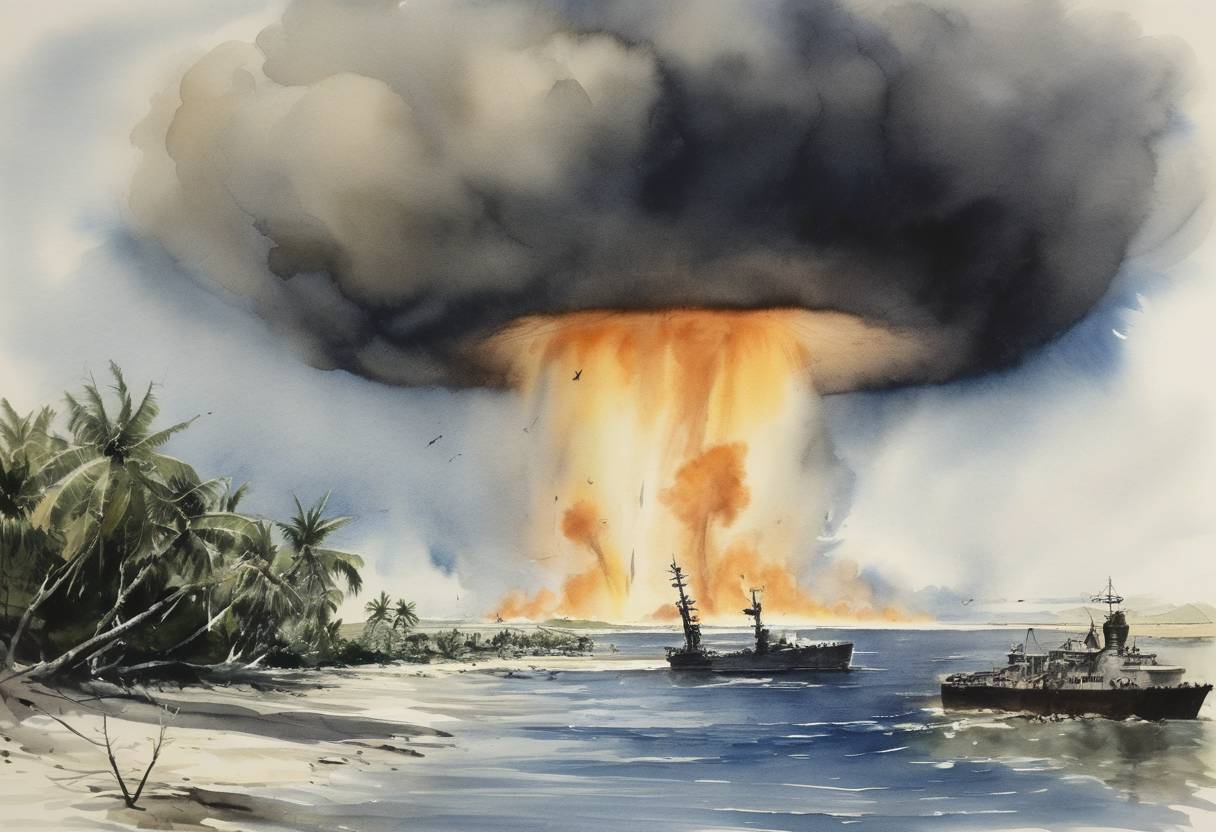
On March 1, 1954, the United States conducted the Castle Bravo nuclear test on Bikini Atoll in the Marshall Islands. This test was part of Operation Castle, a series of high-yield thermonuclear weapon design tests by the United States.
The development of nuclear weapons accelerated significantly post-World War II, with both the United States and the Soviet Union seeking to expand their nuclear arsenals. Castle Bravo was a major focus of the U.S. effort to produce a deliverable thermonuclear weapon, or hydrogen bomb, following the success of the first U.S. hydrogen bomb test, Ivy Mike, in November 1952.
Castle Bravo marked the first test of a new dry fuel thermonuclear device, codenamed the Shrimp. Unlike earlier designs that used liquid deuterium, this device utilized lithium deuteride as its fuel, enabling a more portable and practical weapon.
The device was detonated on a coral reef at Bikini Atoll, a remote site chosen for its isolation from populated areas due to safety concerns. The test was expected to yield six megatons, but due to unexpected reactions in the lithium isotopes, it produced a yield of 15 megatons, making it the most powerful nuclear device ever detonated by the United States up to that time.
The unexpectedly high yield resulted in extensive radioactive fallout, which spread across a much larger area than anticipated. The fallout contaminated the surrounding atolls and affected islands as far as the Rongelap and Utirik Atolls. Additionally, a Japanese fishing vessel, the Daigo Fukuryū Maru (Lucky Dragon No. 5), was exposed to the fallout, which caused acute radiation sickness among its crew.
The contamination led to severe health issues in the affected populations, including radiation sickness and long-term ecological damage. The incident exposed safety shortcomings and increased global fears regarding atmospheric nuclear testing. It contributed significantly to international unrest and calls for nuclear disarmament, influencing public opinion and policymakers alike.
The Castle Bravo test and its fallout had significant political and humanitarian impacts. The controversy and criticism it generated were crucial in the development of the Partial Test Ban Treaty of 1963, which aimed to prohibit atmospheric nuclear tests. Furthermore, it contributed to heightened tensions during the Cold War, catalyzing movements that demanded greater transparency and international oversight of nuclear testing programs. The event remains a poignant example of the potential dangers of nuclear proliferation and the lasting consequences of its environmental and human impacts.
Source: www.atomicheritage.org