Coronation of Charles the Bald as Holy Roman Emperor
875 · Rome, Holy Roman Empire
Charles the Bald was crowned Emperor of the Holy Roman Empire by Pope John VIII, continuing the Carolingian dynasty's influence in Europe.
January 12, 1545
The Munster rebellion is quelled as the city falls to troops loyal to Prince-Bishop Franz von Waldeck.
Münster, Holy Roman Empire | Catholic Church
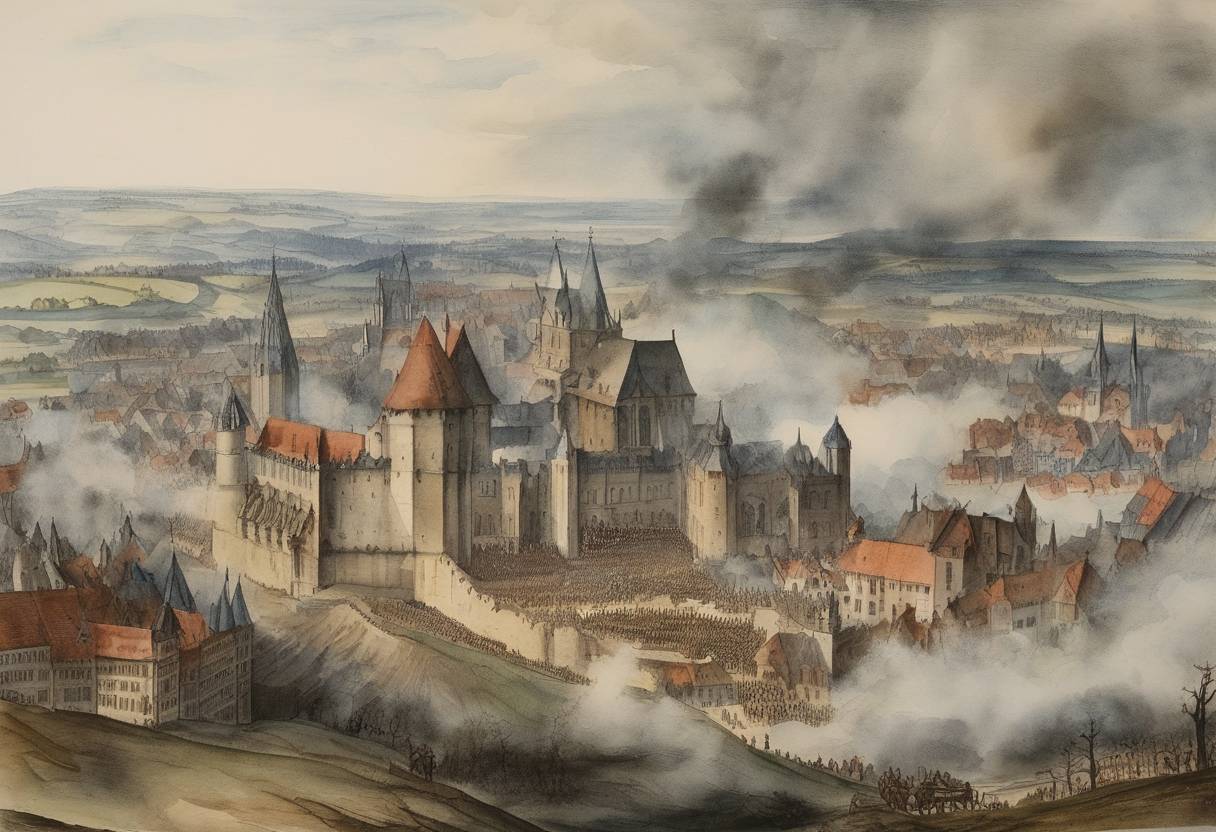
The Munster Rebellion, a pivotal episode in the wider context of the Protestant Reformation and radical religious movements in 16th-century Europe, reached its conclusive end on January 12, 1545. This conclusion came with the falling of the city of Münster, which was recaptured by forces loyal to the Prince-Bishop Franz von Waldeck. This event marked the suppression of a radical Anabaptist insurrection that had captured the imaginations of many as a symbol of revolutionary fervor and religious zeal.
The city of Münster, located in present-day Germany, became the epicenter of Anabaptist agitation in the early 1530s. Anabaptists, advocating for adult baptism and a radical restructuring of society, challenged both Catholic and emerging Protestant religious norms. The Anabaptist takeover of Münster in 1534, led by charismatic leaders like Jan Matthys and later, Jan van Leiden, sought to establish a “New Jerusalem.” This theocratic city forcefully implemented radical communal policies and rejected traditional hierarchies, prompting alarm among regional authorities.
Alarmed by the establishment of an Anabaptist stronghold, neighboring Catholic and Protestant rulers allied to dispatch a military response under the leadership of Prince-Bishop Franz von Waldeck. The siege of Münster commenced in 1534 but extended for over a year due to the city’s strong defenses and dedicated insurgents.
Continuous resistance finally waned due to starvation, internal dissent, and attrition within the besieged city. On January 12, 1545, Bishop Franz von Waldeck’s forces finally breached Münster’s defenses, effectively ending the rebellion. Capture and execution of the movement’s leaders followed, bringing a sobering close to this radical chapter in the Reformation period.
The fall of Münster quashed the immediate spread of Anabaptism and served as a cautionary tale for radical religious movements throughout Europe. In its aftermath, authorities across the continent became more cautious and wary of subversive sects, often leading to increased persecution of similar radical groups.
The Münster Rebellion highlighted the fragility and volatility of the religious and political landscape during the Reformation. While the city’s capture in 1545 marked the end for Anabaptist political aspirations in Münster, it also underscored the intense social dynamics of change characterizing this transformative era. The events in Münster remain a stark reminder of the period’s tumultuous quests for religious, social, and political reformation.
Source: en.wikipedia.org