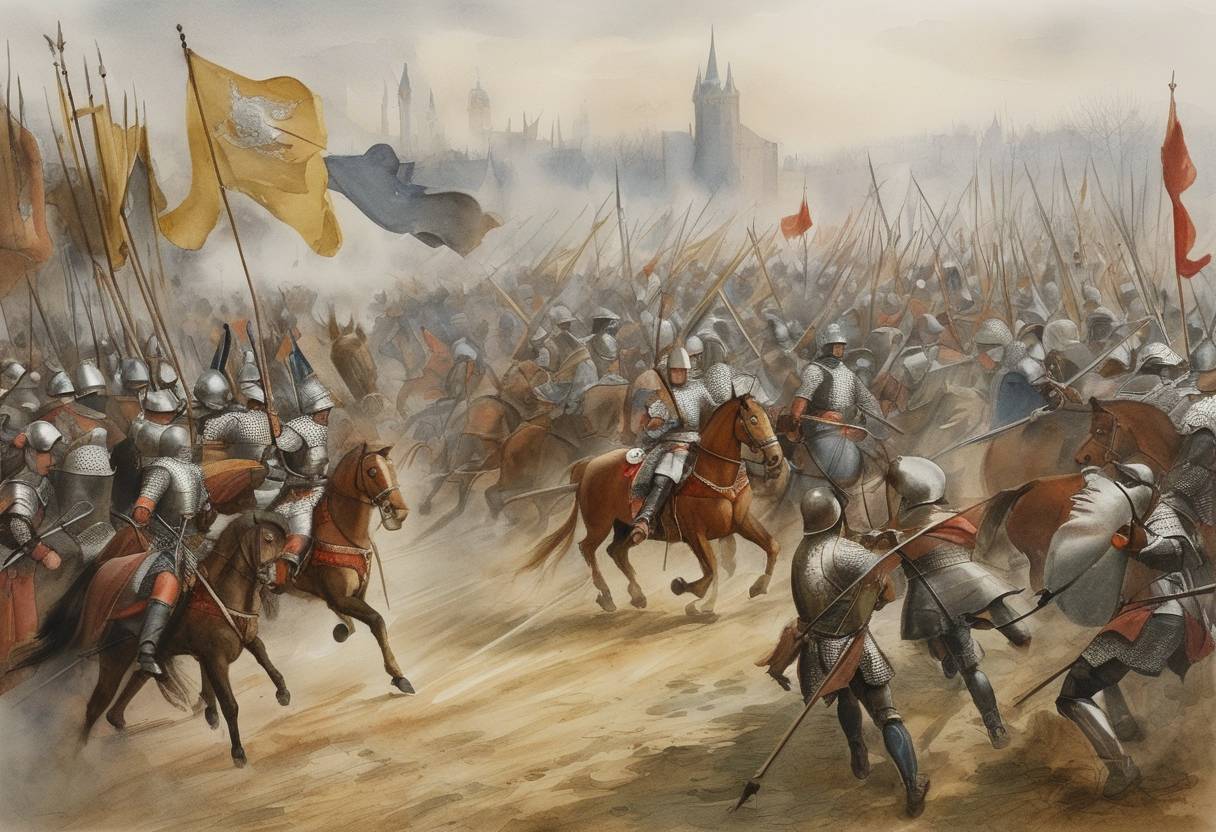
The Battle of the Golden Spurs did not take place on August 20, 1308. The battle actually occurred on July 11, 1302. Below is an account of the correct event.
The Battle of the Golden Spurs
Date and Location
The Battle of the Golden Spurs, also known as the Battle of Courtrai, took place on July 11, 1302, near Kortrijk in the County of Flanders (present-day Belgium).
Background
In the late 13th and early 14th century, the County of Flanders found itself in a turbulent period marked by conflict with the Kingdom of France. Tension arose from economic and political disputes, particularly due to the influence of the French crown over Flemish affairs. The Flemish population, especially the urban bourgeoisie and rural workers, harbored resentment against French rule.
The tension escalated into armed conflict when King Philip IV of France attempted to exert greater control over Flanders. In response, the Flemish towns, led primarily by Bruges and supported by local nobility and militia, rebelled against French annexation efforts.
Key Events
Flemish Insurrection: Prior Resentments led to an uprising in Bruges known as the “Bruges Matins,” which saw the massacre of French inhabitants and troops in May 1302. Buoyed by this success, the Flemish prepared to resist the French more formally.
Battle Formation: The French, aiming to quell the rebellion, dispatched a powerful army of knights and infantry under Count Robert II of Artois. The French forces were considered superior both in numbers and martial prowess.
The Battle: On July 11, near the town of Kortrijk, the Flemish infantry, largely composed of militias and guild members, confronted the heavily armored French knights. The terrain favored the Flemish, who used hidden pits and stakes to break the charge of the French cavalry—a tactic that contributed significantly to their victory.
Outcome: The battle resulted in a crippling defeat for the French, with thousands of French knights, including military leaders, killed. The Flemish captured a significant number of spurs from fallen knights, giving the battle its name.
Aftermath and Significance
Symbol of Resistance: The victory bolstered the Flemish position and became a potent symbol of popular resistance against feudal oppression. It was celebrated as a heroic triumph of common infantry over armored knight elites.
Political Consequences: In the immediate aftermath, Flanders regained its autonomy, though the struggle with France continued. The battle showcased the effectiveness of infantry armed with simple weapons against heavy cavalry, foreshadowing future shifts in military strategies during the Hundred Years’ War.
Legacy: The Battle of the Golden Spurs has since been memorialized in Flemish culture and serves as a landmark event in the region’s struggle for independence and self-determination. In Belgium, July 11 is celebrated as the Day of the Flemish Community.
The Battle of the Golden Spurs stands as a pivotal moment in medieval history, demonstrating the shifting dynamics of warfare and the rising clout of non-noble forces in European conflicts.