William Shakespeare: Birth and Early Life
1564 · Stratford-upon-Avon, England
William Shakespeare, the renowned English playwright and poet, was born in Stratford-upon-Avon.
November 24, 1572
The poet John Donne, known for his metaphysical poetry, was born in London, England. He later became a prominent English writer and cleric in the Church of England.
London, England
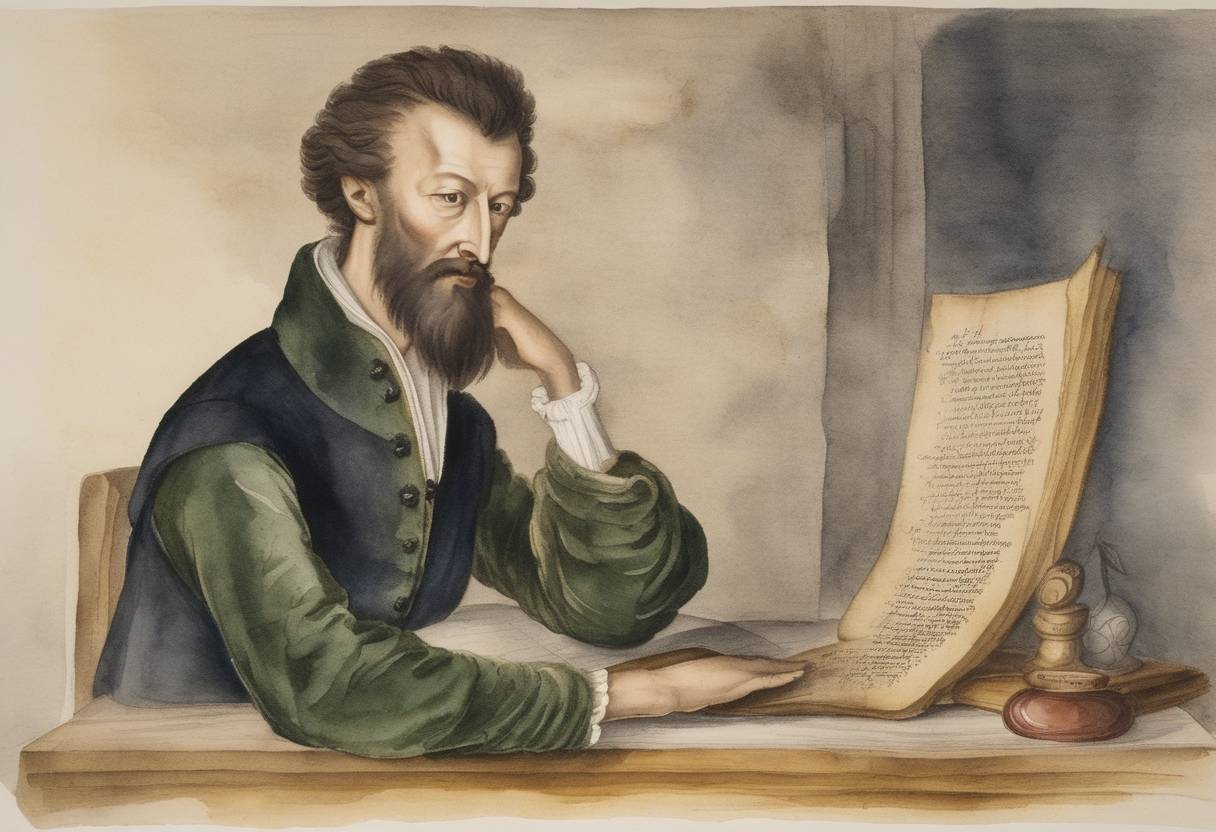
On November 24, 1572, John Donne, a key figure in English literature and a forefather of the metaphysical poetry movement, was born in London, England. Donne’s complex interplay of wit, emotion, and religious themes would come to define his writing and secure his place among the eminent poets of his era.
Donne was born into a Roman Catholic family in a time of religious conflict under the rule of Queen Elizabeth I. His family’s faith subjected them to significant societal pressures, which would later influence his poetic and clerical paths. Donne was well-educated, attending both Hart Hall, now Hertford College, Oxford, and later the University of Cambridge. However, he did not obtain a degree due to his refusal to take the Oath of Supremacy, required at the time for graduation, as it conflicted with his Catholic upbringing.
Donne initially pursued a career in law, studying at Lincoln’s Inn. However, his path changed dramatically following his conversion to Anglicanism, influenced by the political and religious climate in England. In his literary pursuits, Donne became known for his metaphysical poetry, characterized by its philosophical exploration of love, death, and religion, often employing complex imagery and metaphysical conceits.
His most famous works include “The Flea,” “A Valediction: Forbidding Mourning,” and the “Holy Sonnets,” which delve into both secular and sacred themes. Donne’s work diverged from the typical Elizabethan poetry of his time, focusing on more intellectual and spiritually inquisitive themes.
In 1615, King James I persuaded Donne to enter the Anglican ministry, and he was appointed as a royal chaplain. His eloquence in preaching earned him the position of Dean of St Paul’s Cathedral in 1621, a position he held until his death. His sermons and religious poems reveal a deep spiritual journey, illustrating the synthesis of his poetic talent with his religious convictions.
John Donne remains a pivotal figure in English literature. His exploration of complex themes and his pioneering of the metaphysical style have left a lasting impact on the world of poetry. Donne’s works continue to be studied and celebrated for their intellectual depth and artistic beauty, marking him as a seminal figure whose influence transcends time.
Donne’s unique ability to blend intellectual rigor, profound emotional insight, and spiritual exploration has ensured his place as a central figure in the pantheon of English poets.