Construction of the Suez Canal Begins - April 25, 1859
1859 · Port Said, Egypt
Construction of the Suez Canal began, a project that would connect the Mediterranean Sea to the Red Sea, significantly impacting global trade routes.
April 30, 1859
Construction of the Suez Canal began, spearheaded by French diplomat and engineer Ferdinand de Lesseps. The canal aimed to connect the Mediterranean Sea with the Red Sea, revolutionizing global trade by providing a direct shipping route between Europe and South Asia.
Port Said, Egypt | Suez Canal Company
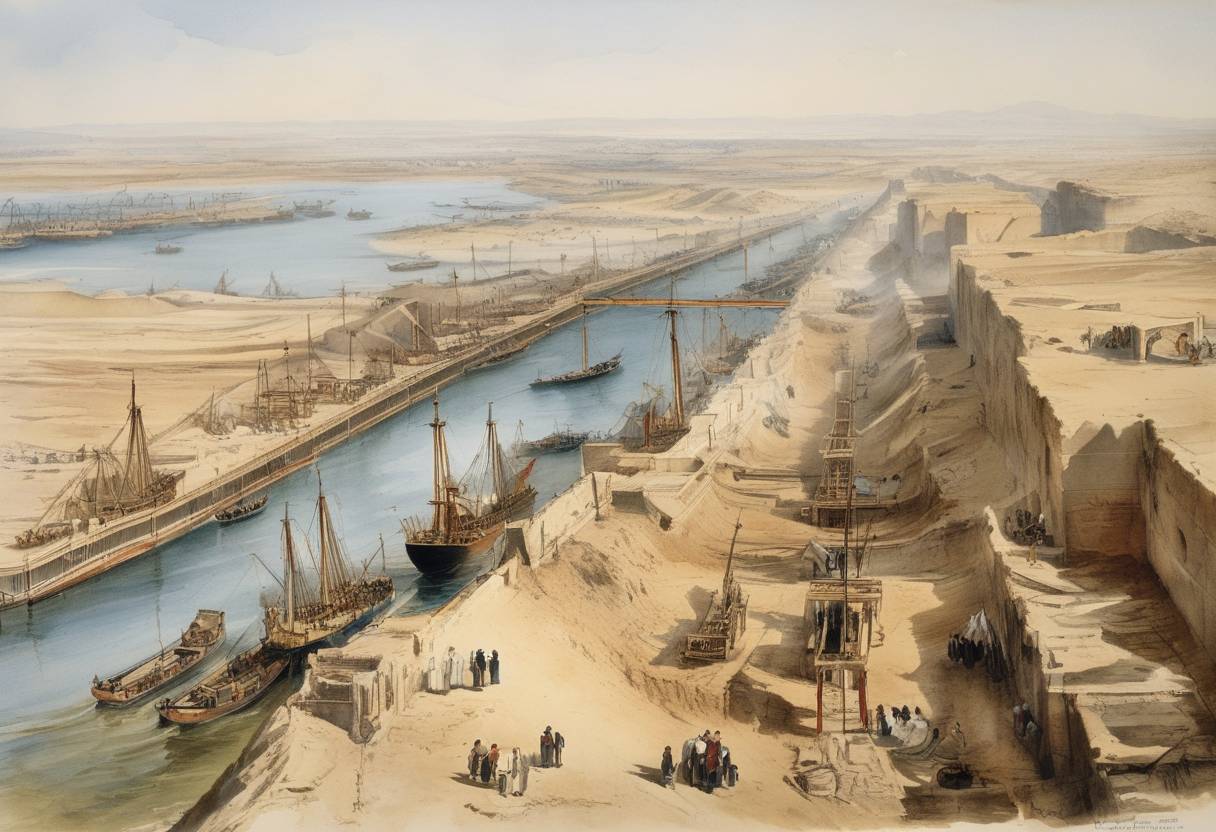
On April 30, 1859, construction of the Suez Canal commenced, marking the beginning of one of the most ambitious engineering projects of the 19th century. Spearheaded by French diplomat and engineer Ferdinand de Lesseps, the canal was designed to forge a direct maritime passage connecting the Mediterranean Sea with the Red Sea. This project aimed to drastically shorten the nautical journey between Europe and South Asia by eliminating the need to navigate around the African continent.
The idea of a canal through the Isthmus of Suez dates back to ancient times, but it was not until the 19th century that technological and financial means were aligned to make it feasible. The Ottoman Empire controlled the region during this period, and de Lesseps negotiated a concession from the Sultan to establish the Suez Canal Company, allowing for significant French influence over the construction and future management of the canal.
The construction of the canal posed immense challenges due to the harsh desert environment and the need for advanced engineering techniques. De Lesseps and his team had to innovate solutions for large-scale earth moving and management of water flows, as steam-powered dredgers and labor strategies were introduced to tackle these formidable obstacles.
The Suez Canal’s eventual completion in 1869 fundamentally transformed global shipping and trade. Its impact included:
This undertaking highlighted the capacity of 19th-century engineering and ambition to reshape global commerce, a legacy that continues to influence trade patterns and international relations to this day.
Source: en.wikipedia.org