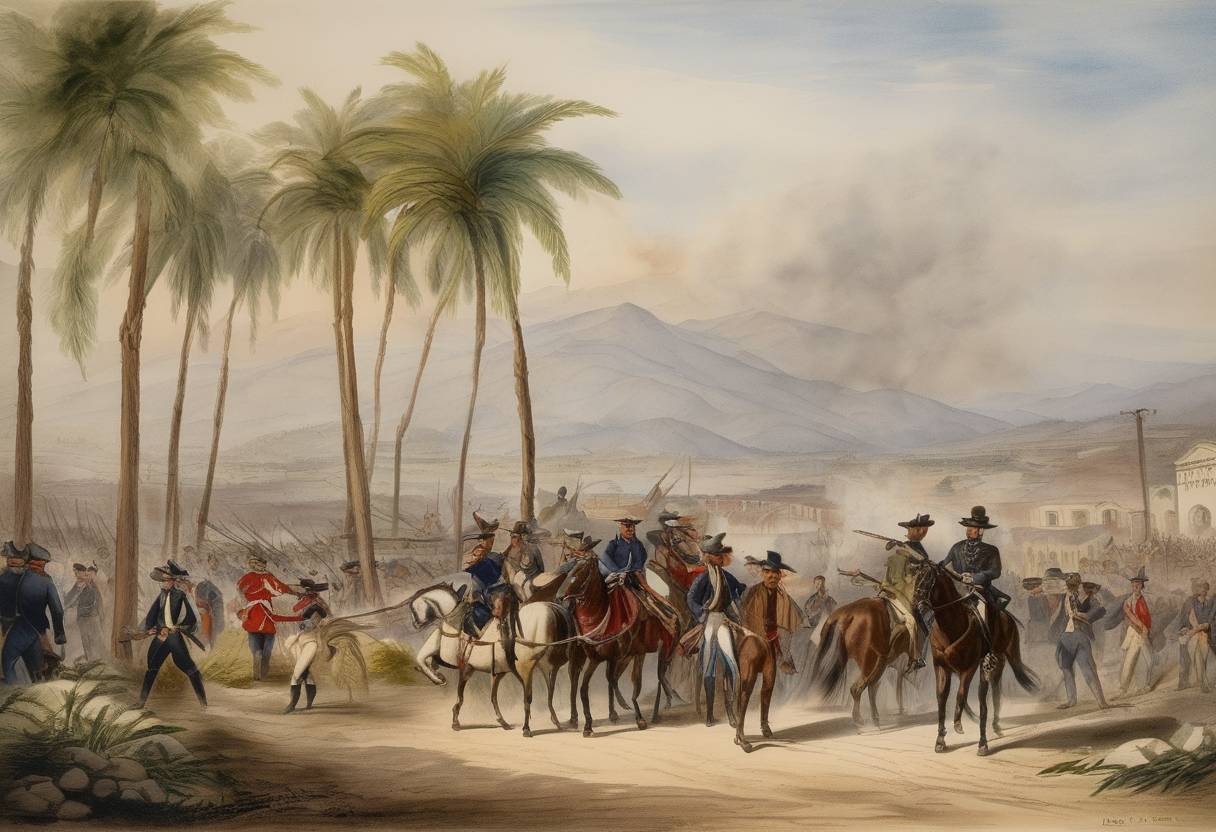
The United States Takes Control of Los Angeles - August 13, 1846
On August 13, 1846, during the Mexican-American War, American forces successfully seized control of Los Angeles, a significant event in the United States’ conquest of California. This military maneuver was a pivotal component of the broader campaign to annex California, driven by both the ideology of Manifest Destiny and strategic military objectives.
Context and Background
The Mexican-American War (1846-1848) was rooted in territorial disputes following the U.S. annexation of Texas in 1845 and the ensuing boundary disagreements between the two nations. The American military strategy aimed to secure California as part of its objective to expand its territories to the Pacific Coast.
Significant Steps Leading to the Capture
William B. Ide’s Bear Flag Revolt (June 1846): The annexation efforts in California began with American settlers in the region declaring independence from Mexico in June 1846, leading to the brief establishment of the California Republic.
Naval and Ground Forces: The U.S. military dispatched naval forces to the California coast and ground troops to penetrate key regions, bolstering their strategic position. Commodore John D. Sloat commanded the Pacific Squadron, capturing Monterey in July 1846 before ultimately leaving the task of securing Los Angeles to his successor.
Commodore Robert F. Stockton and General Stephen W. Kearny: Following prior engagements, Commodore Stockton and General Kearny expanded operations in California. Stockton assumed command after Sloat, pushing inland to capture additional territories.
The Seizure of Los Angeles
The capture of Los Angeles was led primarily by U.S. Navy Commodore Robert F. Stockton. On August 13, Stockton’s forces entered Los Angeles with minimal resistance from the relatively small number of Mexican defenders in the area. The city’s surrender was formalized quickly, marking L.A. as a crucial acquisition in the campaign to annex California.
Aftermath and Significance
Temporary Peace and Southern Rebellion: Initially, the capture of Los Angeles and other strategic points seemed to ensure control over California. However, local unrest led by Californio residents, reluctant to accept U.S. authority, sparked revolts that briefly retook Los Angeles in late 1846, evolving into a series of engagements known as the Siege of Los Angeles.
U.S. Reoccupation (January 1847): Control was ultimately solidified when U.S. reinforcements subdued the local resistance early in 1847.
Treaty of Guadalupe Hidalgo (1848): The conquest of Los Angeles was formalized with the Treaty of Guadalupe Hidalgo, which concluded the Mexican-American War, ceding vast territories including California to the United States.
Los Angeles’ capture was a strategic milestone in extending U.S. political and economic influence across the continent, facilitating the rapid territorial expansion that characterized this era.