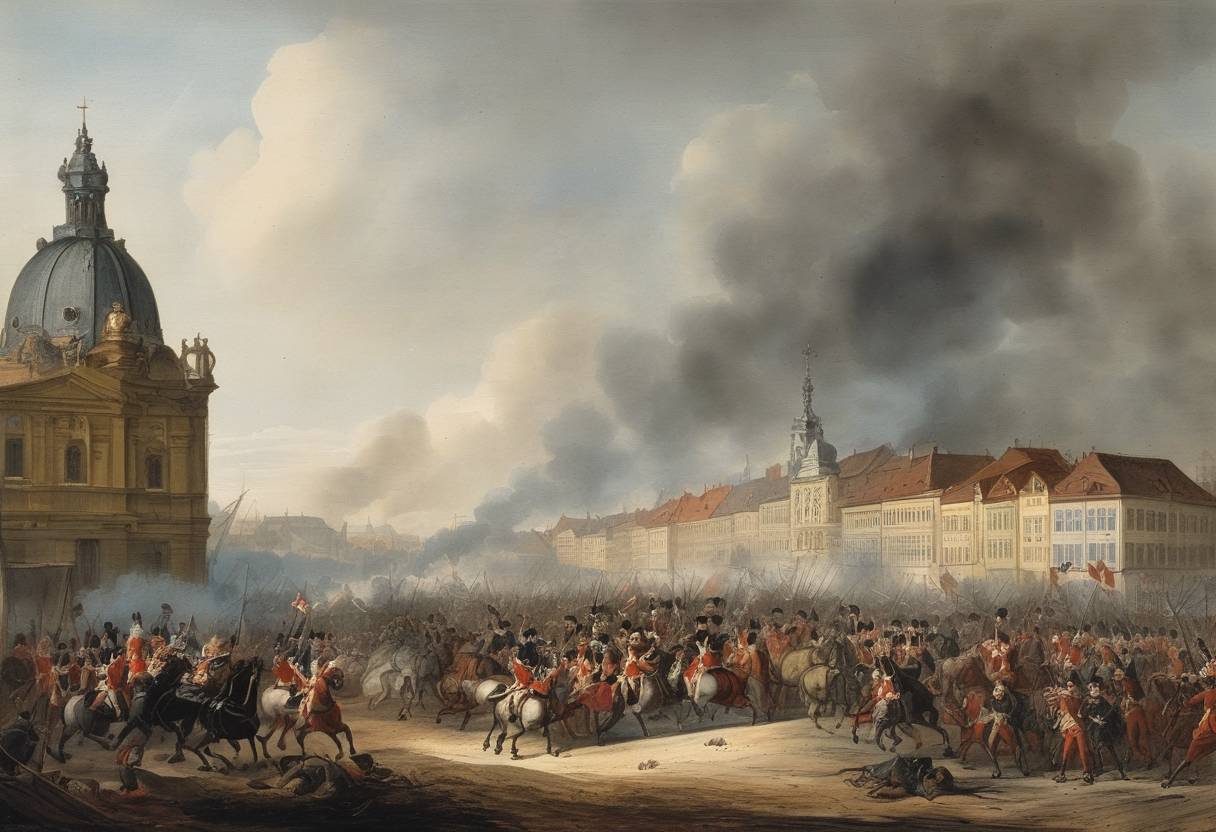
Battle of Prague: May 6, 1757
Context and Background
The Battle of Prague occurred during the Seven Years’ War, a global conflict that spanned from 1756 to 1763. This confrontation took place near the city of Prague in the region of Bohemia. Frederick the Great, the King of Prussia, sought to expand his nation’s influence and territory. The Seven Years’ War pitted Prussia against a coalition that included Austria, France, and Russia, making the Battle of Prague a significant military engagement in Eastern Europe.
- Frederick the Great: King of Prussia, known for his military acumen and strategic prowess.
- Prince Charles Alexander of Lorraine: Austrian commander with the task of defending against Frederick’s forces.
Events Leading Up to the Battle
In the early stages of 1757, Frederick the Great launched a strategic offensive targeting Saxony and Bohemia to swiftly incapacitate Austrian forces. After securing Saxony, the Prussian army moved into Bohemia, aiming to capture Prague, a critical stronghold for the Austrians.
The Battle
On May 6, 1757, the Prussian army, numbering approximately 64,000 troops, engaged the Austrian forces of about 60,000 under Prince Charles. The battle unfolded on the northwestern outskirts of Prague.
Tactical Overview
- Prussian Strategy: Frederick aimed to encircle the Austrian army and execute a decisive blow to incapacitate their ability to retaliate.
- Austrian Strategy: The Austrians held strong defensive positions to protect Prague and attempted to repel the Prussian advance.
Despite the Austrians’ heavily fortified positions, Frederick’s forces successfully executed complex maneuvers. Intense fighting characterized the battle, with both sides incurring significant casualties. The Prussians exploited weaknesses in the Austrian lines, eventually forcing them to retreat into the city of Prague.
Outcome and Aftermath
- Prussian Victory: Frederick the Great achieved a tactical victory, inflicting heavy losses on the Austrian army. Approximately 14,000 Austrians were killed, wounded, or captured, while Prussian casualties numbered around 12,000.
- Siege of Prague: Following the battle, the Austrian army became trapped within Prague, leading to a siege. However, the siege was not fully successful for the Prussians as the Austrians managed to hold out until reinforcements arrived.
Significance
The Battle of Prague demonstrated Frederick the Great’s military genius and emboldened Prussia’s position in the early phase of the Seven Years’ War. It highlighted the volatility of alliances and the strategic importance of swift, decisive action in 18th-century warfare. Despite the victory, the siege’s failure marked a limitation in Frederick’s campaign, underscoring the challenges of extended supply lines and resistance from entrenched enemies. This engagement ultimately set the stage for further conflicts in the region, encapsulating the persistent, dynamic nature of the war.