The Act of Independence of Lithuania: February 16, 1918
1918 · Vilnius, Lithuania
Lithuania declared its independence from Germany and Russia, establishing the short-lived Act of Independence of Lithuania.
September 22, 1908
The Bulgarian Declaration of Independence was issued, proclaiming Bulgaria's total independence from the Ottoman Empire. This event led to Bulgaria asserting itself as a fully sovereign state and adopting the title of Tsardom.
Tarnovo, Bulgaria | Bulgarian Government
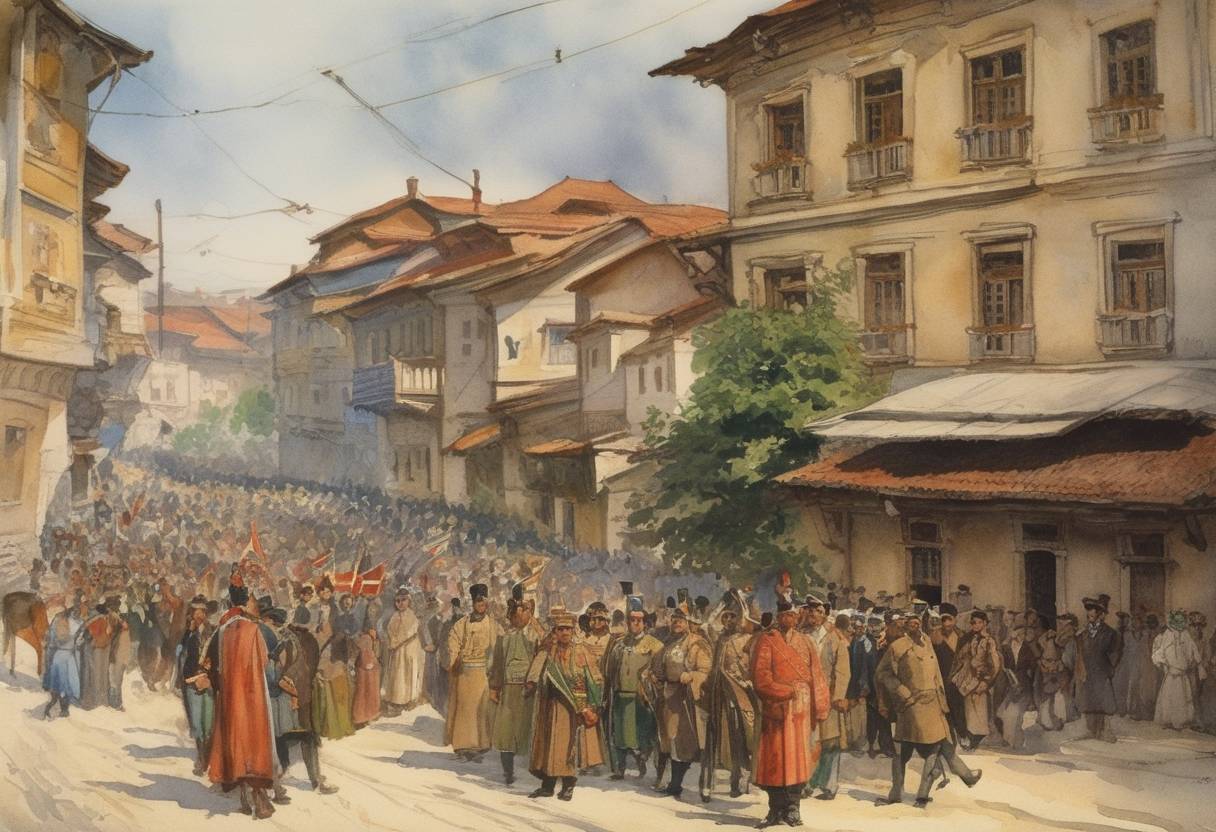
The road to Bulgarian independence from the Ottoman Empire was paved with decades of national awakening and political maneuvering. The Treaty of Berlin in 1878 had already granted Bulgaria a degree of autonomy, establishing it as an autonomous principality, though still technically under Ottoman suzerainty. The region experienced significant nationalistic fervor, pushing for complete sovereignty and the revival of a Bulgarian statehood independent of Ottoman control.
On September 22, 1908, Ferdinand I of Bulgaria declared the complete and total independence of the Principality of Bulgaria from the Ottoman Empire. This significant event took place in the historical town of Veliko Tarnovo, within the iconic Church of the Forty Holy Martyrs. By declaring independence, Bulgaria not only distanced itself from the Ottoman political structure but also re-established itself as the Tsardom of Bulgaria. This change symbolized a cultural and political renaissance, invoking Bulgaria’s medieval history and the title of “Tsar,” which encapsulated sovereign power and a return to past glory.
Ferdinand I: Initially the Prince of Bulgaria, he became its first Tsar following the declaration. His leadership was pivotal in galvanizing the Bulgarian independence movement.
Prime Minister Alexander Malinov: Instrumental in the diplomatic and political efforts that culminated in the declaration of independence.
The declaration and subsequent establishment of the Tsardom of Bulgaria were recognized by the Great Powers and formalized after negotiations, notably with the Ottoman Empire compensating Bulgaria with renounced claims to railway concessions and the recognition of Ferdinand I’s new title.
This event had substantial implications for the Balkan region, contributing to the reshaping of alliances and tensions leading up to the Balkan Wars and even influencing the dynamics that preceded World War I. For Bulgaria, it marked the fruition of national aspirations and the authority to self-govern, politically and territorially expanding in subsequent decades.
Bulgaria’s assertion of sovereignty set a precedent among Balkan states for pursuing complete independence from the Ottoman yoke, exemplifying the wave of nationalism that was sweeping across the region at the dawn of the 20th century.
Source: en.wikipedia.org