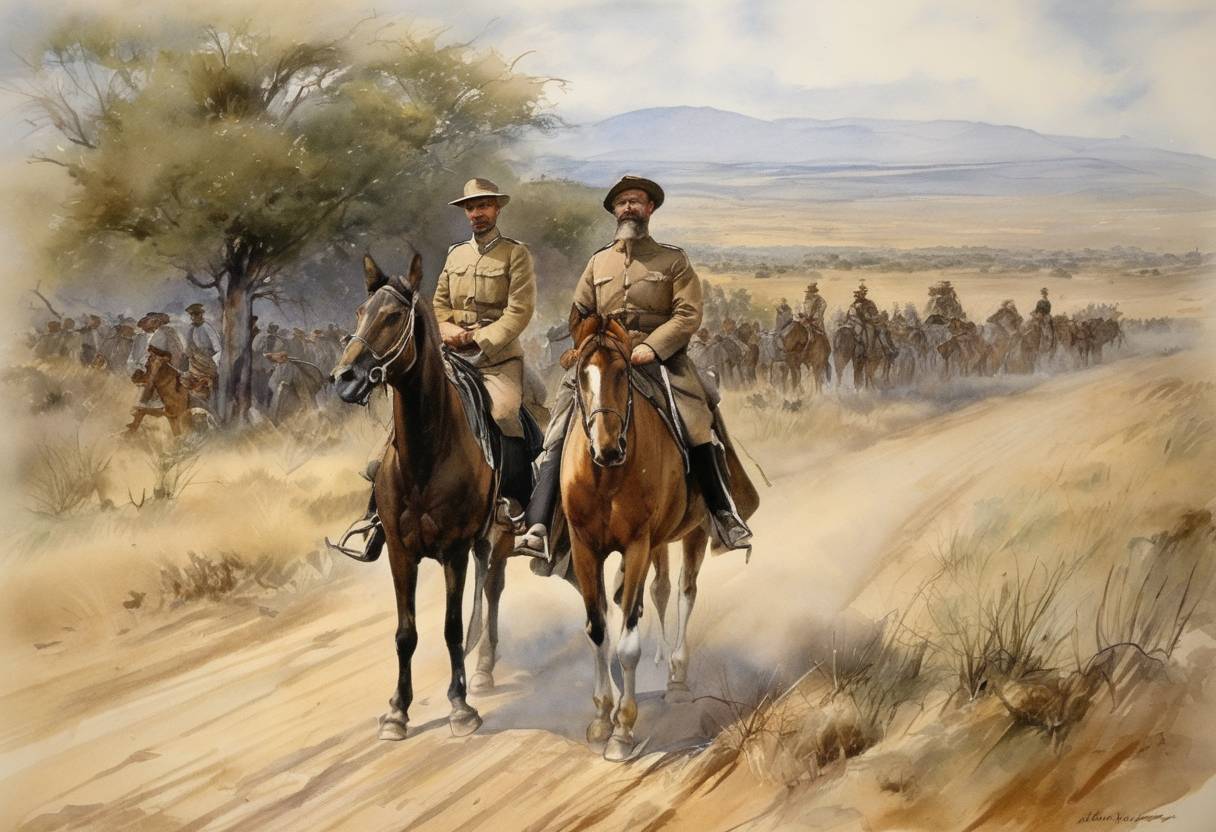
The Outbreak of the Second Boer War: October 11, 1899
The Second Boer War, also known as the Anglo-Boer War, began on October 11, 1899, when hostilities erupted between the British Empire and the two Boer Republics: the South African Republic (Transvaal) and the Orange Free State. This conflict marked a significant chapter in the struggle over control and influence in Southern Africa, rooted in the discovery of gold and the subsequent tension over mining rights.
Context Leading to the War
In the late 19th century, the discovery of rich gold deposits in the Witwatersrand region of the South African Republic (Transvaal) heightened tensions in the region. The British Empire, already established in the neighboring Cape Colony and Natal, had vested interests in securing control over these lucrative resources. The Boers, descendants of Dutch settlers, valued their sovereignty and sought to maintain independence from British influence.
Key Events on October 11, 1899
With diplomatic relations deteriorating and negotiations collapsing, both sides prepared for conflict. On October 9, 1899, the South African Republic issued an ultimatum to the British demanding the withdrawal of British troops from their borders and the cessation of additional troop deployments. The ultimatum expired on October 11 without a British response.
On October 11, 1899, the Boers officially declared war against the British Empire. Hostilities commenced with Boer troops launching preemptive strikes into the British-held territories of Natal and Cape Colony. The Boer Republics utilized their knowledge of the terrain and guerrilla tactics to their advantage early in the conflict.
Significance and Aftermath
The commencement of the Second Boer War set in motion a brutal conflict that lasted until 1902. It was characterized by conventional as well as guerilla warfare, with innovative military tactics on both sides. The war saw notable battles such as the Siege of Ladysmith and the Battle of Spion Kop. Ultimately, the British Empire emerged victorious, and in 1902, the Treaty of Vereeniging was signed, resulting in the annexation of both Boer Republics into the British Empire.
The war had significant consequences for the region, including a humanitarian crisis in the form of civilian internment camps and a restructuring of the political landscape in South Africa, paving the way for the Union of South Africa in 1910. It also marked the first major conflict of the 20th century, illustrating the ruthless efficiency of modern warfare and the complexities of colonial power dynamics.