1806 · Berlin, Prussia
The initial meeting of the Berlin Academy of Sciences' reestablished section on natural philosophy took place.
September 23, 1846
German astronomer Johann Gottfried Galle discovered the planet Neptune, based on predictions by Urbain Le Verrier.
Berlin, Prussia | Berlin Observatory
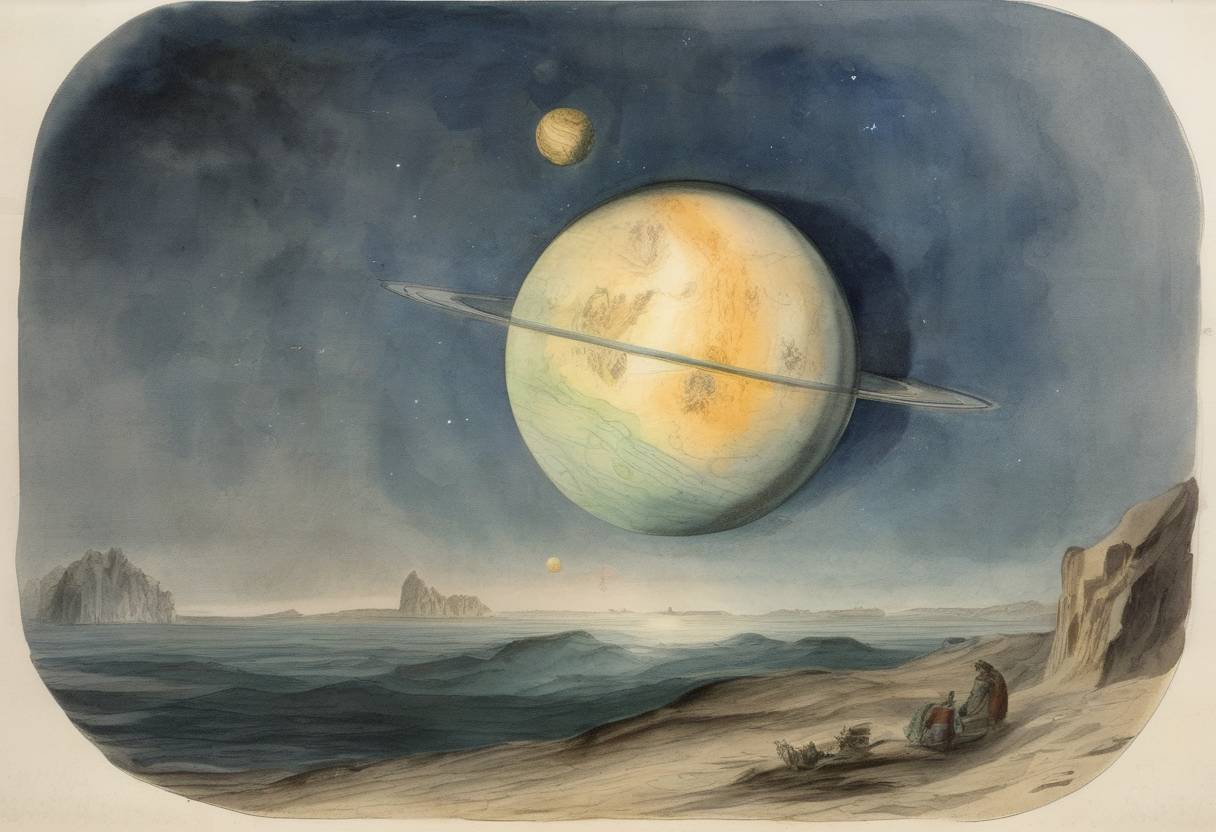
On September 23, 1846, the German astronomer Johann Gottfried Galle, along with his assistant Heinrich Louis d’Arrest, made a monumental discovery in the field of astronomy: the planet Neptune. This discovery was based on the mathematical predictions of the French mathematician Urbain Le Verrier.
During the early 19th century, astronomers observed irregularities in the orbit of Uranus that could not be explained by the gravitational pull of known celestial bodies. These discrepancies suggested the presence of another, yet undiscovered planet exerting gravitational influence.
Urbain Le Verrier, a brilliant mathematician, took on the challenge of explaining Uranus’s orbital anomalies. Through meticulous calculations, Le Verrier predicted the position of the unknown planet. His work was parallel to that of the British mathematician John Couch Adams, who independently arrived at similar conclusions, though Le Verrier’s predictions were communicated more effectively to the astronomical community.
Le Verrier sent his predictions to Johann Gottfried Galle at the Berlin Observatory. On the night of September 23, 1846, Galle, with the assistance of d’Arrest, used the observatory’s telescope to search the region of the sky indicated by Le Verrier. Remarkably, they found Neptune within just one degree of the predicted location.
The discovery of Neptune was a triumph for celestial mechanics and marked the first time a planet was discovered through mathematical prediction rather than direct observation. It validated the Newtonian theory of gravitation and demonstrated the power of mathematical astronomy.
The successful identification of Neptune stands as a testament to the collaboration between theoretical predictions and observational astronomy, highlighting the importance of international scientific cooperation.
Source: en.wikipedia.org