Commissioning of the USS Lexington (CV-16)
1944 · Quincy, USA
The USS Lexington is commissioned as the fifth aircraft carrier of the United States Navy, named in honor of the Revolutionary War Battle of Lexington.
July 30, 1945
The USS Indianapolis was sunk by a Japanese submarine after delivering parts for the first atomic bomb to the island of Tinian. The sinking led to the greatest single loss of life at sea in the history of the U.S. Navy.
N/A, Pacific Ocean | United States Navy
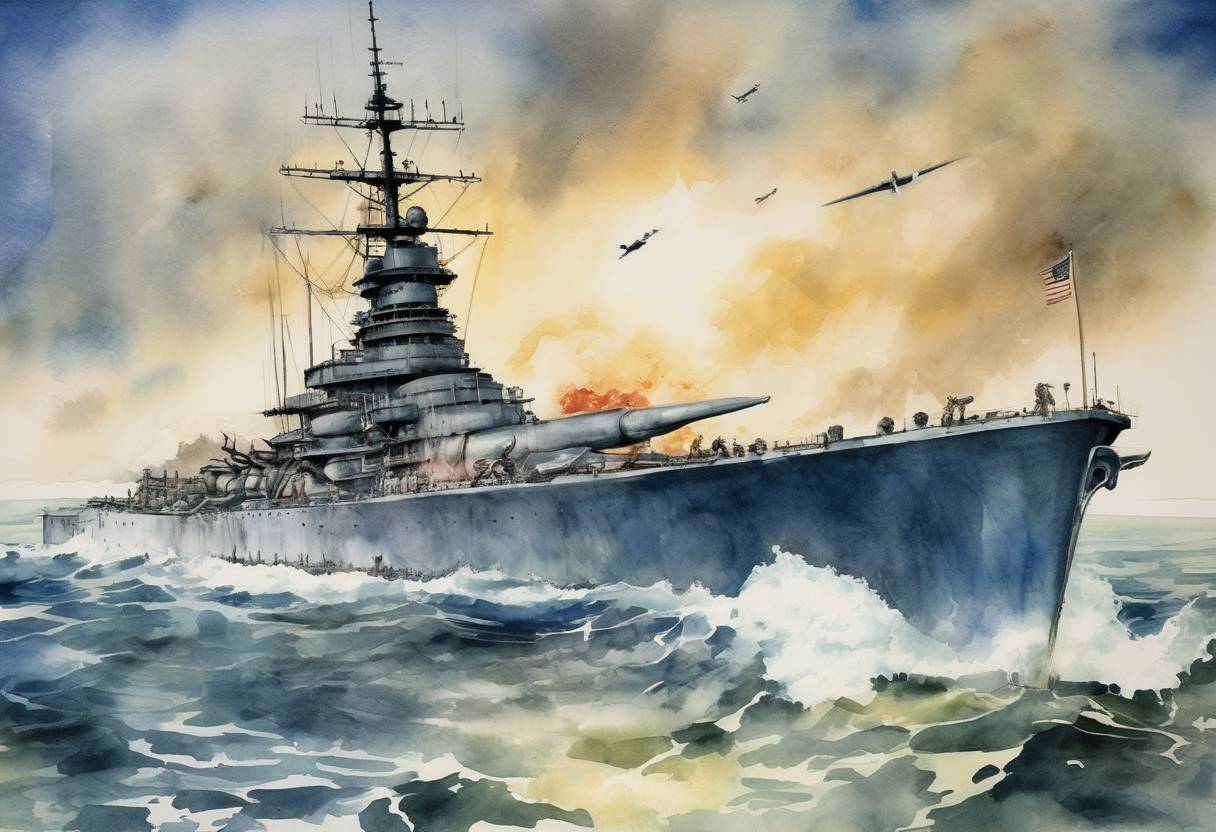
On July 30, 1945, the USS Indianapolis was sunk by a Japanese submarine, marking one of the most tragic events in U.S. naval history. This incident resulted in the greatest single loss of life at sea for the U.S. Navy.
The USS Indianapolis was a Portland-class heavy cruiser of the United States Navy. In July 1945, it completed a top-secret mission to deliver components for “Little Boy,” the first atomic bomb, to the island of Tinian in the Pacific Ocean. This mission was crucial for the United States’ plans to end World War II, as the bomb would later be dropped on Hiroshima.
After successfully delivering the bomb components, the USS Indianapolis set sail for Leyte in the Philippines. On the night of July 30, 1945, while sailing through the Philippine Sea, the ship was torpedoed by the Japanese submarine I-58. The attack was swift and devastating, with two torpedoes striking the cruiser, causing it to sink in just 12 minutes.
Casualties: Of the 1,195 crew members aboard, approximately 300 went down with the ship. The remaining 900 faced exposure, dehydration, saltwater poisoning, and shark attacks while awaiting rescue.
Rescue Efforts: Due to a lack of distress signals and communication errors, the survivors were not discovered until four days later, on August 2, 1945, by a PV-1 Ventura aircraft on a routine patrol. Only 316 men survived the ordeal.
Impact: The sinking of the USS Indianapolis highlighted significant flaws in naval communication and rescue operations, leading to changes in naval procedures to prevent similar tragedies in the future.
The loss of the USS Indianapolis had a profound impact on the U.S. Navy and the families of the lost sailors. It underscored the dangers faced by naval personnel during wartime and the importance of effective communication and rescue protocols. The tragedy also became a poignant reminder of the human cost of war, even as the world was on the brink of a new era with the use of atomic weapons.
The story of the USS Indianapolis remains a significant chapter in naval history, symbolizing both the bravery of its crew and the harsh realities of warfare.
Source: en.wikipedia.org