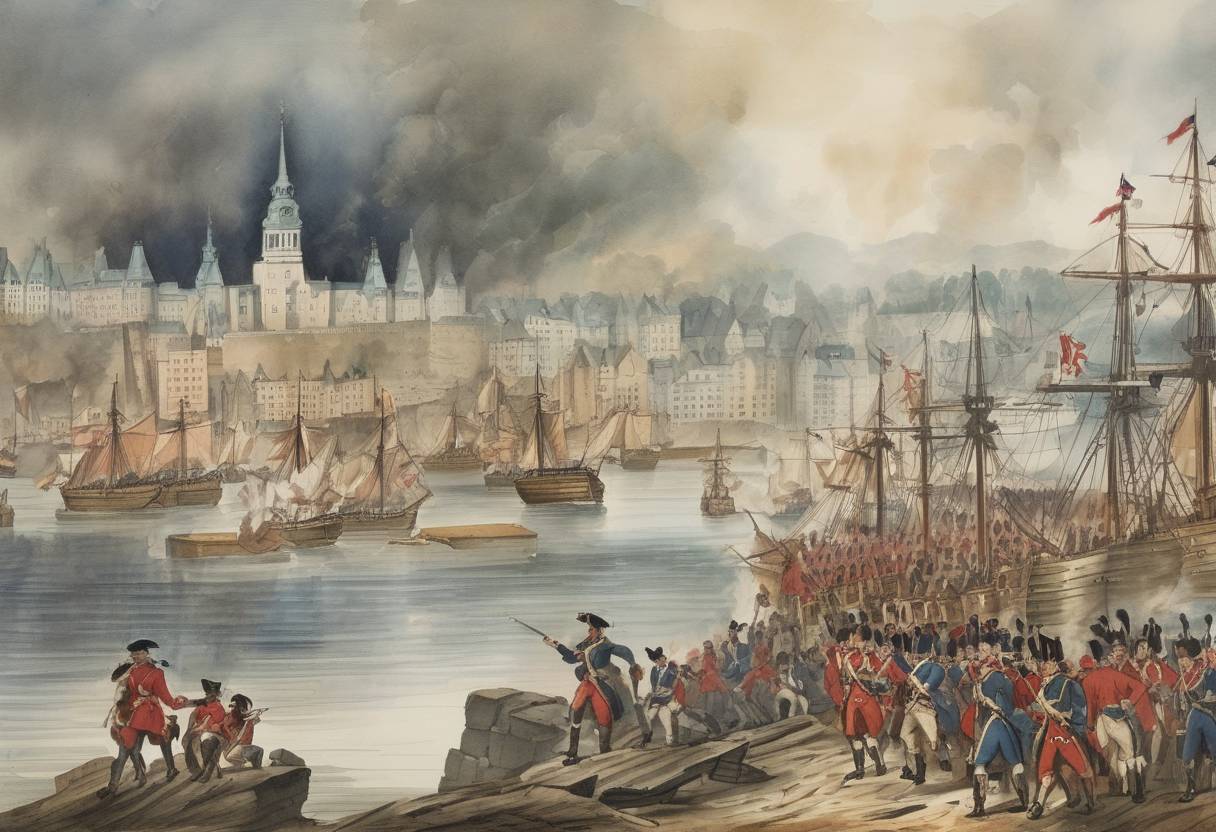
The Battle of Quebec: December 31, 1775
The Battle of Quebec, fought on December 31, 1775, was a pivotal engagement during the American Revolutionary War. This battle marked the first major defeat for the American forces and had significant implications for the Continental Army’s campaign in Canada.
Context and Prelude
In the early stages of the American Revolutionary War, the Continental Congress authorized an invasion of Canada, aiming to bring the French-speaking population into the rebellion against British rule. The campaign was led by two main forces: one under General Richard Montgomery, who had successfully captured Montreal in November 1775, and another led by Colonel Benedict Arnold, who endured a grueling march through the Maine wilderness to reach Quebec.
The Siege of Quebec
By December 1775, Montgomery and Arnold had joined forces outside Quebec City, the capital of the British province of Quebec. The city was well-defended by British troops under the command of Governor General Guy Carleton. Despite the harsh winter conditions and dwindling supplies, the American forces decided to launch an assault on the fortified city.
The Battle
The attack commenced in the early hours of December 31, 1775, under the cover of a snowstorm. The American plan involved a two-pronged assault: Montgomery would attack from the west, while Arnold would approach from the north. However, the plan quickly unraveled:
Montgomery’s Assault: As Montgomery’s troops advanced along the narrow path of the St. Lawrence River, they encountered a barricade defended by British and Canadian forces. Montgomery was killed in the initial volley, causing his men to retreat in disarray.
Arnold’s Assault: Arnold’s column faced fierce resistance in the city’s lower town. Arnold was wounded early in the attack, and command fell to Daniel Morgan. Despite initial success, Morgan’s men were eventually surrounded and forced to surrender.
Aftermath and Consequences
The Battle of Quebec resulted in a decisive British victory. The American forces suffered significant casualties, with over 400 men captured, including Daniel Morgan. The defeat ended the American campaign to capture Canada and solidified British control over the region.
Strategic Impact: The failure to capture Quebec was a major setback for the Continental Army. It dashed hopes of rallying Canadian support for the American cause and left the northern frontier vulnerable.
Long-term Effects: The battle highlighted the challenges of conducting military operations in harsh winter conditions and underscored the importance of supply lines and local support.
Historical Significance
The Battle of Quebec was a turning point in the American Revolutionary War, demonstrating the resilience of British defenses and the limitations of the Continental Army’s resources. It also marked the beginning of Benedict Arnold’s complex legacy, as he would later become infamous for his betrayal of the American cause.
In conclusion, the Battle of Quebec on December 31, 1775, was a critical moment in the Revolutionary War, shaping the course of the conflict in North America and influencing subsequent military strategies on both sides.