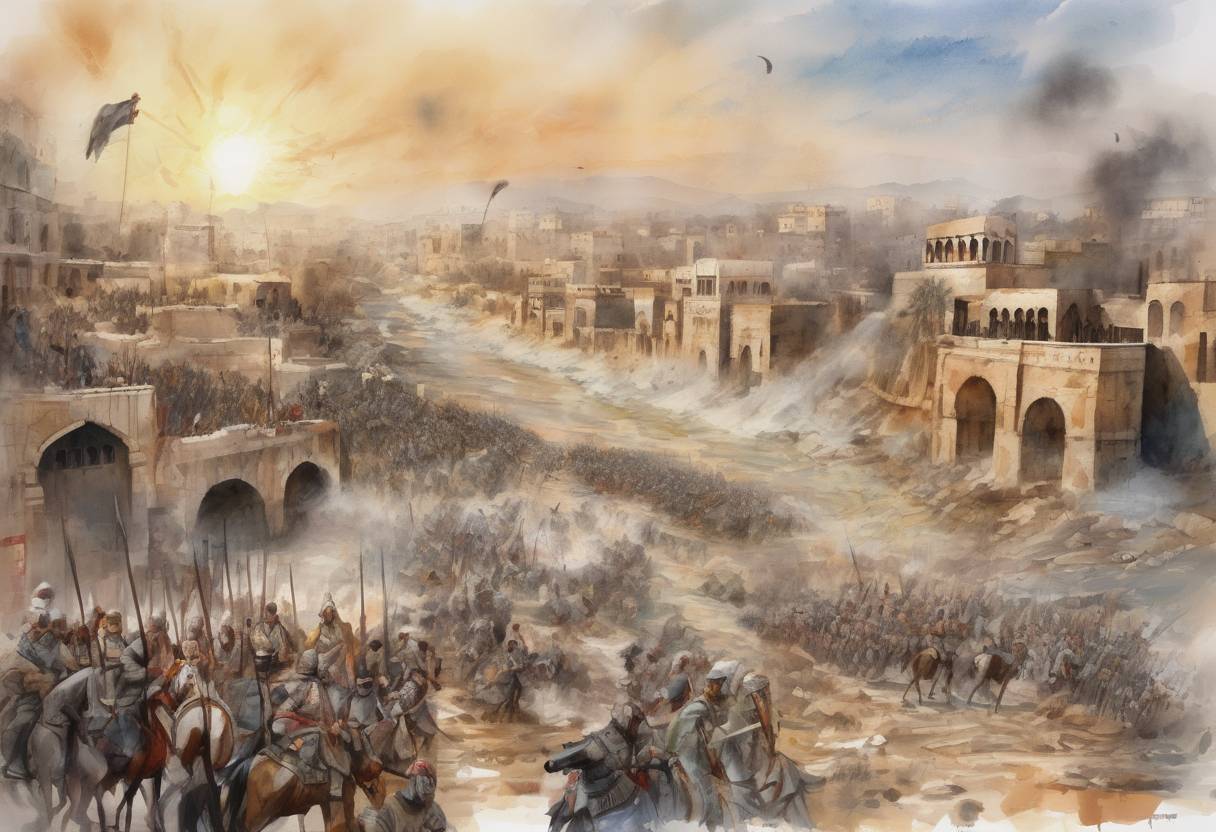
Certainly! However, there seems to be a discrepancy with the date you provided. The Battle of the Yarmouk River, a significant conflict between the Byzantine Empire and the Rashidun Caliphate, actually began on August 15, 636, not November 23, 615. Below is a detailed account of this pivotal event:
The Battle of the Yarmouk River
Background
The Battle of the Yarmouk River was a decisive military engagement between the forces of the Byzantine Empire and the Rashidun Caliphate. It took place near the Yarmouk River, which is in present-day Jordan, and lasted for six days, from August 15 to August 20, 636. This battle was a crucial part of the Muslim conquest of the Levant, a region that was of strategic importance due to its location and resources.
Context
Byzantine Empire: At the time, the Byzantine Empire was one of the most powerful empires, controlling vast territories across Europe, Asia, and Africa. However, it was facing internal strife and external threats, including the ongoing wars with the Sassanian Empire.
Rashidun Caliphate: The Rashidun Caliphate, under the leadership of Caliph Umar ibn al-Khattab, was rapidly expanding. The Muslim forces had already achieved significant victories in the Arabian Peninsula and were now pushing into Byzantine territories.
Key Events Leading Up to the Battle
Muslim Expansion: Following the death of the Prophet Muhammad in 632, the Rashidun Caliphate embarked on a series of military campaigns to expand its territory. By 634, Muslim forces had begun incursions into Byzantine-held Syria.
Byzantine Response: In response to the Muslim advances, Emperor Heraclius organized a large army to repel the invaders and secure the empire’s eastern frontiers.
The Battle
Forces Involved: The Byzantine army, commanded by General Vahan, was composed of a diverse coalition of troops, including Greeks, Armenians, and Christian Arabs. The Rashidun army, led by the skilled general Khalid ibn al-Walid, was smaller but highly mobile and motivated.
Tactics and Strategy: Khalid ibn al-Walid employed brilliant tactics, using the terrain to his advantage and executing a series of feigned retreats to draw the Byzantine forces into a vulnerable position.
Outcome: After six days of intense fighting, the Rashidun forces achieved a decisive victory. The Byzantine army was effectively destroyed, and the Muslim forces gained control of the Levant.
Aftermath and Significance
Territorial Gains: The victory at Yarmouk allowed the Rashidun Caliphate to consolidate its control over Syria and later expand into Palestine and Egypt.
Byzantine Decline: The defeat marked a significant weakening of Byzantine power in the region, contributing to the empire’s gradual decline.
Cultural and Religious Impact: The battle facilitated the spread of Islam in the Levant and had lasting cultural and religious implications for the region.
The Battle of the Yarmouk River is remembered as one of the most significant military engagements in early Islamic history, showcasing the strategic prowess of the Rashidun forces and altering the balance of power in the Near East.